
electronics-journal.com
16
'26
Written on Modified on
Multilayer Varistors for Industrial Transient Overvoltage Protection
TDK Corporation expands its surface-mount multilayer varistor family with the X series, solving transient voltage suppression and sustainability challenges in industrial electronics.
www.tdk.com
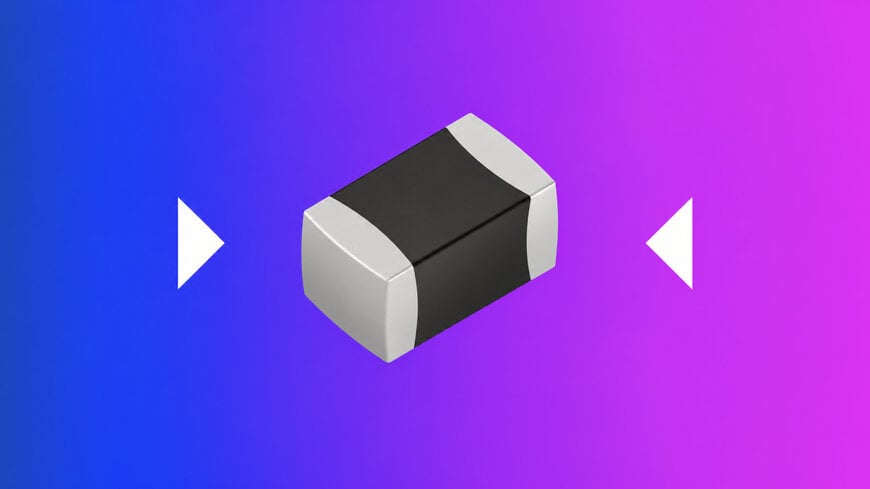
Miniaturized industrial electronics and distributed sensor networks are increasingly vulnerable to destructive electrostatic discharge and high-energy voltage transients on densely populated printed circuit boards. To address this operational challenge while lowering component manufacturing emissions, TDK Corporation has introduced the standard X series of surface-mount multilayer varistors for power supplies, factory automation, industrial IoT systems, and sensor interfaces.
Transient Overvoltage Challenges in Industrial Automation and IIoT
As factory automation systems and industrial IoT devices integrate higher component densities into smaller enclosures, sensitive integrated circuits face heightened exposure to electrical overstress. Switching loads, inductive kickback, and human-machine interactions frequently generate fast transient voltage spikes and electrostatic discharge events along power rails and communication lines.
In harsh industrial environments, protective passive components must suppress these transients instantaneously without degrading signal integrity or requiring derating at elevated ambient temperatures. Simultaneously, industrial equipment manufacturers face stricter corporate sustainability targets, requiring reductions in the embodied carbon of electronic bills of materials.
Low-Temperature Sintered Ceramic Architecture and Electrical Characteristics
The TDK Corporation X series (comprising models CT0402X, CT0603X, CT0805X, CT1206X, CT1210X, CT1810X, and CT2220*X) builds upon the technology platform previously established by the automotive-grade X1 series. The core engineering advancement of the X series lies in its modified ceramic composition. Conventional multilayer varistors require high-temperature firing cycles during co-firing of the ceramic layers and internal electrodes. By formulating a ceramic material that sinters at lower temperatures and utilizes raw materials with a reduced carbon intensity, TDK Corporation decreases the energy consumed during production, cutting the carbon dioxide footprint of the varistors by up to 30 percent compared to standard multilayer varistors.
Electrically, a multilayer varistor operates as a voltage-dependent non-linear resistor. Under normal operating voltages, the component exhibits high impedance and low leakage current. When a transient event exceeds the threshold voltage, the ceramic grain boundaries break down rapidly, shifting the device into a low-impedance clamping state that diverts surge current away from downstream semiconductors.
The X series responds to voltage transients in less than 0.5 ns. This sub-nanosecond turn-on time is critical for intercepting the fast rising edges of electrostatic discharge pulses before peak energy reaches sensitive silicon nodes. Furthermore, with parasitic capacitance values reaching as low as 6 pF, the smaller case sizes can be placed across high-speed data lines and sensor interfaces without introducing capacitive loading or signal distortion.
Technical Specifications and Operating Parameters
Spanning standard surface-mount footprints from EIA0402 to EIA2220, the X series allows circuit designers to scale surge energy handling according to board space constraints. Across the product range, the components support root-mean-square operating voltages from 3.5 V to 40 V, with nominal varistor voltages ranging from 8 V to 350 V and clamping voltages between 24 V and 450 V.
For surge current protection, peak current ratings scale from 1 A in the compact EIA0402 package up to 800 A in the largest footprint. The components are certified to withstand electrostatic discharge up to 15 kV air discharge in accordance with the IEC 61000-4-2 international immunity standard. Designed for thermally demanding enclosures, the X series operates across an ambient temperature range of -55 °C to +125 °C without temperature derating, maintaining a stable protection level and low leakage current over its service life. Customer-specific parameter adjustments are also supported for specialized circuit requirements.
Integration into Industrial Workflows and Surface-Mount Assembly
In practical circuit design, engineers deploy these surface-mount devices directly adjacent to external connectors, fieldbus ports, DC power inputs, and analog-to-digital converter front ends. In factory automation controllers and industrial IoT nodes, the absence of thermal derating up to +125 °C allows placement near heat-generating power management ICs or inside unventilated IP-rated field enclosures without sacrificing surge clamping capability.
From a production perspective, the X series is supplied in tape-and-reel packaging compatible with high-speed automated pick-and-place equipment and standard reflow soldering profiles, integrating directly into high-volume surface-mount technology assembly lines.
Additional Context:
This section details technical specifications and competitive benchmarking not included in the original product announcement.
In industrial circuit protection, engineering selection for transient voltage suppression typically involves evaluating surface-mount multilayer varistors against silicon transient voltage suppression diodes and polymer electrostatic discharge suppressors. Each technology presents distinct physical trade-offs governed by material physics and industry testing standards such as IEC 61000-4-2 for electrostatic discharge and IEC 61000-4-5 for surge immunity.
Compared to silicon transient voltage suppression diodes, zinc-oxide-based multilayer varistors generally offer higher surge energy absorption per unit volume because the energy is dissipated uniformly throughout the bulk ceramic body and interleaved electrode structure rather than across a localized semiconductor p-n junction. While silicon diodes often exhibit slightly lower clamping voltages for a given breakdown rating, standard silicon devices frequently require power derating above +85 °C, whereas high-temperature ceramic varistors like the X series maintain full ratings up to +125 °C.
From a manufacturing standpoint, traditional zinc-oxide multilayer varistors require sintering temperatures typically ranging between 1000 °C and 1300 °C. Lowering this sintering threshold below 1000 °C not only reduces kiln energy consumption for Scope 3 emissions compliance in electronics manufacturing, but also facilitates co-firing with higher-conductivity internal electrode metals, maintaining low series resistance during high-current clamping events.
Edited by Sucithra Mani, Induportals editor – adapted by AI.
www.tdk.com
