
Murata Develops 135 GHz Antenna Module for 6G Systems
The solution combines LTCC ceramic substrates and beamforming integrated circuits for D-band communications.
www.murata.com
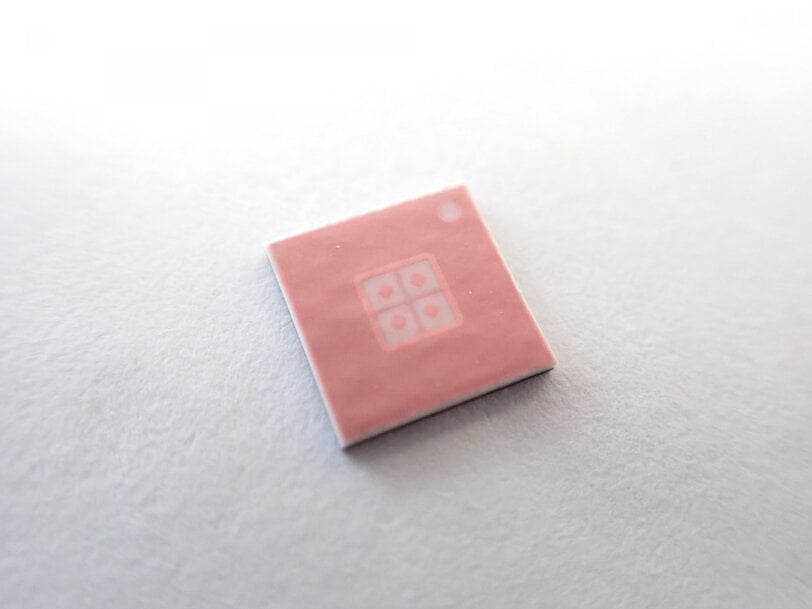
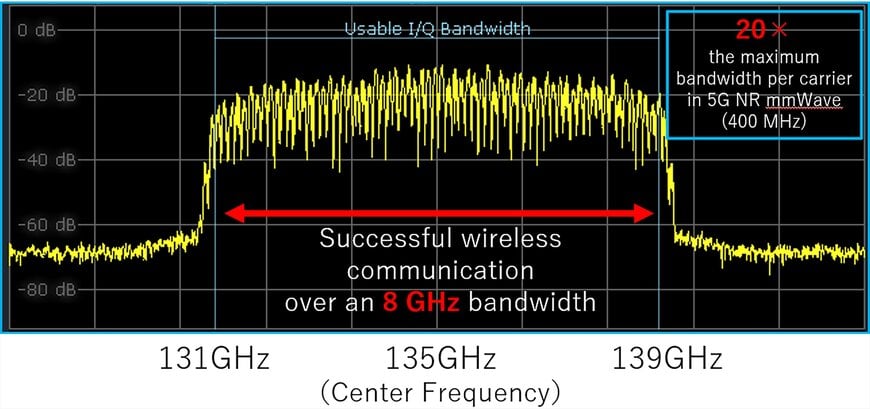
Murata Manufacturing Co., Ltd. has developed a D-band (110 to 170 GHz) antenna module through a joint research project with imec. The device integrates advanced ceramic substrates and high-density packaging technologies with a beamforming integrated circuit (IC). During operational testing, the module successfully demonstrated its capability to execute wireless communications at 135 GHz with a transmission bandwidth of up to 8 GHz, enabling two-dimensional bidirectional beam control in both transmission and reception.
Ceramic Materials and Two-Dimensional Beam Control
To meet the demand for massive real-time data transmission driven by physical artificial intelligence and digital twins, future 6G systems are exploring frequencies exceeding 100 GHz. However, the extremely short wavelength in these bands demands micrometric precision in trace and component placement. Murata's module resolves this limitation by combining low-temperature co-fired ceramic (LTCC) technology with a beamforming IC developed by imec. Proprietary ceramic materials have been formulated with minimal dielectric constants and dissipation factors, drastically mitigating insertion and signal losses at sub-terahertz frequencies.
Toward Commercialization in 2030 and ISAC Technology
The compact design of the LTCC module qualifies it as the first of its kind to integrate two-dimensional beam control for the D-band in a form factor suitable for mass assembly. Beyond transporting ultra-fast mobile telecommunications, the physical architecture enables its implementation in Integrated Sensing and Communications (ISAC) systems and sub-terahertz radars, allowing a single radio unit to transmit massive data while tracking the position or kinematics of objects in its environment with millimeter precision. Murata plans to continue scaling this platform toward mass production, with an eye toward commercial deployment planned starting in 2030.
Additional Context: Dielectric Losses and Packaging in the D-Band
This section details technical specifications and competitive benchmarking not included in the original product announcement.
In the sub-terahertz spectrum (110 to 300 GHz), traditional organic printed circuit board technologies (FR-4 or PTFE-based substrates) exhibit unacceptable signal attenuation due to severe dielectric losses ($tan delta$) and surface copper roughness. Low-temperature co-fired ceramic (LTCC) has established itself as the preferred alternative thanks to its significantly lower loss tangent at millimeter-wave frequencies, high dimensional stability, and a coefficient of thermal expansion (CTE) closely aligned with silicon dies or gallium arsenide/nitride compounds. Furthermore, at 135 GHz, free-space path losses increase according to the inverse-square law, forcing the use of active beamforming phased arrays. Integrating the antenna directly onto the LTCC substrate (Antenna-in-Package or AiP technology) eliminates the parasitic losses of external coaxial connectors, maximizing the equivalent isotropically radiated power (EIRP) required for reliable 6G links.
Edited by industrial journalist Lekshman Ramdas, with AI assistance.
www.murata.com
