
electronics-journal.com
06
'26
Written on Modified on
Silicon Carbide Solid-State Relays Target High-Voltage Test Automation
Rutronik announces the distribution of OMRON semiconductor switching components designed to manage elevated electrical loads within electromobility and automated testing architectures.
www.rutronik.com
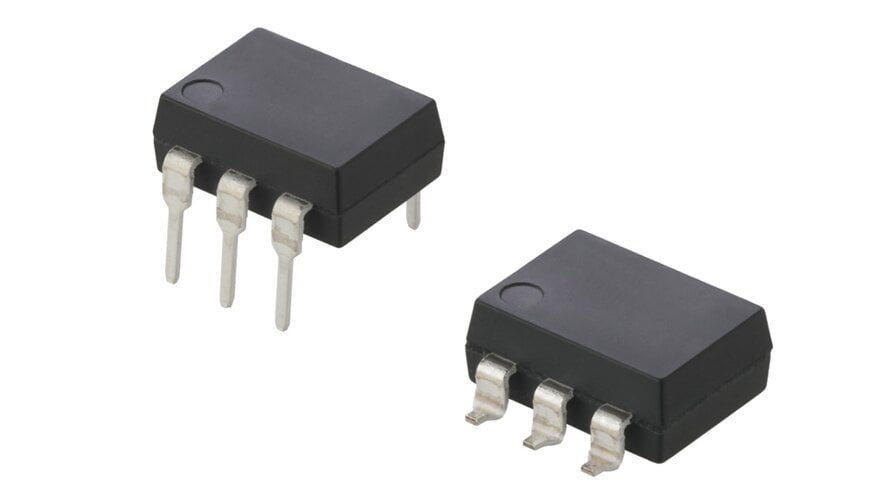
Rutronik introduces the availability of the OMRON G3VH series, a line of silicon carbide (SiC) MOSFET relays engineered for high-voltage automated test systems and measurement applications. The solid-state components address the increasing switching requirements in power electronics, battery management systems, and electric vehicle infrastructure where direct current voltages routinely exceed legacy semiconductor thresholds.
Component Architecture and Electrical Isolation
The integration of a silicon carbide substrate allows the G3VH series to manage maximum load voltages of 1,800 V or 3,300 V while maintaining a low turn-on resistance. The relay provides an input-to-output isolation voltage of 5,000 Vrms, establishing a secure thermal and electrical barrier for testing modern power electronics. This SiC-based architecture enables fast switching speeds and extended operational lifespans compared to standard electromechanical alternatives, which are subject to physical contact wear and higher switching latency. The internal components are housed in a DIP6 package measuring 8.8 by 6.4 millimeters, available with either printed circuit board (PCB) through-hole or surface-mount device (SMD) terminals, allowing engineers to minimize spatial footprint in dense printed circuit board layouts.
Industrial Deployment and Application Scenarios
The physical compactness and high isolation rating of the relays make them specifically applicable for automatic test equipment (ATE) utilized in semiconductor quality control and validation. In high-volume testing environments, precise fault and conformance detection is critical, and the high-speed switching capability of the SiC relays directly reduces the duration of individual test cycles. Beyond semiconductor validation, the components function within electric vehicle electrical systems, energy storage infrastructure networks, and railway technology systems. By utilizing a wear-free solid-state relay design instead of mechanical reed relays, systems engineers can reduce the maintenance intervals typically required for high-voltage direct current contactors.
Additional Context
This section details technical specifications and competitive benchmarking not included in the original news release.
In the high-voltage relay market, the G3VH series competes with traditional high-voltage reed relays, such as those manufactured by Standex Electronics, and standard silicon-based photorelays produced by companies like Toshiba and Panasonic. Mechanical reed relays can achieve isolation and load voltages well above 5,000 V with near-zero leakage current, but they occupy a significantly larger circuit board footprint and possess finite mechanical lifespans typically limited to hundreds of millions of cycles. Standard silicon-based photo-MOSFETs offer infinite switching cycles without mechanical degradation but historically encounter physical limitations when scaling beyond 1,500 V load limits due to an exponential increase in on-resistance. By utilizing the wider bandgap of silicon carbide, the OMRON relays overcome the breakdown voltage limit of standard silicon, achieving a 3,300 V load capacity within a standard 8.8-millimeter DIP6 package. This provides a measurable spatial advantage for high-density automated test equipment matrices that require thousands of individual relay nodes to function simultaneously.
Edited by Aishwarya Mambet, Induportals Editor, with AI assistance.
www.rutronik24.com
