
electronics-journal.com
30
'26
Written on Modified on
Rutronik presents JAE DX07 USB-C connectors with mechanical locking
The series supports Thunderbolt 5, 240 W power delivery, and optional locking for secure industrial applications.
www.rutronik.com
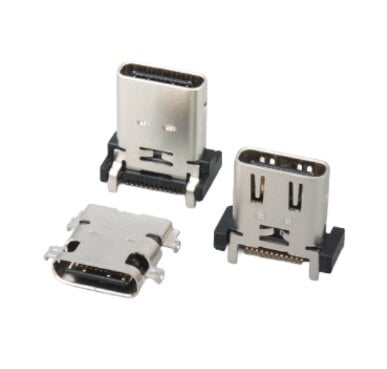
Rutronik has announced the availability of the JAE (Japan Aviation Electronics) DX07 Series, a new family of USB Type-C connectors engineered to handle the growing demands of data-intensive and high-power devices. Designed to support the latest USB4 and Thunderbolt 5 protocols, the connectors are capable of delivering up to 240 W of power alongside ultra-high-speed data transfer. By consolidating high-capacity power delivery and massive bandwidth into a single, reversible interface, the DX07 series allows hardware developers to minimize board space, reduce cabling complexity, and streamline system integration across computer peripherals, docking stations, and external storage solutions.
Mechanical locking for harsh environments
While standard USB-C interfaces rely solely on internal friction for retention, the DX07 series introduces an optional mechanical locking mechanism to ensure secure connections in demanding operational environments. This locking feature actively mitigates the risk of accidental disconnections caused by sudden cable tension, prolonged mechanical vibration, or frequent movement. By integrating this physical security, the connectors prevent costly data loss and equipment downtime in industrial control systems, mobile field devices, and automation equipment, providing a highly reliable connectivity solution in use cases where conventional USB-C retention proves insufficient.
Additional Context: USB PD 3.1 Extended Power Range and PAM3 Signaling
This section details electrical specifications and signal modulation principles not included in the original press release.
The ability to deliver 240 W of power through a standard USB-C form factor is governed by the USB Power Delivery (PD) 3.1 specification, specifically the Extended Power Range (EPR) protocol. Before EPR, USB-C was capped at 100 W (20V at 5A). To reach 240 W without melting the contacts, the standard increases the voltage up to 48V while maintaining the 5A current limit. This requires connectors like the DX07 to feature enhanced dielectric isolation and specialized arc-mitigation designs to prevent sparking when a cable is rapidly unplugged under a 48V load. Concurrently, supporting Thunderbolt 5 requires the connector's physical layer to handle up to 120 Gbps of asymmetric bandwidth. This is achieved using PAM3 (Pulse Amplitude Modulation 3-level) signaling, which transmits data across three distinct voltage levels rather than the traditional binary (0 and 1) NRZ signaling. Transmitting these ultra-high-frequency PAM3 signals without severe signal integrity degradation—such as crosstalk or insertion loss—demands hyper-precise contact geometries and advanced internal metallic shielding within the connector housing.
Edited by an industrial journalist, Lekshman Ramdas, with AI assistance.
www.rutronik.com
