
electronics-journal.com
05
'26
Written on Modified on
Space-Grade Adaptive SoC for In-Orbit Processing
AMD Versal AI Core XQRVC1902 samples in an enhanced space-grade package designed for long-duration processing and extreme orbital reliability challenges.
www.amd.com
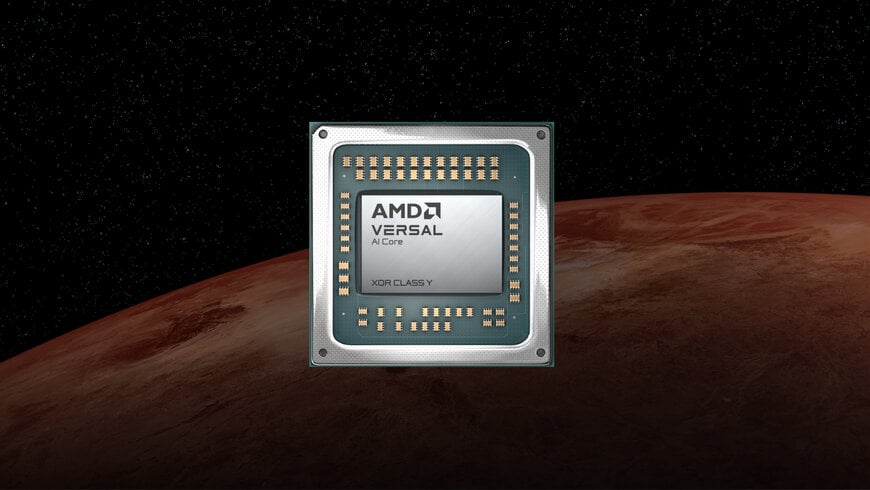
Long-duration orbital and interplanetary missions increasingly require real-time onboard data processing to analyze complex payload inputs without relying entirely on limited-bandwidth downlink channels. Spaceflight electronics designed for these mission profiles must withstand extreme thermal cycling, mechanical stress, and radiation degradation across lifespans reaching up to 15 years in high-value, human-rated, and deep space exploration programs.
High-Reliability Packaging Architecture for Orbital Environments
To address thermal and mechanical stresses encountered during extended flight operations, the newly sampled processing platform integrates an advanced organic lidless package architecture. Developed specifically for spaceflight constraints, the packaging leverages conservative design rules combined with an enhanced organic substrate material and space-grade chip capacitors backed by flight heritage.
The lidless form factor directly exposes the die top to optimize heat dissipation toward satellite thermal management structures. This physical configuration reduces junction-to-case thermal resistance, allowing dense multi-core processing without exceeding safe junction temperatures under vacuum conditions. The hardware retains pin compatibility with commercial, defense-grade, and space-grade variants in the 2197-ball grid array footprint, preserving PCB design reusability across early prototyping and final flight builds.
Onboard Compute Capabilities for Autonomous Payloads
Modern satellite payloads require high compute density to support vector-based processing, sensor fusion, radar signal decomposition, and machine vision workloads directly on orbit. The heterogeneous architecture of the adaptive SoC incorporates programmable logic cells, distributed SRAM, multigigabit transceivers, and dedicated vector compute engines.
In aerospace payloads, this computational density enables autonomous operational adjustments and edge analytics, reducing latency compared to ground-segment processing loops. System designers can implement machine learning inference models and dynamic digital signal processing routines directly at the sensor interface.
Testing Toward Class Y Qualification
Spaceflight deployment across geosynchronous Earth orbit, cislunar space, heliocentric paths, and deep space trajectories demands rigorous manufacturing and screening standards. The component is undergoing qualification testing against the MIL-PRF-38535 Class Y standard, which governs non-hermetic, ceramic-alternative monolithic microcircuits designed specifically for spaceflight systems.
According to Ken O'Neill, Aerospace and Defense lead systems architect at AMD, space missions increasingly require onboard processing combined with verified long-term operational integrity. Sampling the architecture in this packaging format provides aerospace engineers with functional hardware to construct engineering models and validate mission architectures requiring Class Y screening.
Early access customer sampling is underway, with engineering data documented under datasheet DS946. Units fully certified to flight-qualified Class Y standards are scheduled for availability in the second half of 2027.
Additional Context
This section details technical specifications and competitive benchmarking not included in the original product announcement.
The transition toward organic substrate packaging represents an evolutionary shift in space microelectronics standardization. Historically, MIL-PRF-38535 Class V served as the definitive ceramic-hermetic qualification for space components. However, ceramic packages introduce physical scaling constraints, excessive mass, and high parasitic inductance that limit pin count and multi-gigahertz transceiver signaling. The Class Y category was formulated by NASA, the space community, and JEDEC standardizing bodies to qualify advanced flip-chip non-hermetic packaging with organic substrates, bridging high-density semiconductor nodes into mission-critical aerospace applications.
In the space-qualified processing ecosystem, designers traditionally relied on rad-hard field programmable gate arrays such as the BAE Systems RAD5500 family or Microchip RTG4 devices. While these legacy components provide exceptional total ionizing dose resistance, they operate at significantly lower operating frequencies and lack dedicated matrix vector accelerators. The introduction of modern 7nm-class heterogeneous architectures into Class Y packages positions adaptive computing directly alongside multi-core space DSPs and rad-hard SoCs, expanding autonomous spaceborne artificial intelligence capabilities.
Edited by Evgeny Churilov, Induportals Media - Adapted by AI.
www.amd.com
