
electronics-journal.com
06
'26
Written on Modified on
Open-Source Profiler for Edge AI Workloads
Ambiq Micro has released a diagnostic utility designed to provide cycle-level execution metrics for neural network optimization on resource-constrained microcontrollers.
ambiq.com
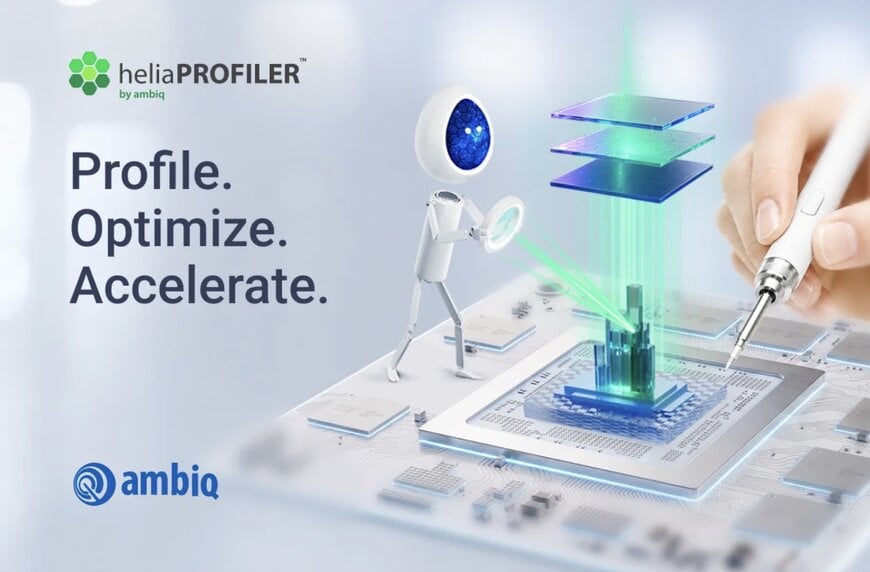
Ambiq Micro, Inc. has released heliaPROFILER, an open-source software tool designed to evaluate artificial intelligence model execution directly on embedded hardware. This technology addresses the evaluation and optimization of machine learning workloads for always-on edge devices, streamlining the transition from model development to physical silicon deployment.
Architectural Integration Within the Edge AI Ecosystem
Evaluating neural networks on embedded hardware traditionally involves manual analysis and fragmented toolchains, which can obscure the exact resource demands of a model. The heliaPROFILER utility consolidates these diagnostic procedures into a single automated workflow, executed via a unified command structure. By interfacing directly with the Ambiq Apollo System on Chip (SoC) architecture, the software maps cycle-level telemetry data—such as compute cycles, memory allocation, and optional real-time power consumption—directly to the specific structural layers of the AI model.
This layer-level resolution isolates computational bottlenecks that emerge when executing complex inference tasks on edge microcontrollers constrained by strict power and memory limitations. By utilizing physical hardware readouts rather than theoretical estimations, developers gain accurate metrics regarding how specific model layers interact with the physical memory hierarchy of the SoC.
Runtime Analysis and Model Visualization
The tool enables direct performance benchmarking between distinct runtime environments, specifically comparing the heliaRT and heliaAOT execution engines. This comparison mechanism allows embedded systems engineers to quantify the physical trade-offs between ahead-of-time (AOT) compiled models and standard runtime execution on production silicon.
Dr. Adam Page, Head of AI at Ambiq, noted that linking AI optimization directly to production hardware provides developers with the actionable data necessary to maximize the physical energy efficiency of the silicon. To facilitate data interpretation, the profiler generates visual performance reports formatted for compatibility with Google's Model Explorer, integrating the hardware telemetry seamlessly into existing machine learning workflows.
Open-Source Distribution and Platform Support
As an extension of the existing HELIA software stack—which includes heliaCORE, heliaRT, and heliaAOT—the profiler operates as a continuous link between model construction and deployment. The tool is distributed as an open-source Python package, with the alpha build currently accessible via PyPI and GitHub. While the initial release focuses exclusively on the Apollo SoC platform, architectural support for external hardware environments is slated for the version 1.0 release.
Additional Context
This section details technical specifications and competitive benchmarking not included in the original news release.
Within the embedded AI ecosystem, tools like heliaPROFILER operate in a similar utility space to ARM’s Ethos-U toolchain or STMicroelectronics’ STM32Cube.AI. Benchmarking embedded AI profilers typically focuses on cycle-accuracy, memory footprint estimation, and power profiling integration. While STM32Cube.AI provides static analysis of RAM and Flash utilization prior to execution, Ambiq’s approach emphasizes on-device, hardware-in-the-loop power and cycle measurements specific to its sub-threshold power architecture. This hardware-specific profiling is critical for always-on applications, where theoretical model estimation often diverges from actual silicon performance due to dynamic memory allocation and real-world processor states.
Edited by Aishwarya Mambet, Induportals Editor, with AI assistance.
www.ambiq.com
