
electronics-journal.com
05
'26
Written on Modified on
Axial aluminum electrolytic capacitors for heavy DC links
TDK Corporation expands its electrolytic capacitor portfolio for 48-volt to 120-volt systems in order to effectively reduce component counts within industrial traction inverters.
www.tdk.com
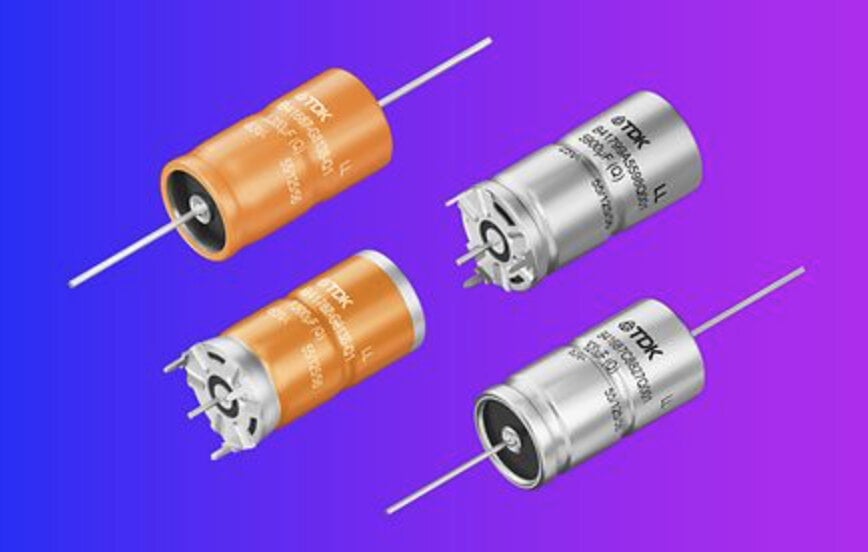
In the development of compact traction inverters for micromobility and industrial drive technology, increasing system voltages require more powerful DC link capacitors for stabilization. To overcome this infrastructural challenge, TDK Corporation introduces new series of aluminum electrolytic capacitors in axial and soldering star designs, which buffer high ripple currents in highly dynamic DC power networks.
Engineering Context
Electrical drive systems in compact electric vehicles (xEVs), forklifts, and humanoid robots generate high-frequency current fluctuations during operation. These ripple currents subject the DC link to thermal and mechanical stress, which in traditional designs often requires the series connection of multiple capacitors with a lower voltage rating. This circuit topology significantly increases the space required on the printed circuit board while simultaneously leading to undesirable parasitic inductances and resistances. Increasing the voltage rating of individual components is therefore crucial for engineers to minimize circuit complexity, reduce power dissipation, and ensure system reliability in environments with rapid load changes.
Technical Explanation
The B43693 and B43793 series are designed for rated voltages of 125 V to 250 V and support ripple currents of up to 21.6 A. This dielectric strength makes series connections in 96 V system designs obsolete. In parallel, the B41687 and B41787 series expand the spectrum in the low-voltage range with new 63 V variants. The capacitors exhibit a low equivalent series resistance (ESR), which reduces heat generation within the inverter DC link during high current loads.
Due to the mechanical design featuring axial terminals or soldering stars, the components can be flexibly integrated into the circuit architecture, whether horizontally, vertically, on classic printed circuit boards, or directly on solid busbars. The construction also allows direct thermal coupling of the aluminum case to a heat sink, significantly increasing the ripple current capability. For example, the maximum permissible ripple current of an 18 x 30 mm component at an ambient temperature of 105 °C increases from 5.2 A to 11.1 A when the case is actively cooled to 105 °C.
Product Relevance
Due to the increased rated voltage and improved heat dissipation, power electronics developers can reduce the number of capacitors required per energy bank. This directly lowers assembly costs and increases the power density of the overall system. Physical properties include a capacitance range from 56 µF to 650 µF for the 125 V versions and 510 µF to 4800 µF for the 63 V series. The components offer a useful life of 2500 hours at operating temperatures of up to 140 °C (125 V variants) or 150 °C (63 V variants). Standard mechanical vibration resistance of 20 g, which can be increased to 60 g upon request, ensures structural stability in harsh industrial and automotive environments. All series are fully RoHS-compliant.
Real-World Applications
The capacitor series are specifically designed for use in heavily loaded, space-critical power electronics. In automotive and industrial electronics, they act as a central energy buffer in compact inverters for micromobility, such as in electric two-wheelers or electric boats. In intralogistics, they electrically stabilize the 48-volt and 80-volt power networks of electrically driven forklifts. Furthermore, the compact sizes, ranging from 16 x 25 mm to 21 x 49 mm, enable seamless integration into the highly regulated joint drives and power distribution systems of humanoid robots.
Additional Context
This section details technical specifications and competitive benchmarking not included in the original product announcement.
In the market segment of DC link capacitors for voltages below 150 V, classic aluminum electrolytic capacitors compete directly with film capacitors and polymer hybrid capacitors. While film capacitors feature an extremely low ESR and tolerate high voltage peaks, aluminum electrolytic capacitors offer a significantly higher capacitance density per volume, which is often absolutely necessary at frequencies in the lower kilohertz range to smooth voltage ripple.
The technology trend toward 48 V and 96 V architectures in the automotive industry requires components that can handle very high currents at these low voltages since more current must flow for the same electrical power than in high-voltage systems. Competing solutions from manufacturers such as Panasonic or Rubycon in the automotive sector often rely on polymer hybrid capacitors, which, however, reach cost scalability limits given the required high total capacitances of over 1000 µF. The combination of high capacitance, mechanically robust axial mounting, and the option for direct case cooling positions the TDK series as a pragmatic and efficient alternative for managing the high thermal losses in modern traction applications.
Edited by Maria Brueva, Induportals editor – adapted by AI.
www.tdk-electronics.tdk.com
