
electronics-journal.com
31
'26
Written on Modified on
Qualified Firmware Storage for Baseboard Management Controllers
Infineon validates its non-volatile memory architecture to support continuous out-of-band server management and infrastructure operations within high-density data center environments.
www.infineon.com
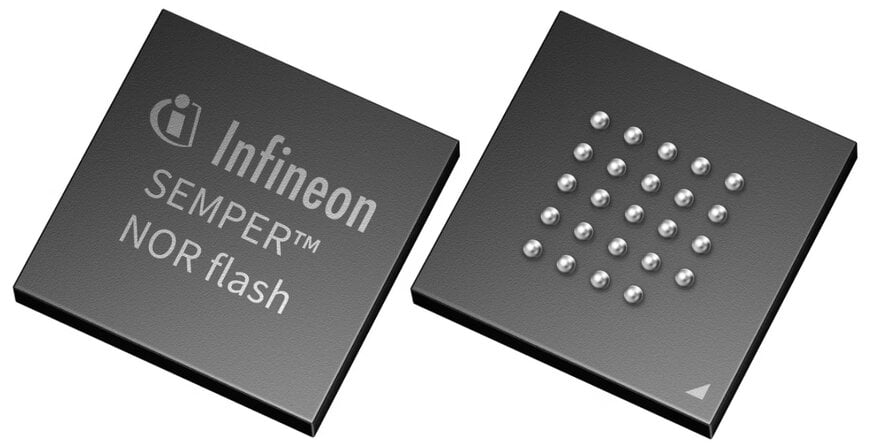
Infineon Technologies AG is announcing the qualification of its SEMPER NOR Flash Memory for the ASPEED Technology AST2700 Baseboard Management Controller (BMC) Approved Vendor List. This hardware combination provides dedicated out-of-band management and secure boot capabilities for data center servers processing artificial intelligence, cloud, and enterprise workloads.
Baseboard Management Controller Architecture and Out-of-Band Operations
As computing demands in hyperscale data centers increase, server reliability necessitates independent management systems that operate outside the host central processing unit (CPU). The ASPEED AST2700 is an eighth-generation BMC manufactured on a 12-nanometer process technology, designed to provide enhanced system integration. The BMC functions as a continuous monitoring mechanism that operates independently of the main server state, remaining active even during complete power-off conditions. It dictates power sequencing, facilitates remote access, and manages system recovery protocols within the broader server management ecosystem.
Non-Volatile Memory Mechanisms for System Recovery
The operational capability of a BMC relies directly on the stability of its firmware storage. The SEMPER NOR Flash memory serves as the physical repository for this critical management firmware. During every system power cycle, the memory architecture verifies firmware integrity before executing secure boot sequences or allowing over-the-network firmware updates. By utilizing standard Serial Peripheral Interface (SPI) protocols, the memory achieves the fast read performance required to minimize boot times and execute rapid diagnostic routines without initiating the primary host CPU.
Error Correction and Data Integrity Standards
High-endurance operation in enterprise environments requires robust fault tolerance to prevent unrecoverable system failures. To maintain data integrity over the lifecycle of the server, the NOR Flash architecture hardware-integrates Cyclic Redundancy Check (CRC) and Error Correcting Code (ECC) mechanisms. These protocols automatically detect and correct bit errors that occur naturally in non-volatile memory cells over time. For server Original Equipment Manufacturers (OEMs), utilizing a pre-qualified memory module on the AST2700 Approved Vendor List establishes a validated hardware baseline, thereby reducing component compatibility risks and simplifying bill-of-materials procurement.
Additional Context
This section details technical specifications and competitive benchmarking not included in the original news release.
In the enterprise server component market, Infineon’s SEMPER NOR Flash competes with alternative non-volatile memory architectures such as Winbond’s SpiFlash and Macronix’s OctaFlash series. For BMC firmware storage, standard benchmark criteria include SPI read throughput, endurance cycles, and hardware-based error correction. While Winbond provides widely adopted Quad SPI (QSPI) NOR flash solutions targeting general server motherboards, the SEMPER architecture specifically hardware-integrates ECC and CRC processing. This hardware-level integration reduces the computational overhead on the BMC during secure boot sequences compared to software-reliant ECC implementations. Furthermore, the explicit qualification for the 12-nanometer AST2700 positions this memory against high-density SPI solutions required for complex hyperscale server deployments, where autonomous system recovery and continuous out-of-band telemetry are strict hardware requirements.
Edited by Aishwarya Mambet, Induportals Editor, with AI assistance.
www.infineon.com
