
electronics-journal.com
26
'26
Written on Modified on
5G NR Uplink Data Compression Test Case Verification
Anritsu and Qualcomm verify 3GPP Release 17 uplink data compression test cases for 5G networks.
www.anritsu.com
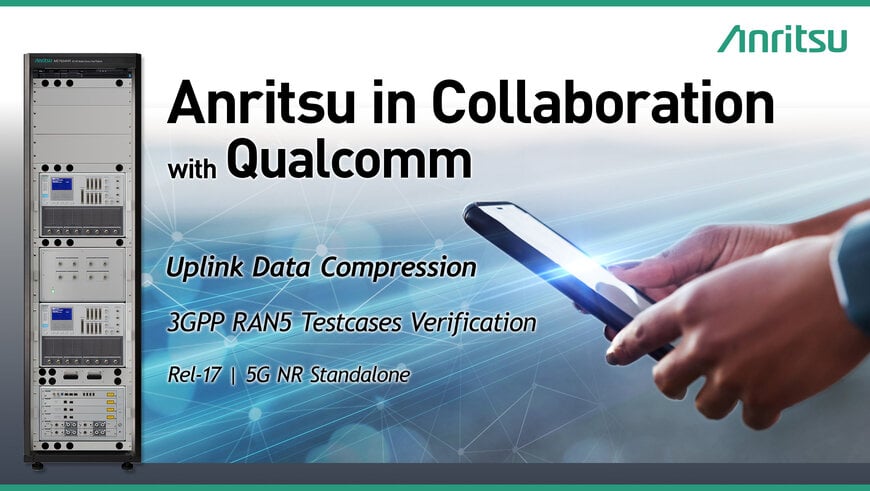
Anritsu Corporation, in collaboration with Qualcomm Technologies, has completed the verification of 3GPP RAN5 Release 17 New Radio (NR) Uplink Data Compression (UDC) test cases. The verification process utilized Anritsu’s ME7834NR 5G NR Mobile Device Test Platform integrated with the Qualcomm X105 5G Modem-RF system. This testing protocol validates device conformance for 5G NR Standalone (SA) network deployments.
Protocol Efficiency and Payload Compression
In 5G networks, uplink transmissions frequently generate significant protocol overhead from IP and transport-layer headers. While traditional mechanisms such as Robust Header Compression (ROHC) specifically address header compression, the 3GPP Release 17 UDC standard is designed to reduce redundant data payload prior to radio frequency (RF) transmission. Operating at the User Equipment (UE) side before transmission, UDC mitigates transmission volume where data redundancy exists. This mechanism improves overall uplink spectral efficiency and increases effective user data throughput, specifically for traffic types that are not previously compressed or encrypted at higher application layers.
Conformance Standardization
The validated conformance tests are defined by the 3GPP under the TS 38.523-1 specification and align with the core architectural requirements detailed in TS 38.323. Following the verification using the Qualcomm modem architecture, Anritsu has formally submitted these test parameters to the 3GPP Radio Access Network Working Group 5 (RAN WG5). The validated test cases are now available on the 3GPP RAN5 portal to establish baseline interoperability standards for device vendors and network operators implementing Release 17 uplink features.
Additional Context: This section details technical specifications not included in the original announcement
In the 5G NR protocol stack, Uplink Data Compression (UDC) is executed within the Packet Data Convergence Protocol (PDCP) layer. Unlike Robust Header Compression (ROHC), which only minimizes the size of packet headers (e.g., IPv4/IPv6, UDP, TCP), UDC applies compression algorithms—typically based on the DEFLATE algorithm (RFC 1951), which combines LZ77 and Huffman coding—directly to the data payload itself. When a UE prepares to transmit data, the PDCP layer compresses the payload prior to the ciphering and encapsulation stages. The receiving gNodeB (base station) then handles the decompression. This process is highly effective for text-based internet protocols (such as HTTP or SIP) that contain repetitive string patterns. By reducing the absolute byte size of the payload, the UE requires fewer physical resource blocks (PRBs) for transmission, which concurrently reduces the active duration of the device's RF power amplifier and extends battery life.
Edited by Lekshman Ramdas, Induportals editor – adapted by AI.
www.anritsu.com
