
Programmable Two-Wire Two-Bit Hall Switch for Automotive Electronics
Melexis introduces a contactless magnetic position sensor with programmable current levels and thresholds to replace mechanical microswitches in automotive body applications.
www.melexis.com
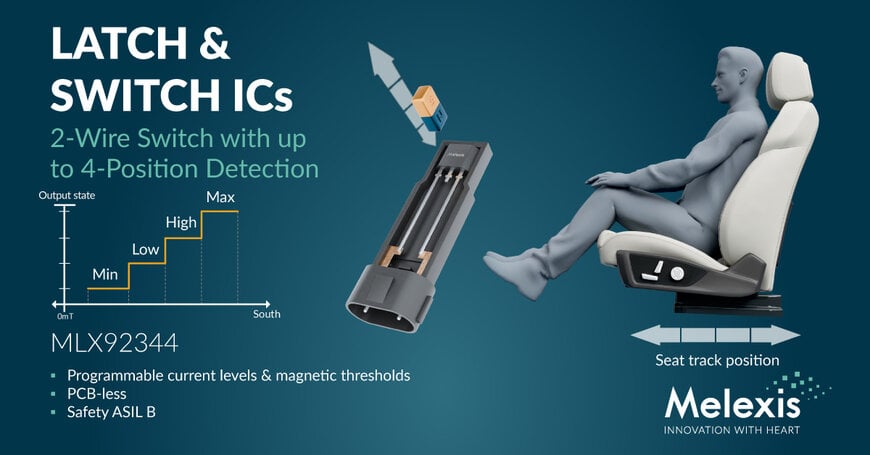
Melexis has developed the MLX92344, a PCB-less, contactless magnetic position sensing component designed to detect up to four mechanical positions. The technology targets automotive body electronics, including seat track positioning, soft-closing doors, and multi-level trunk locks, offering a solid-state alternative to traditional mechanical microswitch arrays.
Dual Programmable Architecture and Current Levels
Automotive position sensing typically relies on multiple mechanical switches to detect intermediate positions, a method that increases wiring requirements and mechanical complexity. The MLX92344 integrates a dual programmable architecture that assigns specific output current levels directly to defined magnetic operating (BOP1, BOP2) and release (BRP1, BRP2) thresholds. The component features temperature compensation for both neodymium and ferrite magnets.
Engineers can configure up to four distinct current levels, typically set at 5 mA, 10 mA, 15 mA, and 20 mA, within an operational range of 3 mA to 28 mA. This functionality allows the sensor to emulate standard microswitch interfaces while maintaining compatibility with existing electronic control units (ECUs). The output is processed via standard input/output triggers or an analog-to-digital converter (ADC), requiring software adjustments rather than hardware modifications.
Environmental Specifications and Form Factor
The sensor operates within a voltage range of 2.7 V to 28 V, with a 32 V absolute maximum rating to support commercial truck electrical systems. It operates across an automotive temperature range of -40 degrees Celsius to +150 degrees Celsius. The component is AEC-Q100 qualified and classified as an ASIL B Safety Element out of Context (SEooC).
Available packaging includes a TSOT23-3L surface-mount and a TO92-3L through-hole format. The device provides electrostatic discharge (ESD) protection, with tested tolerances of 8 kV for the Human Body Model (HBM) and 15 kV at the system level to ensure continuous operation in automotive electrical environments.
On-Chip Memory and Magnetic Concentrator Integration
Device parameters, including switching thresholds, current outputs, diagnostic behavior, and output states, are stored in an on-chip non-volatile memory. This enables optimization for varying magnet geometries and mechanical tolerances. End-of-line (EoL) programmability allows engineers to calibrate the device after assembly, compensating for mechanical deviations and positioning variations. Additionally, variants utilizing Integrated Magnetic Concentrator (IMC) technology enable the detection of lateral magnetic fields, expanding configuration options for magnet placement and mechanical design.
Automotive Application Scenarios
A primary application for the sensor is seat-track position sensing. Emerging automotive safety standards require the detection of three distinct seat positions to optimize airbag deployment based on driver proximity to the steering wheel. Instead of utilizing extra microswitches, the MLX92344 maps these positions using a single device over a two-wire interface, reducing the wiring harness volume required in seat systems. Similar monitoring mechanisms apply to tracking the physical extension of the steering column.
The component also functions within electronic latch mechanisms for doors, hoods, and trunks. By detecting four distinct mechanical states—fully open, semi-latched, fully latched, and over-pushed—it facilitates soft-close mechanisms. Furthermore, the component monitors electric vehicle charge ports, identifying the physical position of the port door or connector mechanism to manage high-voltage system engagement and physical access.
Component Integration
Minko Daskalov, Product Line Director at Melexis, noted that the programmable architecture allows automotive engineers to replace multiple microswitches while meeting structural safety requirements. He indicated that linking configurable current outputs to magnetic switching thresholds facilitates the design of more compact body electronic systems.
Additional Context: This section details technical specifications and competitive benchmarking not included in the original product announcement.
In the automotive sensor sector, 2-wire Hall-effect switches are utilized to reduce harness weight and diagnostic complexity compared to 3-wire alternatives. Standard unipolar or latching 2-wire Hall switches generally provide binary on/off states based on a single magnetic threshold. Detecting three or four positions previously required arraying multiple discrete sensors or utilizing a linear Hall sensor paired with a microcontroller for continuous position calculation.
The 2-bit multi-threshold capability integrates the positional mapping of a multi-switch array into a single logic device. While semiconductor manufacturers such as Allegro MicroSystems and Infineon Technologies produce programmable 2-wire Hall switches with advanced safety diagnostics, the integration of dual programmable operating and release thresholds tied specifically to four distinct current levels within a single standalone component provides an alternative for specific miniaturization requirements in e-latch and seat-track position assemblies.
Edited by an industrial journalist, Lekshman Ramdas, with AI assistance.
www.melexis.com
