
electronics-journal.com
04
'26
Written on Modified on
Low-Inductance DC-Link Capacitors for Silicon Carbide Power Electronics in Industrial Applications
TDK Corporation develops a high-frequency stable capacitor platform to reduce voltage spikes in modern energy storage and drive systems.
www.tdk.com
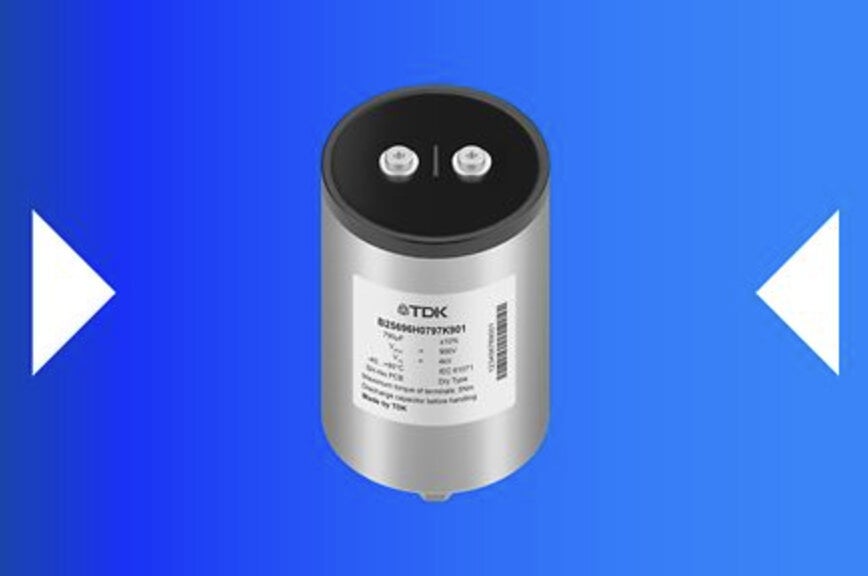
The introduction of the B25696H series represents a new generation of power capacitors for the DC-link, specifically optimized for the high switching frequencies of silicon carbide semiconductors. This technology is used in energy storage systems, solid-state transformers, as well as in railway traction and industrial drive systems.
Optimization of Self-Inductance Through Internal Busbar Configuration
The reliability of converter systems depends heavily on minimizing parasitic effects. The capacitors feature capacitance values ranging from 47 microfarads to 1280 microfarads, as well as nominal DC voltages from 900 volts to 2000 volts. A key feature of this series is its special internal busbar configuration. This structure distributes the electrical current entirely homogeneously across the individual capacitor windings. Thanks to this geometric optimization, an ultra-low self-inductance value of just 30 nanohenries is achieved. In addition, the equivalent series resistance drops to as low as 0.8 milliohms at a frequency of 10 kilohertz. Since this resistance value remains stable up to a frequency of 100 kilohertz, ohmic losses and dangerous voltage spikes during the switching of silicon carbide components are effectively reduced, increasing efficiency within the digital supply chain.
Structural Features and Thermal Resilience in Continuous Operation
The cylindrical components are based on a self-healing dielectric made of metallized polypropylene film. This is housed in a robust aluminum case sealed with a stable resin top. For mechanical and electrical integration, two housing diameters of 85 millimeters and 100 millimeters are available, featuring M6 screw terminals and an M12 mounting stud. The thermal design allows an operating temperature range from minus 40 degrees Celsius up to plus 85 degrees Celsius at the hotspot.
Under nominal voltage and at a hotspot temperature of plus 75 degrees Celsius, the components achieve a lifetime expectancy of 100000 hours. Through targeted voltage derating, this value can be doubled to up to 200000 hours. A maximum ripple current capability of up to 91 amperes at an ambient temperature of plus 60 degrees Celsius enables the design of compact inverters with high power density, which are also relevant within the automotive data ecosystem for fast-charging stations. To shorten development cycles, the manufacturer provides the free online simulation tool CapThermal, which allows engineers to precisely calculate thermal behavior and lifetime expectancy under specific application conditions.
Additional Context: This section details technical specifications and competitive benchmarking not included in the original product announcement
When designing fast switching circuits with silicon carbide power semiconductors, reducing the self-inductance of the DC-link forms the critical technological bottleneck. Conventional DC-link capacitors often exhibit self-inductance values ranging from 40 nanohenries to over 50 nanohenries, which leads to significant overvoltages given the steep current rise speeds of modern semiconductors. The 30 nanohenries achieved by TDK represent a technological peak in the field of large cylindrical capacitors, competing directly with high-end film capacitors from competitors such as Vishay or Kemet.
Vishay offers flat DC-link capacitors in similar series that are also optimized for high ripple currents but frequently require a modified geometry or parallel connections to achieve similarly low inductance values. Another essential benchmark is the behavior of the equivalent series resistance at increasing frequencies. While standard power capacitors often show a drastic increase in series resistance in the frequency range above 20 kilohertz, the value for this series remains stable up to 100 kilohertz. This minimizes thermal power loss inside the housing and prevents the formation of local hot spots, thereby safeguarding the lifetime expectancy even under continuous alternating current loads.
Edited by Maria Brueva, Induportals editor – adapted by AI.
www.tdk-electronics.tdk.com
