
electronics-journal.com
22
'26
Written on Modified on
Automotive Hall-Effect Latch for Low-Field Position Sensing
Diodes Incorporated introduces a high-sensitivity Hall-effect latch for automotive motor control and position sensing applications operating in electrically harsh environments.
www.diodes.com
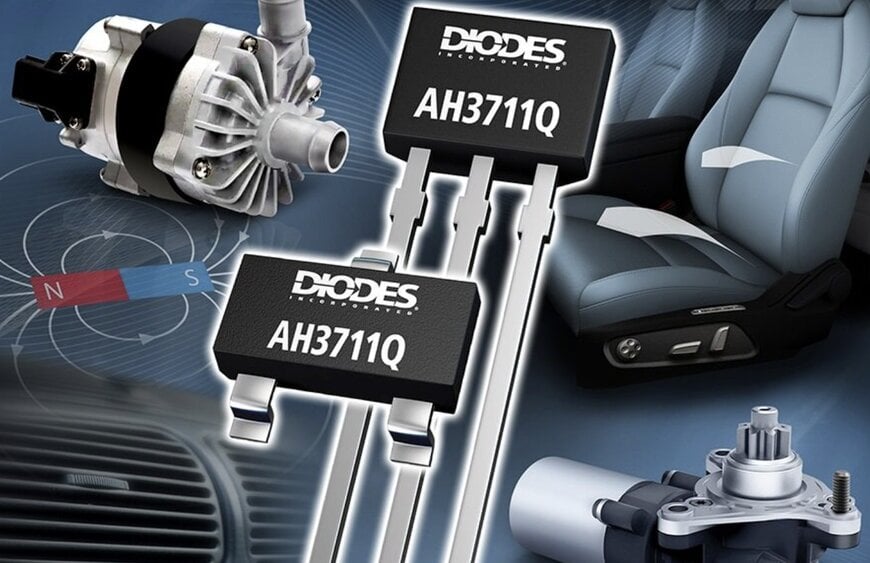
Diodes Incorporated has expanded its automotive Hall-effect sensor portfolio with a latch device designed for low magnetic threshold detection in vehicle motion control and position sensing systems. The component targets automotive electronics including brushless DC motor control, actuator positioning, rotary encoding, and speed measurement, where magnetic sensitivity, voltage robustness, and thermal stability directly influence sensing accuracy.
Magnetic Sensing Requirements in Automotive Motor Control
Automotive motor control systems increasingly rely on contactless magnetic sensing for position detection, speed monitoring, and commutation control. Applications such as power windows, sunroof actuation, tailgate mechanisms, seat adjustment motors, cooling fans, and fluid pumps require sensing components capable of operating under electrical noise, wide voltage fluctuations, and elevated temperatures.
In these applications, Hall-effect latches provide bipolar switching behavior, allowing state changes based on alternating magnetic polarity. This architecture is commonly used in BLDC commutation and encoder-based motion control, where repeatable switching thresholds are essential for maintaining system timing accuracy within the broader automotive data ecosystem.
Hall Latch Architecture and Electrical Characteristics
The newly introduced AH3711Q extends the AH371xQ automotive-compliant Hall-effect latch family and is specified for operation at magnetic operate and release thresholds of ±10 Gauss. This sensitivity level allows detection of weaker magnetic fields, which can support the use of smaller permanent magnets in compact actuator assemblies, potentially reducing system size and bill-of-materials cost.
The device operates across a 3V to 27V supply range and includes protection circuitry intended for automotive electrical conditions. Integrated reverse blocking, Zener clamping on the supply rail, output overcurrent limiting, and output clamping provide protection against reverse polarity events, short circuits, and load dump transients up to 40V.
Electrostatic discharge resilience is rated at 8kV Human Body Model (HBM) and 1kV Charged Device Model (CDM), while operating temperature spans from -40°C to +150°C. These parameters align with requirements for automotive electronics deployed in engine-adjacent or externally mounted environments.
Signal Stability and Thermal Drift Control
A chopper-stabilized internal architecture is used to reduce switch-point drift across the operating temperature range. In Hall-effect sensors, drift can alter trigger thresholds as temperature changes, affecting commutation timing or positional accuracy.
Diodes Incorporated states that the design also improves resistance to physical stress introduced during PCB assembly. This is relevant because package stress can alter magnetic sensor behavior in compact automotive electronics.
The power-on response time is specified at 13µs typical, which is relevant in systems where delayed sensor initialization could interfere with startup diagnostics or control sequencing. Open-drain output architecture allows designers to use external pull-up configurations above or below the device supply voltage, increasing interface flexibility.
Packaging and Application Integration
The AH3711Q is available in SC59, SOT23 (Type S), and SIP-3 package formats. Magnetic operating polarity differs by package orientation. In the SOT23 (Type S) and SIP-3 versions, activation requires the south pole facing the marked side of the package, while the SC59 version requires the south pole on the opposite side.
This packaging variation matters in mechanical integration, particularly in compact automotive actuator assemblies where magnet orientation and sensor placement are constrained.
Target use cases include BLDC motor commutation, valve actuation, linear and incremental rotary encoders, speed sensing, and general position detection in automotive electromechanical subsystems.
Additional Context
This section details technical specifications and competitive benchmarking not included in the original news release.
Automotive Hall-effect latch sensors represent a mature semiconductor category with established offerings from suppliers including Allegro MicroSystems and Melexis. Benchmark comparisons typically focus on operating voltage range, switching sensitivity, AEC-Q100 qualification, thermal operating range, ESD protection, and integrated fault protection.
The AH3711Q’s 3V to 27V operating range compares closely with automotive Hall latch devices such as Allegro’s APS12203, which supports 2.7V to 26V operation and also uses chopper stabilization for switch-point stability. Allegro’s A1260 extends junction temperature support to 175°C, exceeding the 150°C ambient operating range specified for the Diodes device, although package orientation and application targeting differ.
A distinguishing specification for the AH3711Q is its ±10 Gauss switching threshold, placing it in the high-sensitivity segment for low-field magnetic detection. This is particularly relevant in compact automotive actuator systems where smaller magnets or increased sensor placement flexibility can simplify mechanical design.
Edited by Aishwarya Mambet, Induportals Editor, with AI assistance.
www.diodes.com
