
electronics-journal.com
22
'26
Written on Modified on
High-Speed ESD Protection for Automotive Interfaces
ROHM introduces low-capacitance protection diodes for multi-gigabit industrial, automotive, and consumer interfaces where signal integrity and transient suppression must coexist.
www.rohm.com
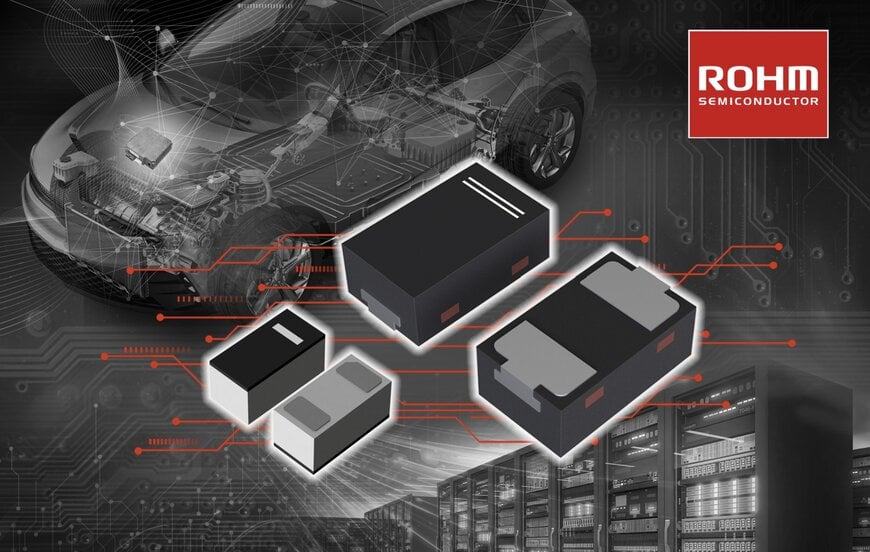
High-speed digital interfaces in automotive electronics, industrial infrastructure, and consumer computing increasingly require external electrostatic discharge protection that does not compromise signal performance. ROHM’s new ESD protection diode series targets this constraint by combining low parasitic capacitance with reduced dynamic resistance for interfaces operating beyond 10 Gbps.
Why High-Speed Interfaces Require Different ESD Protection
As data rates increase across the digital supply chain, conventional ESD protection components become more difficult to deploy without affecting signal quality. High-speed interfaces such as USB4, Thunderbolt 4, PCI Express, HDMI, DisplayPort, LVDS, and MIPI D-PHY/C-PHY are sensitive to parasitic capacitance, which can distort signal waveforms, reduce eye margins, and degrade communication reliability.
This design challenge is becoming more pronounced in industrial and automotive electronics, where device miniaturization has reduced the tolerance of integrated circuits to electrical overstress (EOS) and electrostatic discharge. System-level protection requirements for boards and modules have therefore become stricter, particularly in applications with exposed connectors, long interconnects, or high-speed serializer/deserializer (SerDes) links.
Technical Characteristics of the New Diode Architecture
ROHM’s RESDxVx series is designed to address the traditional trade-off between capacitance and dynamic resistance in transient suppression devices.
According to the company, the bidirectional variants provide terminal capacitance of 0.24 pF, while unidirectional versions reach 0.48 pF. Dynamic resistance is specified at 0.28 ohms, which reduces clamping voltage relative to conventional designs. ROHM states this results in approximately 40% lower clamping voltage, improving protection for sensitive downstream ICs during transient events.
This combination is relevant because lower capacitance reduces signal loading at high frequencies, while lower dynamic resistance improves transient energy dissipation by limiting voltage overshoot during ESD events.
Target Applications in Industrial, Consumer, and Automotive Electronics
The components are intended for systems where high-speed communication interfaces must maintain signal integrity under transient exposure.
Industrial use cases include AI servers, data centers, routers, optical transceivers, factory automation cameras, and 5G or 6G communications infrastructure.
Consumer electronics applications include notebook PCs, smartphones, tablets, gaming consoles, USB peripherals, and audiovisual equipment.
In automotive systems, the components target advanced driver assistance systems (ADAS), autonomous driving camera modules, surround-view systems, rear-view cameras, infotainment head units, body control electronic control units (ECUs), and automotive Ethernet or SerDes communication links.
ROHM states that the RESDxVxBASAFH and RESDxVxUASAFH variants in DFN1006-2W packaging are qualified to AEC-Q101, making them suitable for automotive-grade deployment.
Interface Compatibility and System Integration
ROHM positions the series for integration across a broad range of modern interfaces exceeding 10 Gbps, alongside lower-speed automotive networking technologies including 10/100/1000 Mbps automotive Ethernet.
For system designers, device placement remains critical. ESD protection performance depends not only on diode specifications but also on PCB layout, trace inductance, grounding strategy, and proximity to the external transient entry point.
The product family forms part of ROHM’s broader protection device portfolio spanning low-capacitance ESD and transient voltage suppression components used in communications infrastructure, automotive electronics, and compute platforms.
Additional Context
This section details technical specifications and competitive benchmarking not included in the original news release.
The high-speed ESD protection segment includes comparable offerings from multiple semiconductor suppliers. Infineon’s ESD175-B1-W01005, for example, specifies 0.11 pF capacitance and 0.28 ohms dynamic resistance for high-speed line protection, indicating that ultra-low capacitance designs are becoming a competitive benchmark in advanced interface protection.
Benchmarking across this category typically focuses on four measurable parameters: capacitance, dynamic resistance, clamping voltage, and compliance with standards such as IEC 61000-4-2 for electrostatic discharge robustness and AEC-Q101 for automotive qualification.
ROHM’s differentiator appears to be the stated balance between sub-picofarad capacitance and reduced clamping behavior in automotive-qualified packaging, which is particularly relevant for camera-based automotive data ecosystem architectures and multi-gigabit industrial communications.
Edited by Aishwarya Mambet, Induportals Editor, with AI assistance.
www.rohm.com
