
electronics-journal.com
08
'26
Written on Modified on
AMD Previews MI430X GPU for HPC & AI
Upcoming accelerator targets large-scale scientific simulation and AI training with projected FP64 performance exceeding 200 TFLOPs.
www.amd.com
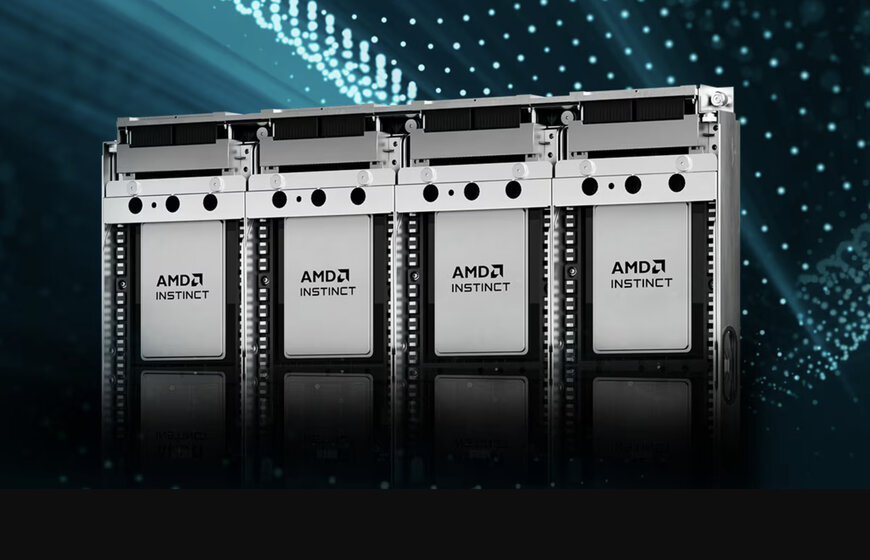
AMD presented details of its upcoming AMD Instinct MI430X GPU during the HPC User Forum 2026, held on 5–6 May in Austin, Texas. The accelerator is designed for high-performance computing (HPC) and AI-for-science workloads, with AMD projecting more than 200 TFLOPs of native FP64 performance for large-scale scientific simulation, modeling, and AI training applications.
The announcement reflects increasing convergence between HPC infrastructure and artificial intelligence systems, particularly in research environments where scientific simulations are being used to generate training data for next-generation AI models. National laboratories, academic institutions, and industrial research centers are increasingly deploying hybrid computing architectures capable of supporting both traditional simulation workloads and AI processing within the same infrastructure.
FP64 performance for scientific computing
According to AMD, the MI430X GPU is designed to establish a new performance category for FP64 computing, which remains critical for numerically intensive scientific workloads requiring high precision and computational accuracy. FP64 arithmetic is widely used in climate modeling, materials science, fluid dynamics, nuclear engineering, and computational physics, where reduced numerical precision can affect simulation reliability and reproducibility.
AMD stated that the MI430X is projected to deliver more than six times the FP64 performance of NVIDIA’s upcoming Rubin architecture. If achieved, this would position the accelerator among the highest-performing FP64 GPUs developed for scientific computing applications.
The company also emphasized the growing importance of precision computing within AI-driven scientific research. As research organizations increasingly use simulated datasets to train AI models, the numerical quality of those simulations directly affects model accuracy and scientific validity. HPC systems are therefore being designed to support both low-precision AI operations and high-precision simulation workloads within unified computing environments.
AI-for-science and hybrid HPC infrastructure
AMD described the MI430X as part of a broader shift toward AI-for-science infrastructure, where supercomputers are expected to combine scientific simulation, AI training, inference, and automated research workflows. Emerging workloads include surrogate modeling, automated laboratories, and closed-loop discovery systems that integrate simulation and machine learning pipelines.
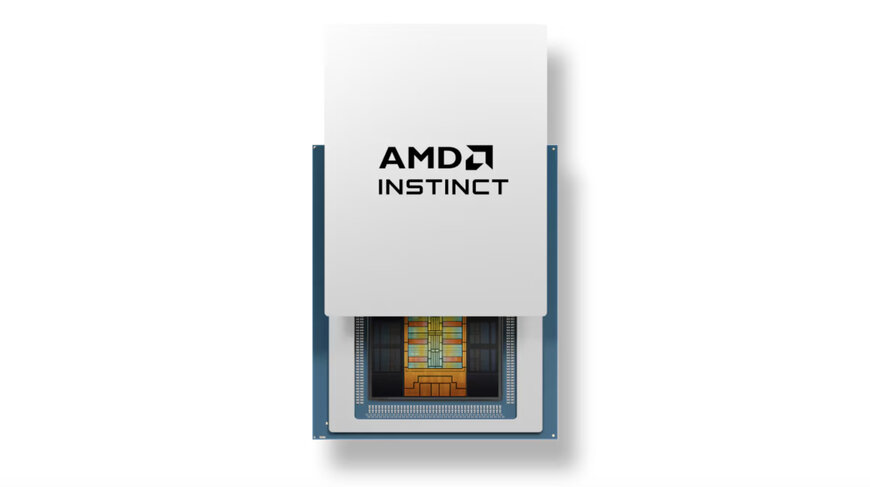
The accelerator is designed to support both FP64 workloads and lower-precision AI computation within a single package. This hybrid capability is becoming increasingly important for AI gigafactories and next-generation HPC centers that require high computational throughput while maintaining scientific accuracy.
The HPC User Forum agenda reflected this transition toward converged computing architectures, with technical sessions addressing middleware, hybrid workflows, and domain-specific HPC applications. AMD also participated in an industry panel discussing the role of FP64 computing, reduced precision processing, and software-based emulation techniques in future HPC systems.
Deployment in next-generation supercomputers
AMD stated that the MI430X GPU is planned for deployment in several upcoming large-scale supercomputing systems.
At Oak Ridge National Laboratory, the Discovery system is expected to be deployed in 2028 in cooperation with the U.S. Department of Energy under the Genesis Mission program. The system is designed to support AI training, inference, agentic AI, and scientific simulation using AMD Instinct MI430X GPUs alongside next-generation AMD EPYC CPUs. AMD described Discovery as one of the first planned “AI factory” supercomputers in the United States.
In Europe, the Alice Recoque system is being deployed in cooperation with GENCI and operated by Commissariat à l'énergie atomique et aux énergies alternatives. The supercomputer is designed to provide exascale-class performance for both AI and traditional HPC workloads and is expected to deliver more than one exaflop of High-Performance Linpack performance.
AMD stated that these deployments represent part of a broader expansion of sovereign AI and HPC infrastructure, where governments and research institutions are investing in domestic high-performance computing ecosystems to support scientific research, industrial innovation, and AI development.
HPC infrastructure and future computing demands
The increasing computational requirements of scientific AI models are driving demand for accelerators capable of combining high numerical precision with large-scale AI processing performance. HPC infrastructure developers are also placing greater emphasis on energy efficiency, throughput, and scalability as exascale and AI-integrated systems become more common across research and industrial computing environments.
AMD positioned the MI430X GPU as a platform intended to support this transition, particularly in environments where scientific accuracy and large-scale AI processing must operate together within the same HPC infrastructure.
Edited by Natania Lyngdoh, Induportals editor, with AI assistance.
www.amd.com
