
electronics-journal.com
08
'26
Written on Modified on
Toshiba Introduces High-Speed Differential Signal Switches
New multiplexer and demultiplexer devices support PCIe 6.0 and USB4 Version 2.0 in industrial and computing systems.
www.global.toshiba
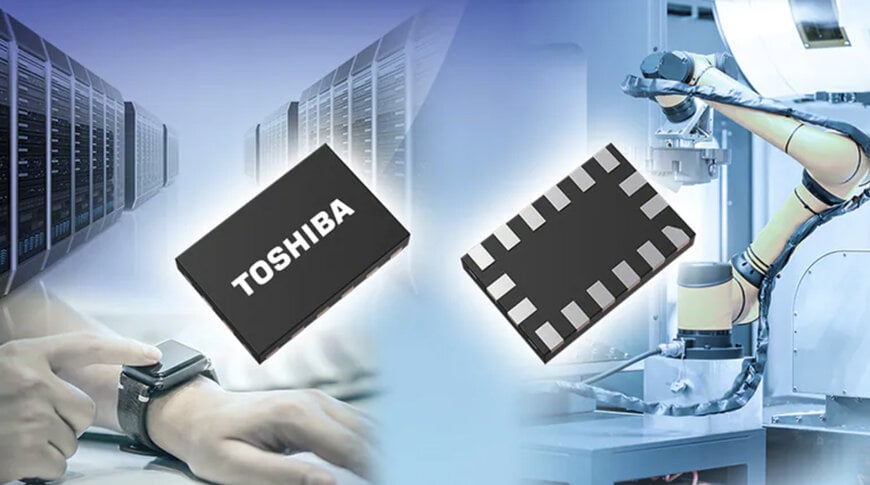
Toshiba Electronic Devices & Storage Corporation has introduced the TDS5C212MX and TDS5B212MX, 2:1 multiplexer and 1:2 demultiplexer switches designed for high-speed differential signal routing in interfaces including PCIe 6.0 and USB4 Version 2.0. The devices support operating temperatures from -40°C to 125°C, targeting industrial systems, servers, robotics platforms, and high-performance computing applications where signal integrity and compact board layouts are critical.
The new switches are intended for next-generation data transmission systems requiring reliable routing of ultra-high-speed signals across increasingly constrained PCB designs. Applications include industrial testers, robotic systems, PCs, servers, wearable electronics, and mobile devices that depend on high-bandwidth interconnects for data transfer and peripheral communication.
High-bandwidth switching for next-generation interfaces
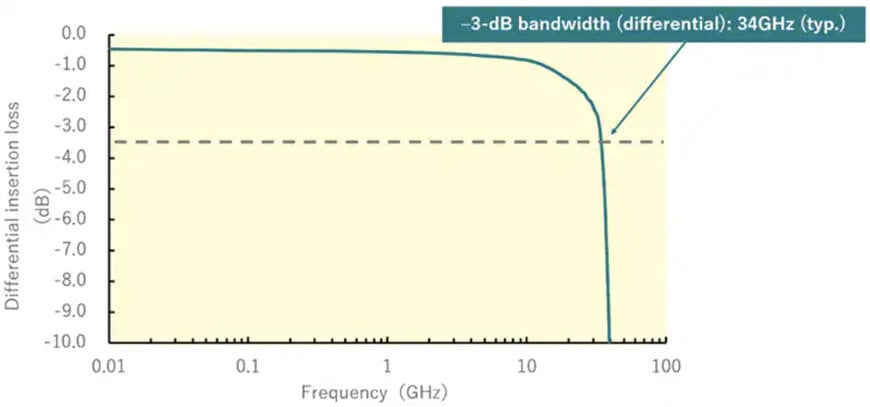
Toshiba developed the devices using its proprietary TarfSOI silicon-on-insulator process technology for high-frequency semiconductor applications. According to the company, the process enables an industry-leading differential –3 dB bandwidth of 34 GHz typical for the TDS5C212MX and 29 GHz typical for the TDS5B212MX, based on Toshiba’s May 2026 survey for 2:1 multiplexer and 1:2 demultiplexer switches.
In high-speed digital systems, bandwidth performance directly affects signal integrity and transmission reliability. Wider bandwidth helps reduce waveform distortion, insertion loss, and signal reflection during high-speed data transfer. Toshiba stated that the TDS5C212MX includes an optimized pin layout that shortens signal paths to further minimize reflections and losses in high-frequency applications.
The switches can operate either as 2-input/1-output multiplexers or 1-input/2-output demultiplexers, allowing system designers to share a single high-speed interface among multiple devices or dynamically switch signal paths depending on system requirements. Such switching architectures are increasingly used in data center hardware, industrial automation systems, and modular computing platforms where flexible interface allocation is required.
Support for PCIe, USB4, CXL, and Thunderbolt interfaces
The devices support a broad range of high-speed interface standards used in modern computing and industrial communication systems. Supported PCIe interfaces include PCIe 6.0, 5.0, 4.0, and 3.0, with PCIe 6.0 providing transfer rates up to 64 GT/s, double that of PCIe 5.0.
The switches also support CXL 3.0, 2.0, and 1.0 interfaces used in memory and accelerator interconnect architectures for data center systems. Additional compatibility includes USB4 Version 2.0, USB4, USB 3.2, Thunderbolt 5, 4, 3, and 2, along with DisplayPort 2.0 and earlier versions.
USB4 Version 2.0 supports data transfer rates of up to 80 Gbps, increasing the need for signal routing components capable of maintaining stable transmission performance across high-frequency channels. As bandwidth requirements continue to increase in AI servers, industrial robotics, and edge computing systems, high-speed analog switching components are becoming increasingly important within the broader automotive data ecosystem and digital supply chain infrastructure supporting connected devices and industrial automation.
Industrial operating range and integration flexibility
Both devices support operating temperatures up to 125°C, enabling use in industrial environments where electronic systems may experience elevated thermal conditions during continuous operation. High-temperature tolerance is particularly relevant for robotics, automated testing systems, and embedded computing equipment operating in factory and industrial environments.
Toshiba stated that it will continue developing high-performance analog switch technologies designed to support evolving high-speed interface standards and next-generation electronic systems.
Edited by Natania Lyngdoh, Induportals editor, with AI assistance.
www.toshiba.semicon-storage.com
