
electronics-journal.com
06
'26
Written on Modified on
High Capacity Solid State Storage Systems for Data Center Infrastructure
Micron Technology introduces a 245TB solid state drive designed to enhance rack-scale density and energy efficiency within the global automotive data ecosystem.
www.micron.com
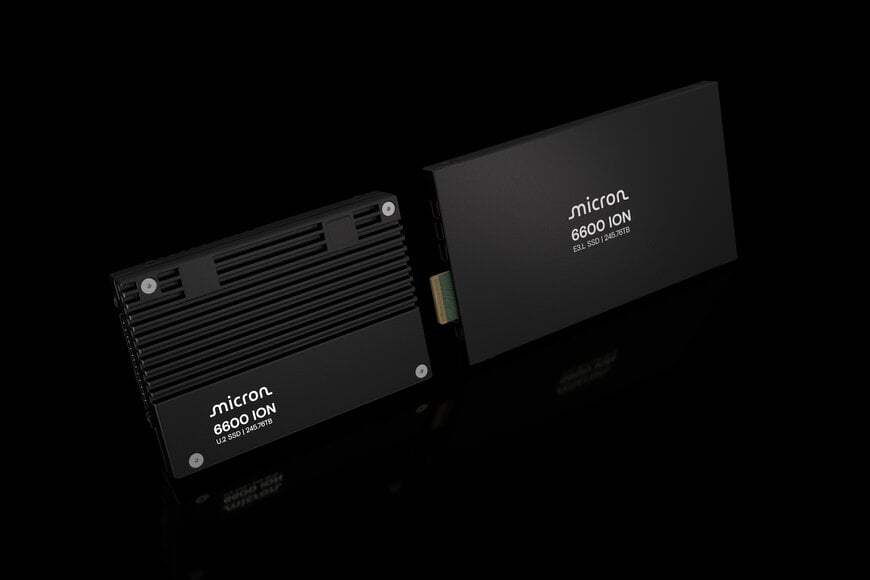
The Micron 6600 ION is a high-capacity solid state drive (SSD) utilizing ninth-generation (G9) Quad-Level Cell (QLC) NAND technology to provide 245TB of storage in a single unit. This density is specifically engineered for hyperscale workloads, including AI data lakes and cloud-scale object storage, where physical space and power availability are primary infrastructure constraints.
Technical Mechanisms of Rack-Scale Density
The 245TB capacity of the 6600 ION allows for a significant reduction in physical hardware requirements compared to traditional Hard Disk Drive (HDD) deployments. To achieve an equivalent raw storage capacity, the 6600 ION E3.L form factor requires 82% fewer racks than HDD-based systems. This consolidation simplifies the digital supply chain by reducing the number of physical components, failure points, and maintenance intervals required for petabyte-scale environments.
Built on G9 QLC NAND, the architecture supports high-density storage without the mechanical latency inherent in rotating media. The drive is available in both U.2 and E3.L-S form factors, ensuring compatibility with standard enterprise server configurations while maximizing the usable capacity per square foot of floor space.
Performance Metrics in AI and Object Storage
Technical evaluations conducted in laboratory environments indicate measurable gains in throughput and latency for data-intensive applications. In AI preprocessing tasks, the 6600 ION demonstrates 8.6 times faster performance and 3.4 times better ingest throughput compared to HDD systems. These improvements are critical for maintaining the velocity of AI data pipelines where storage bottlenecks can stall GPU utilization.
For object storage workloads, the drive achieves 58 times better aggregate throughput and a 96-fold improvement in "time to first byte." This responsiveness is essential for real-time data retrieval in distributed enterprise environments.
Energy Efficiency and Thermal Management
The 6600 ION addresses the growing power constraints of modern data centers by consuming a maximum of 30 watts (W). This represents approximately half the power consumption of an HDD deployment with comparable capacity. In a 1-exabyte (EB) deployment, HDD systems require 1.9 times more energy than the 245TB SSD alternative. The resulting reduction in thermal output has a direct impact on Facility Power Usage Effectiveness (PUE).
Measurable sustainability benchmarks for a large-scale deployment include:
- An annual energy saving of 921 megawatt-hours (MWh).
- A reduction in HVAC cooling requirements exceeding 3.14 billion British thermal units (Btu) per year.
- Carbon dioxide emission reductions of 438 metric tons (MT) annually.
Comparative Context in Storage Media
While HDDs have traditionally offered a lower cost-per-terabyte for bulk storage, the shift toward AI and hyperscale computing has established rack-level efficiency as the primary benchmark. The 6600 ION competes with high-density HDD arrays by offering up to 84 times better energy efficiency per watt in AI workloads. By eliminating the mechanical latency of HDDs, which the 6600 ION reduces by up to 29 times, the technology enables data centers to scale capacity without expanding their physical or environmental footprint.
Edited by Evgeny Churilov, Induportals Media - Adapted by AI.
www.micron.com
While HDDs have traditionally offered a lower cost-per-terabyte for bulk storage, the shift toward AI and hyperscale computing has established rack-level efficiency as the primary benchmark. The 6600 ION competes with high-density HDD arrays by offering up to 84 times better energy efficiency per watt in AI workloads. By eliminating the mechanical latency of HDDs, which the 6600 ION reduces by up to 29 times, the technology enables data centers to scale capacity without expanding their physical or environmental footprint.
Edited by Evgeny Churilov, Induportals Media - Adapted by AI.
www.micron.com
