
electronics-journal.com
05
'26
Written on Modified on
Multilayer varistors target 48V automotive power systems
KYOCERA AVX expands high-temperature transient protection components to support growing 48V vehicle architectures, addressing electrical stress, space constraints, and reliability in automotive electronics.
global.kyocera.com
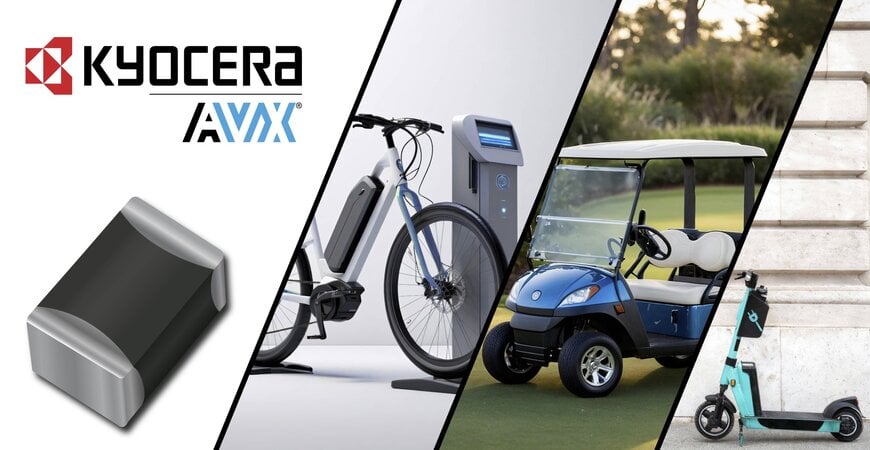
Electrical transients remain a persistent constraint in modern vehicle electronics, particularly as 48V architectures expand across electric mobility and auxiliary systems. In this context, KYOCERA AVX introduced new multilayer varistors for 48V power supply systems within its TransGuard® VT Series, targeting automotive, industrial, and transportation applications.
Addressing transient risks in 48V vehicle electronics
The shift toward 48V electrical systems in electric vehicles, e-bikes, and hybrid subsystems increases exposure to load dumps, switching noise, and electrostatic discharge (ESD). These conditions require compact protection devices capable of handling high energy pulses while maintaining stability across elevated temperatures.
The TransGuard® VT Series multilayer varistors (MLVs) are based on zinc oxide ceramic semiconductor structures that provide bidirectional overvoltage protection combined with EMI/RFI attenuation. By integrating these functions into a single surface-mount package, the devices reduce the need for additional multilayer ceramic capacitors (MLCCs), supporting board space optimization and bill-of-materials reduction in dense automotive electronics.
Typical application areas include powertrain electronics, DC motor control systems, charging infrastructure, and auxiliary systems exposed to repetitive transient events. Protection extends to disturbances generated by relays, engines, radiators, and uninterruptible power supplies.
Electrical performance and qualification standards
The components operate across a temperature range of −55°C to +175°C without derating, addressing thermal conditions in engine compartments and industrial environments. They meet AEC-Q200 automotive qualification, along with IEC 61000-4-2 and ISO 10605 standards for ESD immunity.
The devices achieve Human Body Model ESD Class 6 classification, corresponding to tolerance above 25 kV, and are rated at Moisture Sensitivity Level 1, enabling standard handling without dry storage or pre-bake requirements.
Electrical characteristics include high current and energy handling capability, multi-strike endurance, and low leakage behavior. These attributes support repeated exposure to transient pulses without significant degradation, which is critical in automotive data ecosystem architectures where reliability directly impacts system availability.
Configuration for 48V system requirements
The newly introduced 48V System VT Series variants are specifically designed and tested for 48V automotive power networks and qualified to VDA-320. They support operating temperatures up to 150°C and are available in standard EIA chip sizes from 0805 to 2220.
Key electrical parameters include working voltages of 56 VDC or 40 VAC, clamping voltages between 100 V and 110 V, and transient handling from 30 A to 1,500 A with energy ratings of 0.2 J to 9 J. Capacitance values range from 80 pF to 2,800 pF, enabling design flexibility depending on filtering and protection requirements.
These specifications align with the demands of 48V subsystems used in electric passenger vehicles, commercial vehicles, and light electric mobility platforms such as e-scooters and golf carts, as well as associated charging stations.
Mechanical robustness under automotive stress
Selected part numbers are available with FLEXITERM® terminations, designed to mitigate mechanical stress caused by vibration and PCB flexure. These terminations withstand up to 5 mm board flex and up to 3,000 temperature cycles reaching 150°C, exceeding AEC-Q200 requirements of 1,000 cycles at 125°C.
This mechanical resilience is relevant for automotive environments where thermal cycling and vibration can induce solder joint fatigue or internal cracking in standard components.
Portfolio range and integration considerations
Across the broader TransGuard® VT Series, components are available in case sizes from 0603 to 2220, with voltage ratings spanning 12–56 VDC and 4–40 VAC. Clamping voltages range from 32 V to 110 V, with transient current handling up to 2,150 A and energy ratings up to 9 J.
All devices feature RoHS-compliant matte tin terminations with nickel barriers and are supplied in tape-and-reel formats for automated assembly.
Within compact automotive electronics and digital supply chain hardware, integrating transient voltage suppression and EMI filtering into a single component simplifies layout design and reduces component count, particularly in distributed 48V architectures where space and thermal margins are constrained.
Edited by Aishwarya Mambet, Induportals Editor, with AI assistance.
www.kyocera-avx.com
