
electronics-journal.com
29
'26
Written on Modified on
Integrated DC-DC converters simplify industrial power design
TDK Corporation introduces encapsulated converter modules to reduce design complexity and footprint in industrial power architectures.
www.tdk.com
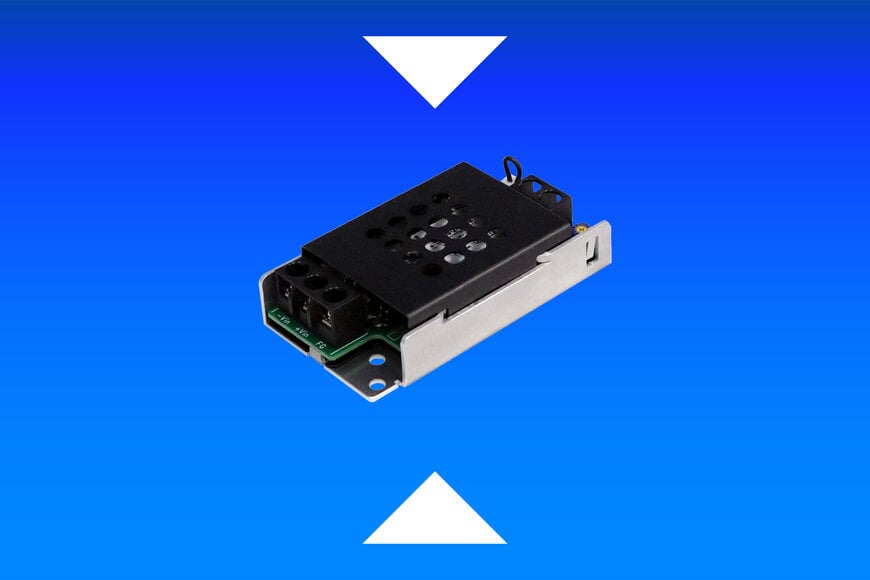
Isolated DC-DC converters are being integrated into pre-engineered modules to streamline industrial power system design. TDK Corporation has introduced 15 W and 30 W converter units that eliminate the need for external components, targeting applications such as factory automation, railway systems, and semiconductor manufacturing.
Design simplification through integrated power modules
TDK Corporation has expanded its power supply portfolio with the CCGS series, developed to reduce design effort in distributed power architectures. The converters integrate essential circuitry into a single package, removing the requirement for external filtering or protection components. This approach supports faster implementation in systems aligned with industrial automation and digital supply chain infrastructure.
The series builds on the established board-mount CCG platform, which has demonstrated field reliability in long-term deployments. By transferring this architecture into enclosed modules, the design addresses system-level requirements such as mechanical mounting, wiring robustness, and compliance.
Electrical performance and configurability
The converters are available in 15 W and 30 W variants with single outputs of 3.3 V, 5 V, 12 V, and 15 V, along with ±12 V and ±15 V configurations. The 15 W model supports input ranges of 9–36 V (with safety certification from 18–36 V) and 18–76 V, while the 30 W version is fully certified across both ranges.
An adjustable output voltage function allows fine-tuning within defined tolerances, supporting use cases where precise voltage regulation is required for sensitive loads such as test instrumentation or communication modules. Efficiency levels range from 84% to 87%, depending on configuration, which is consistent with isolated converter performance in this power class.
Remote on/off control enables system-level power sequencing, a feature relevant in modular industrial systems where subsystems must be activated selectively. This contributes to reduced maintenance downtime and improved operational safety.
Mechanical integration and installation efficiency
The modules are offered in multiple mechanical formats to support varied installation environments. The chassis-mount version measures 52 × 93 × 23.5 mm and includes screw terminals with captive screws to prevent hardware loss during installation. DIN-rail variants increase height to 31.9 mm and allow direct integration into control cabinets commonly used in factory automation.
Optional connector configurations using push-on interfaces reduce wiring errors, particularly in high-density installations. These design elements support faster assembly and improved reliability in environments where installation time and serviceability are critical.
Environmental and safety compliance
The converters operate within a temperature range of –20 °C to 70 °C using natural convection cooling, eliminating the need for forced airflow. Certification to IEC/EN/UL/CSA 62368-1 ensures compliance with safety standards for industrial and ICT equipment, including operation at altitudes up to 5000 m.
Electrical isolation ratings include 1500 Vdc from input to output and input to chassis, and 1000 Vdc from output to chassis, supporting safe operation in electrically demanding environments such as railway systems and industrial automation lines.
Application relevance in industrial systems
The CCGS series targets sectors including semiconductor manufacturing equipment, robotics, test and measurement, railway systems, and communications infrastructure. These applications require compact, reliable, and easily deployable power solutions to support increasingly modular system architectures.
By integrating power conversion into standardized modules, the design aligns with trends toward decentralized power distribution and scalable industrial systems, where reduced wiring complexity and predictable performance are essential.
Edited by an industrial journalist Sucithra Mani with AI assistance.
www.tdk.com
