
electronics-journal.com
28
'26
Written on Modified on
Murata introduces ultra-low power AMR sensors
New AMR sensors enable low-voltage operation and extended battery life in healthcare, wearable, and IoT applications.
www.murata.com
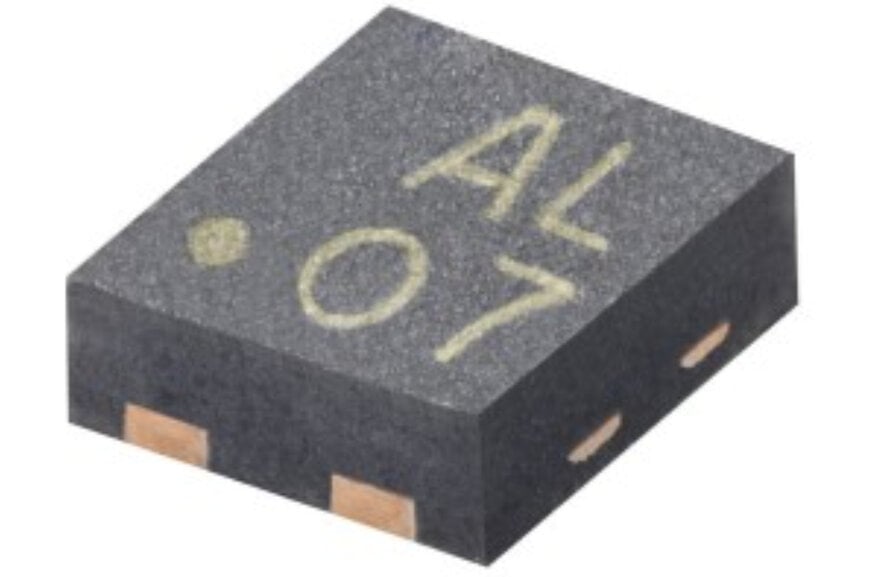
Murata Manufacturing Co., Ltd has initiated mass production of two anisotropic magnetoresistance sensors, MRMS166R and MRMS168R, designed for low-power switching applications in battery-constrained devices such as medical wearables and IoT systems.
Low-power switching for battery-constrained devices
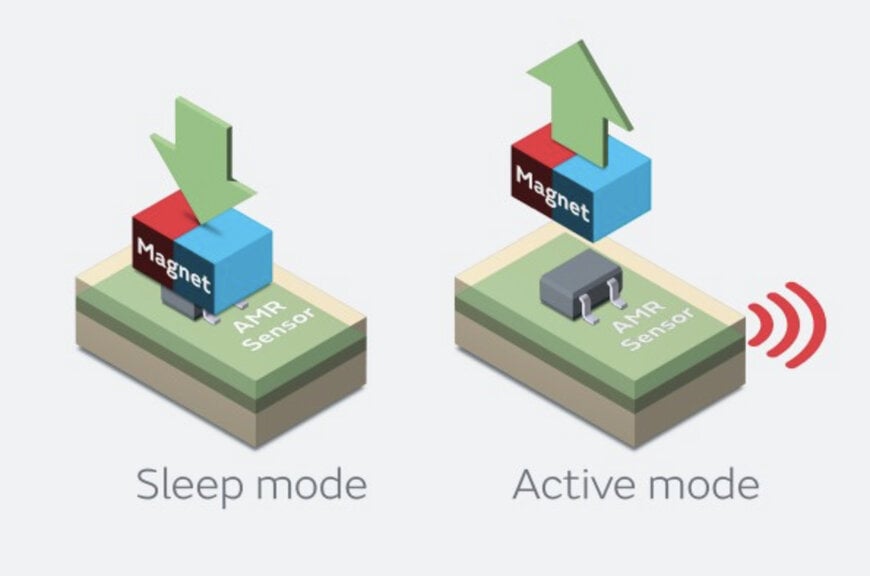
The sensors target applications where automatic switching between active and sleep modes is used to reduce standby energy consumption. In devices such as capsule endoscopes, medical patches, wireless earbuds, and access control systems, magnetic switches detect the presence or absence of a magnetic field and trigger system-level state changes.
Unlike mechanical switches, AMR-based solid-state sensors operate without physical contact, reducing wear and enabling sealed designs. This supports miniaturization and improves reliability in environments where mechanical components are prone to degradation.
Circuit design enabling nanoampere-level consumption
The MRMS166R achieves an average current consumption of 20 nA while operating from a supply voltage as low as 1.2 V. This is enabled by a redesigned internal circuit structure that minimizes leakage current and optimizes signal detection under low-voltage conditions.
This operating range aligns with the characteristics of silver oxide coin cell batteries, which typically provide nominal voltages around 1.55 V but have limited capacity. Reducing standby current at the sensor level directly impacts overall system power consumption, extending operational lifetime.
Under typical usage conditions, the reduced current draw supports device operation exceeding two years without battery replacement, depending on system duty cycles and load characteristics.
Device variants and electrical characteristics
The two sensor variants address different system requirements. The MRMS166R supports a supply range from 1.2 V to 3.6 V, with a typical operating voltage of 1.5 V and a maximum output current of 1 mA. This configuration is suited to ultra-low-power systems with minimal load requirements.
The MRMS168R operates over a higher voltage range from 2.0 V to 3.6 V, with a typical operating voltage of 3.0 V. It provides an average current consumption of 80 nA and a higher maximum output current of 12 mA, enabling direct driving of larger loads or interfacing with systems requiring higher current levels.
Both devices are packaged in a compact 1.0 × 1.0 × 0.4 mm form factor, supporting integration into space-constrained designs such as wearable electronics and miniaturized medical devices.
Application scope in healthcare and IoT systems
The sensors are designed for use in systems requiring reliable, low-power state detection. In healthcare devices, this includes activation mechanisms in ingestible or wearable systems where battery replacement is not feasible. In IoT and security applications, such as door sensors and smart locks, the sensors enable continuous monitoring with minimal energy consumption.
By combining low-voltage operation, nanoampere-level current consumption, and solid-state switching, the devices support the development of energy-efficient digital infrastructure in portable and embedded systems.
Edited by Natania Lyngdoh, Induportals Editor — Adapted by AI.
www.murata.com
