
electronics-journal.com
30
'26
Written on Modified on
Power management ICs for industrial embedded processors
STMicroelectronics introduces PMICs designed to consolidate power supply, monitoring, and protection functions for STM32-based embedded systems in industrial electronics.
www.st.com
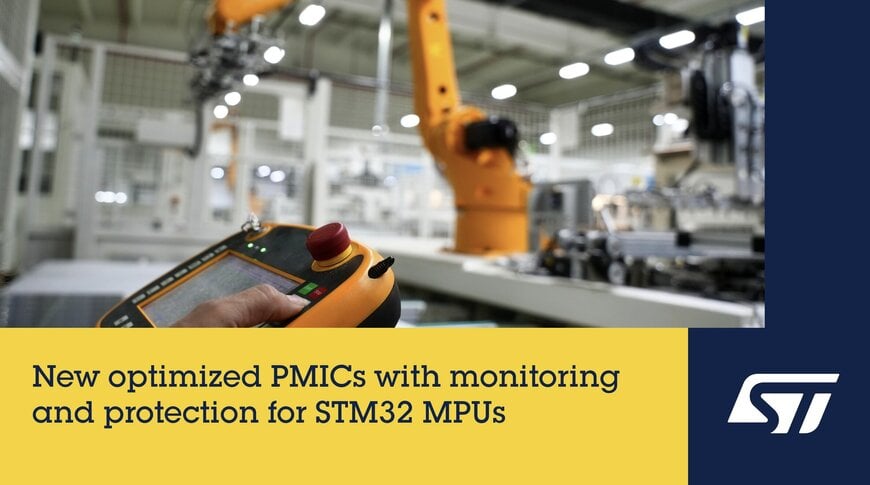
Power management integration remains a key design factor in embedded systems where board space, thermal stability, and power sequencing directly affect system reliability. In this context, STMicroelectronics introduced the STPMIC1L and STPMIC2L power-management ICs for STM32 microprocessor platforms used in industrial and edge computing equipment.
Power architecture integration for embedded processing platforms
The PMICs were developed for the 32-bit STM32MP1x and 64-bit STM32MP2x microprocessor families, combining multiple voltage regulators and supervisory functions into a single device to reduce external components and simplify power-tree design. Both devices integrate fixed and adjustable LDO regulators and DC/DC buck converters to supply the various MPU power rails, including dedicated LDO support for external DDR DRAM.
This level of integration can reduce the bill of materials and board footprint in embedded hardware development, particularly in industrial automation and edge computing systems where compact PCB layouts are often required.
Target systems from POS hardware to industrial edge devices
Application areas include point-of-sale terminals, network gateways, home automation controllers, edge processing platforms, printers, barcode scanners, and electronic metering systems. The specified junction temperature range of –40°C to 125°C supports deployment in industrial controls, thermostats, and smart factory equipment where extended environmental tolerance is required.
The STPMIC1L, intended for STM32MP1 processors, integrates two DC/DC buck converters, four LDOs, one DRAM LDO, and two external power control pins. The STPMIC2L, designed for STM32MP2 processors, includes three buck converters, seven LDOs, a DRAM LDO, and three external control pins.
Both devices support an input voltage range from 2.8V to 5.5V, allowing system designers to power equipment from low-voltage AC/DC adapters, USB sources, or Li-ion and Li-polymer batteries.
Voltage regulation behaviour and protection mechanisms
The integrated buck converters use adaptive constant on-time (COT) control to support fast transient response during load changes. Dynamic voltage scaling is also supported to improve energy efficiency in embedded processing systems.
Protection and monitoring functions include programmable output discharge, selectable overcurrent protection (OCP), and continuous monitoring of power rails. The PMICs also manage power-up and power-down sequencing to meet the voltage accuracy and timing requirements of the STM32MPU platforms.
Development support within the STM32 ecosystem
Evaluation platforms STEVAL-PMIC1LKV1 and STEVAL-PMIC2LKV1 were released to support early design validation and power configuration testing. Both platforms include graphical user interfaces for configuration, monitoring, and non-volatile memory parameter setup.
The STPMIC1L and STPMIC2L devices are supported within the STM32 MPU software ecosystem, including compatibility with OpenSTLinux, allowing integration into embedded Linux-based industrial computing platforms.
Edited by industrial journalist Aishwarya Mambet, with AI-assistance.
www.st.com
