
electronics-journal.com
10
'26
Written on Modified on
AMD Expands Ryzen AI Embedded Processors for Industrial Edge AI
New Ryzen AI Embedded P100 processors deliver higher CPU core counts, increased AI throughput, and integrated CPU, GPU, and NPU acceleration for industrial and robotics edge systems.
www.amd.com
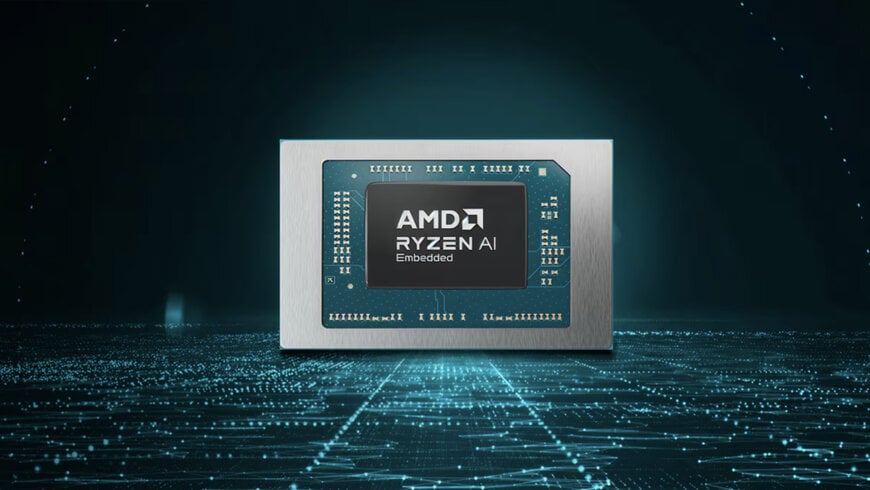
Industrial automation, mobile robotics, and medical imaging systems increasingly rely on edge computing platforms capable of processing artificial intelligence workloads locally while maintaining real-time responsiveness and reliability. AMD has expanded its Ryzen AI Embedded P100 Series processor portfolio to support these requirements, introducing new processors designed to deliver higher AI compute performance within compact embedded platforms.
The processors are intended for AI-driven edge applications, including factory automation systems, autonomous mobile robots, and medical imaging devices that require deterministic performance and continuous operation.
Integrated AI Acceleration on a Single Embedded Platform
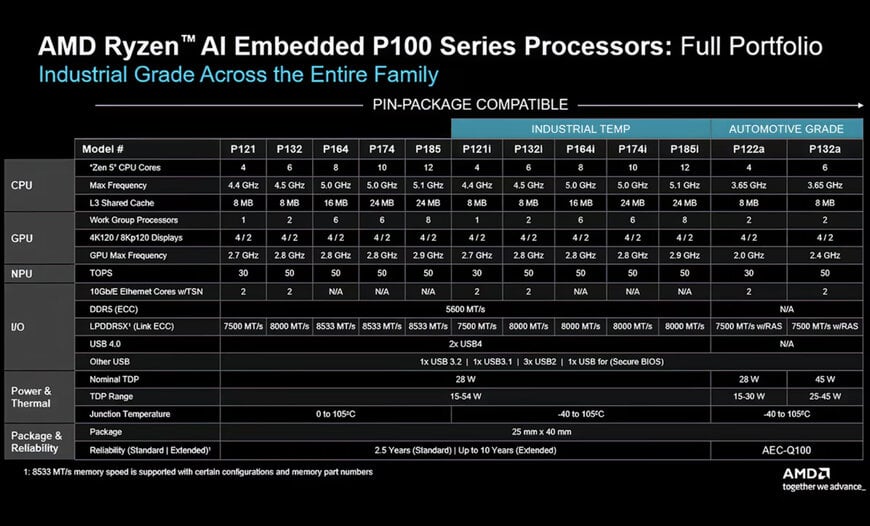
The expanded Ryzen AI Embedded P100 Series combines multiple compute engines within a single chip architecture. The processors feature eight to 12 “Zen 5” CPU cores, integrated RDNA 3.5 graphics, and a neural processing unit (NPU) based on the XDNA 2 architecture.
Together, these components provide up to 80 tera operations per second (TOPS) for AI acceleration. Compared with the previous Ryzen Embedded 8000 Series, the new processors deliver up to 39% higher multithreaded CPU performance and up to 2.1× greater total system TOPS.
The integrated CPU, GPU, and NPU architecture enables developers to distribute workloads according to their computational requirements. CPU cores manage real-time control and deterministic processing, GPUs handle parallel visual workloads, and the NPU performs low-power AI inference for tasks that require continuous operation.
Industrial AI Workloads from Machine Vision to Robotics
The processors are designed to support a range of industrial and edge AI scenarios.
In intelligent factory environments, industrial PCs can consolidate programmable logic controllers (PLCs), machine vision processing, and human-machine interface (HMI) functions into a single computing platform. Integrated GPU and NPU acceleration enable multi-camera inspection and anomaly detection using AI models such as DeepSORT, RAFT-Stereo, CenterPoint, GDR-Net, and PaDiM.
For mobile robotics and autonomous systems, the CPU manages navigation and motion control while the GPU processes multiple camera streams for spatial awareness and visual simultaneous localization and mapping (SLAM). The NPU supports continuous object detection and scene analysis using AI models such as YOLOv12 and MobileSAM.
In medical imaging applications, the processors can support edge-based image processing for ultrasound systems, endoscopy, tissue classification, and tumor detection using models including U-Net, nnU-Net, and MONAI. Integrated AI acceleration also supports automated clinical reporting workflows and clinical decision support systems.
ROCm Software Ecosystem for Edge AI Development
The processors support the AMD ROCm open-source software ecosystem, which enables developers to run AI frameworks using open-source compilers, runtimes, and libraries. ROCm uses the Heterogeneous-computing Interface for Portability (HIP) programming model, allowing GPU programming to remain independent of specific hardware implementations.
This approach enables developers to deploy embedded AI models without rewriting existing code while maintaining compatibility with commonly used machine learning frameworks.
Virtualization and Mixed-Criticality Workloads
For industrial environments where multiple software environments must run simultaneously, AMD provides a virtualized reference stack built on the Xen hypervisor. This architecture allows operating systems such as Linux, Windows, Ubuntu, and real-time operating systems (RTOS) to run in isolated domains.
By separating workloads, developers can run safety-critical tasks, real-time control processes, and AI workloads on the same hardware platform while maintaining predictable latency and system reliability.
Availability and Ecosystem Support
The Ryzen AI Embedded P100 Series processors are currently sampling across several configurations. Eight- to 12-core processors are expected to enter production in July 2026, while four- to six-core models are scheduled for production in the second quarter of 2026.
Hardware manufacturers including Advantech, congatec, and Kontron are developing platforms based on the new processors, including computer-on-modules, single-board computers, and industrial edge AI systems designed for embedded computing environments.
www.amd.com
Edited by Industrial Journalist, Natania Lyngdoh.
Powered by AI.
