
electronics-journal.com
10
'26
Written on Modified on
Edge AI Development Board Integrates Real-Time Control
Arduino introduces VENTUNO Q powered by Qualcomm Dragonwing IQ8, combining AI acceleration and real-time microcontroller control for robotics and edge AI systems.
www.qualcomm.com
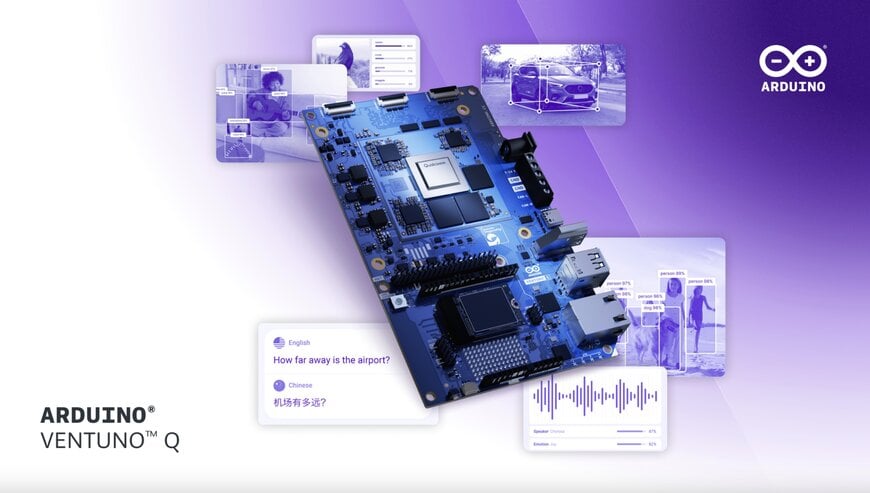
Arduino has announced the VENTUNO Q platform ahead of Embedded World, expanding its hardware portfolio with a development board designed for edge artificial intelligence and real-time control applications. The platform integrates high-performance AI processing with deterministic control functions to support robotics, machine vision and autonomous systems operating directly at the edge.
Dual-Architecture for AI and Real-Time Tasks
VENTUNO Q employs a dual-processor architecture combining a Qualcomm Dragonwing IQ8 series processor with an STM32H5 microcontroller. The main processor handles AI inference workloads while the microcontroller manages low-latency control tasks such as motor actuation and sensor response.
The Dragonwing processor includes an NPU capable of delivering up to 40 dense tera operations per second (TOPS) for AI inference workloads. The system also incorporates 16 GB of RAM and expandable storage up to 64 GB, enabling simultaneous execution of multiple AI tasks.
This architecture allows perception, decision-making and physical control to operate on a single embedded platform, reducing system complexity in robotics and automation projects.
Edge AI and Autonomous System Applications
The board is designed to support a range of edge AI scenarios, including fully offline AI agents that process data locally without relying on cloud infrastructure.
Example applications include local voice assistants using embedded large language models, gesture-responsive user interfaces and automated service kiosks with speech recognition and synthesis. In robotics environments, the platform supports applications such as vision-guided robotic arms, service robots capable of identifying and following individuals and autonomous navigation systems based on visual simultaneous localization and mapping (SLAM).
Edge AI vision systems can also use the platform for applications such as automated quality inspection, traffic analysis or safety monitoring using locally executed vision-language models.
Unified Development Environment
VENTUNO Q runs Linux distributions including Ubuntu and Debian on the main processor, while the microcontroller executes Arduino Core on Zephyr OS to maintain deterministic real-time behavior.
Development is supported through the Arduino App Lab environment, which integrates Arduino sketches, Python scripts and pre-trained AI models. The platform provides ready-to-use models for tasks such as speech recognition, gesture detection, pose estimation and object tracking that can run entirely offline using Qualcomm AI Hub.
For developers building custom AI models, the platform integrates with Edge Impulse Studio, enabling dataset management, training and deployment workflows directly within the development environment.
Connectivity and Hardware Integration
The board includes industrial-grade interfaces such as CAN-FD, PWM outputs and high-speed GPIO to support physical control systems. It also offers high-speed connectivity for MIPI-CSI cameras, displays, advanced audio devices and 2.5 Gb Ethernet networking.
VENTUNO Q supports ROS 2 workflows for robotics development and maintains compatibility with existing hardware ecosystems. It can operate with Arduino UNO shields, Modulino nodes, Qwiic sensors and Raspberry Pi HATs, providing flexibility for developers building complex edge AI prototypes.
By combining AI acceleration, real-time control and broad hardware compatibility, VENTUNO Q aims to provide a development platform for embedded systems where perception and actuation must operate together in real time.
Edited by Industrial Journalist, Romila DSilva – AI Powered
