
electronics-journal.com
05
'26
Written on Modified on
Arrow Electronics and Infineon Launch High Power Motor Control Solution
Arrow Electronics and Infineon introduce a 240W USB-C reference design, streamlining development for battery-powered motor applications with advanced power delivery and integrated control features.
www.arrow.com
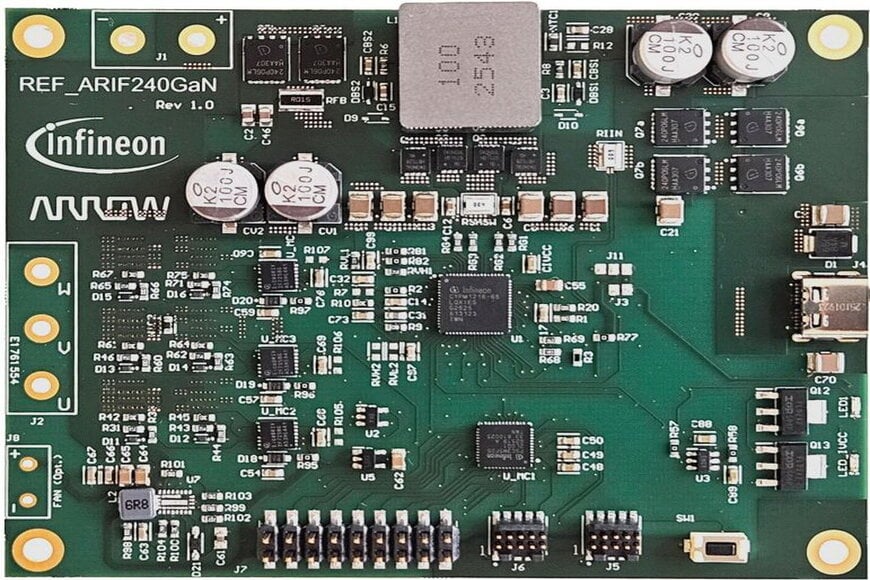
This reference design provides a standardized blueprint for integrating the USB Power Delivery (PD) 3.1 Extended Power Range (EPR) specification into industrial and consumer hardware. By enabling up to 240W of power delivery at 48V and 5A through a single USB-C interface, the solution allows engineers to replace proprietary barrel connectors and bulky AC adapters in high-power applications such as power tools, light electric vehicles (LEVs), and robotic systems.
Advancing the Automotive and Industrial Data Ecosystem
The collaboration addresses the growing requirement for interoperability within the digital supply chain by moving toward a universal charging standard. Historically, high-power systems requiring more than 100W were limited by legacy USB protocols, necessitating dedicated power supplies. The new reference design utilizes the EPR specification to bridge this gap, offering a scalable architecture for the automotive data ecosystem where standardized 48V power rails are becoming more common.
The hardware implementation centers on the Infineon EZ-PD PMG1-S3 high-voltage microcontroller. This SoC (System on Chip) integrates a USB-C PD controller, a buck-boost battery charge controller, and an ARM Cortex-M0 processor. By consolidating these functions, the design reduces the Bill of Materials (BOM) and physical footprint, which is critical for compact motor-driven devices.
Technical Performance and Implementation Features
The 240W sink reference design (REF_ARIF240WS3) is engineered to operate in tandem with the Infineon source evaluation board (REF_XDPS2222_240W1). The source-side architecture employs a hybrid flyback (HFB) topology and CoolGaN power transistors to achieve a power density of 25W/in³ and a peak efficiency of 95.92%.
To ensure safety and reliability in high-voltage motor applications, the design incorporates several hardware-based protection mechanisms:
- Voltage Regulation: Supports Adjustable Voltage Supply (AVS) mode, allowing for 100mV increments above 15V to precisely match battery charging profiles.
- Fault Management: Features integrated overvoltage, overcurrent, and short-circuit protection at both input and output stages.
- Sensing and Control: Includes two SAR ADCs for real-time monitoring of battery voltage and charge current, alongside integrated gate drivers for four N-FETs in the buck-boost stage.
Application and Industry Impact
This technology was demonstrated at Embedded World 2024. The primary application areas include the electrification of gardening equipment, vacuum cleaners, and e-bikes. By adopting this reference design, manufacturers can leverage the universal nature of USB-C, reducing electronic waste and simplifying the end-user experience through a single-charger ecosystem for multiple high-performance devices.
Comparative Technical Standards
Compared to the previous USB PD 3.0 standard, which capped power delivery at 100W (20V at 5A), the 3.1 EPR standard nearly doubles the available wattage by increasing the maximum voltage to 48V. While alternative high-power charging protocols exist—such as proprietary laptop charging standards or specialized industrial DC connectors — the USB PD 3.1 standard provides an open, cross-manufacturer benchmark that ensures electrical safety through the BMC (Biphase Mark Coding) communication protocol, which is not present in basic DC barrel jack systems.
www.arrow.com
This technology was demonstrated at Embedded World 2024. The primary application areas include the electrification of gardening equipment, vacuum cleaners, and e-bikes. By adopting this reference design, manufacturers can leverage the universal nature of USB-C, reducing electronic waste and simplifying the end-user experience through a single-charger ecosystem for multiple high-performance devices.
Comparative Technical Standards
Compared to the previous USB PD 3.0 standard, which capped power delivery at 100W (20V at 5A), the 3.1 EPR standard nearly doubles the available wattage by increasing the maximum voltage to 48V. While alternative high-power charging protocols exist—such as proprietary laptop charging standards or specialized industrial DC connectors — the USB PD 3.1 standard provides an open, cross-manufacturer benchmark that ensures electrical safety through the BMC (Biphase Mark Coding) communication protocol, which is not present in basic DC barrel jack systems.
www.arrow.com
