
electronics-journal.com
04
'26
Written on Modified on
Micron Launches World’s First High Capacity 256GB LPDRAM SOCAMM2 Module
The industry's first 32Gb LPDDR5X die enables 1.33x more capacity, 2.3x faster LLM inference, and 3x better efficiency while significantly reducing power and footprint.
www.micron.com
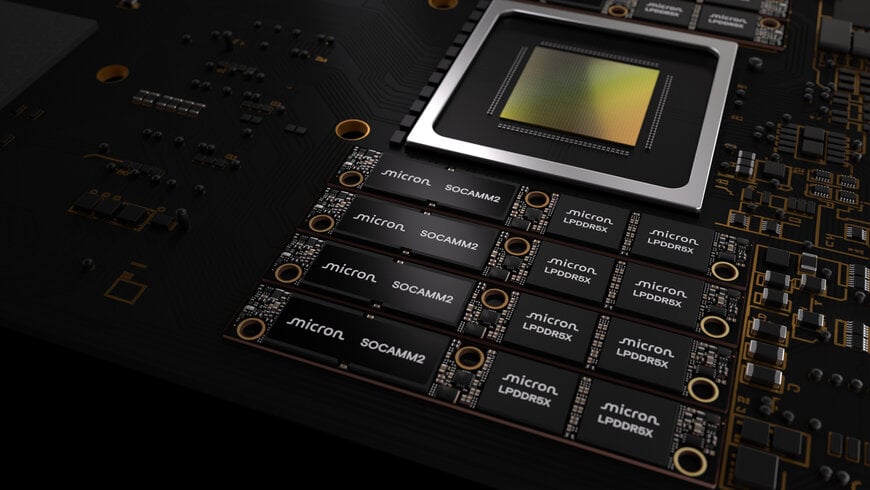
The development of large language models and intensive data processing requires memory solutions that balance high capacity with strict power and thermal constraints. Micron Technology has introduced a 256GB SOCAMM2 (Server Compression Attached Memory Module) based on a monolithic 32Gb LPDDR5X die. This architecture is designed to address the increasing demands of the digital supply chain for data center efficiency, specifically targeting AI inference, training, and general-purpose compute applications where space and energy consumption are critical factors.
Technical Performance and Efficiency Metrics
The 256GB SOCAMM2 achieves a 33% increase in capacity compared to previous 192GB modular solutions. In 8-channel server configurations, this allows for a total of 2TB of LPDRAM per CPU. Beyond density, the module provides measurable improvements in energy utilization and physical footprint.
Technical evaluations indicate that the SOCAMM2 consumes one-third of the power required by equivalent RDIMMs while occupying only one-third of the physical area (14x90mm). These reductions allow for higher rack density and improved airflow in data centers, which is particularly relevant for the adoption of liquid-cooled server architectures.
Optimization for AI Inference and HPC
The integration of LPDRAM into server architectures directly impacts the performance of Large Language Models (LLMs). Internal testing using the Llama3 70B model with a 500K context length demonstrated that 256GB SOCAMM2 improves time to first token (TTFT) by 2.3 times compared to standard configurations. This improvement stems from more efficient handling of key-value (KV) cache offloading in unified memory architectures.
For high-performance computing (HPC) applications, the technology delivers a three-fold increase in performance-per-watt over mainstream memory modules. According to Ian Finder, head of Product for Data Center CPUs at NVIDIA, this level of optimization is necessary to maximize efficiency for AI reasoning workloads that require massive bandwidth within limited power envelopes.
Standardized Modular Architecture
The transition to SOCAMM2 represents a shift toward modularity in low-power server memory, which traditionally relied on soldered-down components. By following JEDEC standards, the modular design enhances serviceability and allows for future capacity scaling without requiring motherboard replacements.
The current portfolio offered by Micron spans 8GB to 64GB components and 48GB to 256GB SOCAMM2 modules. This range supports a variety of deployment scales, from edge computing to hyper-scale data centers, ensuring that the automotive data ecosystem and other data-intensive industries can maintain performance targets while reducing total cost of ownership (TCO).
Competitive Benchmarks
When compared to standard DDR5 RDIMM solutions, the LPDDR5X-based SOCAMM2 offers a distinct advantage in power-to-performance ratios for specific data center workloads. While RDIMMs remain a standard for certain high-bandwidth applications, the SOCAMM2 is positioned as the primary solution for environments where thermal management and energy efficiency are the prioritized constraints. The use of the monolithic 32Gb die allows for this capacity increase without the latency penalties often associated with complex multi-die stacking in traditional DRAM modules.
www.micron.com
