
electronics-journal.com
04
'26
Written on Modified on
AI-RAN Workflow Integrates Training and Validation
Keysight, Samsung Electronics and NVIDIA demonstrate an end-to-end AI-driven radio access network testing workflow at Mobile World Congress 2026.
www.keysight.com
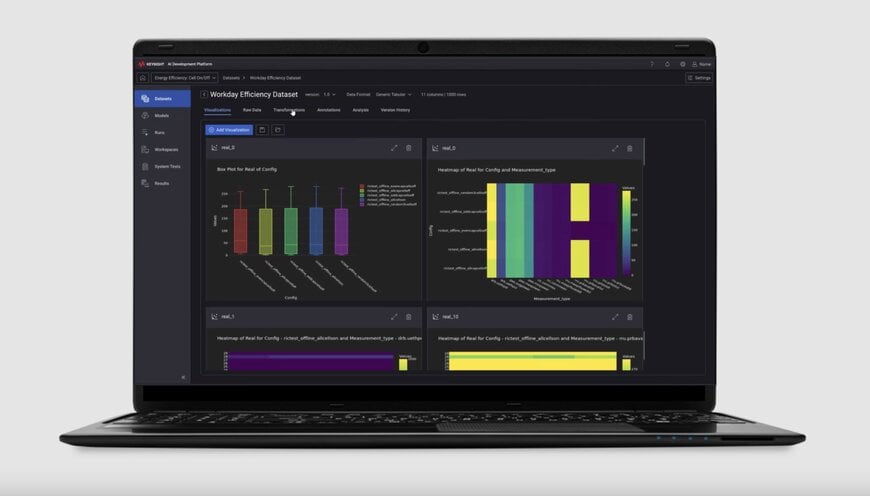
Keysight Technologies, Samsung Electronics and NVIDIA are demonstrating an end-to-end Artificial Intelligence Radio Access Network (AI-RAN) validation workflow at Mobile World Congress 2026 in Barcelona. The demonstration integrates data generation, AI/ML model training and performance benchmarking into a unified testing framework designed to accelerate development and deployment of AI-enabled radio access networks.
AI Validation Challenges in the Radio Access Network
As artificial intelligence becomes embedded in radio access network (RAN) functions, validating algorithms across diverse network conditions becomes increasingly complex. Engineers must assess AI performance across varying propagation environments, traffic patterns and device behaviors.
In many development pipelines, data generation, model training and validation occur in separate environments. This fragmentation complicates reproducibility and makes it difficult to compare algorithm performance prior to deployment. The challenge is particularly significant for physical-layer tasks such as channel estimation, which directly influence throughput, reliability and user experience.
The demonstration focuses on a Physical Uplink Shared Channel (PUSCH) channel estimation use case. PUSCH channel estimation plays a critical role in determining uplink signal quality and enabling efficient resource allocation within the RAN.
Integrated AI-RAN Simulation Workflow
Keysight’s AI-RAN Simulation Toolset addresses these challenges by orchestrating a unified workflow for dataset generation, AI/ML training and benchmarking. The platform automates realistic scenario generation and enables engineers to test AI-driven RAN modules in repeatable laboratory environments.
The integrated approach allows consistent comparison of model architectures and training strategies while providing measurable insights into performance improvements. By combining simulation and benchmarking within a single environment, engineers can evaluate AI algorithms before deploying them in live networks.
Collaboration Across Compute and Radio Platforms
The demonstration integrates Keysight’s toolset with the NVIDIA Aerial Testbed, an over-the-air AI-RAN research environment. The system operates on accelerated computing platforms including NVIDIA GH200 and NVIDIA DGX Spark infrastructure.
A digital twin of the network environment is provided through the NVIDIA Aerial Omniverse platform, which models wireless network behavior and enables realistic simulation scenarios. Commercial radio hardware, including Analog Devices’ Titan Open Radio Unit (O-RU), is used to validate AI-driven RAN behavior in controlled conditions.
AI/ML models used in the demonstration were developed jointly by Samsung, NVIDIA and Keysight. These models are trained and benchmarked within the unified workflow to generate reproducible performance metrics.
Toward Scalable AI-Native Networks
The demonstration illustrates how integrated testing environments can support scalable adoption of AI within the RAN. By combining realistic scenario generation, AI training and repeatable benchmarking, the workflow helps operators and infrastructure vendors evaluate new algorithms while reducing deployment risk.
As wireless networks evolve toward AI-native architectures and future 6G systems, such integrated validation frameworks are expected to play a critical role in ensuring reliable and predictable performance across increasingly complex radio environments.
www.keysight.com
