
electronics-journal.com
02
'26
Written on Modified on
Edge AI Vision Platforms for Multi-Camera Systems
e-con Systems presents edge AI and multi-camera vision technologies for robotics, mobility, and industrial applications at NVIDIA GTC 2026 and Embedded World 2026.
www.e-consystems.com
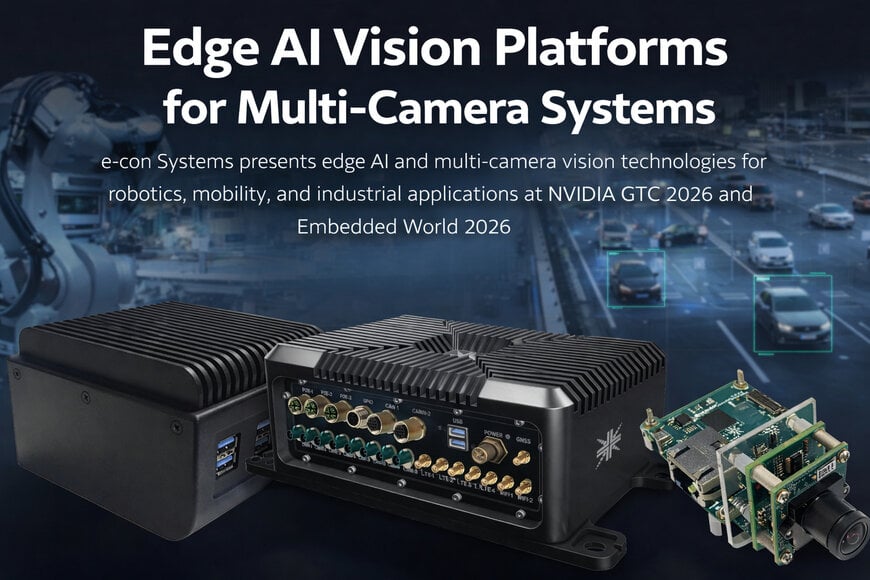
e-con Systems will demonstrate integrated edge AI vision platforms featuring synchronized multi-camera streaming, 3D depth sensing, and AI-based analytics at NVIDIA GTC 2026 (March 16–19, San Jose, USA) and Embedded World 2026 (March 10–12, Nuremberg, Germany). The technologies target robotics, intelligent transportation systems, industrial automation, and other embedded vision deployments requiring real-time perception and scalable device management.
Event Context and Demonstration Platforms
NVIDIA GTC will take place March 16–19, 2026, in San Jose, USA, where e-con Systems will exhibit at Booth #3119. Embedded World is scheduled for March 10–12, 2026, in Nuremberg, Germany, with demonstrations hosted at Hall 2, Booth #2-111 (QUAD GmbH).
At both events, the company will present live demonstrations focused on real-time AI vision processing, multi-sensor integration, and edge-based analytics designed for deployment-ready embedded systems.
Multi-Camera Edge AI Processing Architecture
The multi-camera demonstration features synchronized streaming from eight HDR GMSL cameras combined with AI inference running on an edge computing platform.
Key technical elements include:
- Real-time synchronization across eight high dynamic range (HDR) GMSL camera inputs, supporting deterministic multi-sensor capture for robotics and mobility systems.
- High-resolution 3D depth sensing using a continuous-wave indirect time-of-flight (iToF) camera based on the onsemi AF0130 sensor architecture.
- AI-based analytics executed at the edge for robotics perception and autonomous navigation use cases.
- Cloud-enabled device management to support remote configuration and fleet-level monitoring within a digital supply chain.
By combining synchronized RGB and depth inputs, the system demonstrates multi-sensor fusion workflows required for obstacle detection, object tracking, and spatial mapping in dynamic environments. Edge processing reduces latency compared to cloud-only architectures and enables operation in bandwidth-constrained or safety-critical scenarios.
Holoscan-Based Vision for Intelligent Transportation
A second demonstration integrates a Holoscan-compatible camera platform with generative AI–enabled video analytics for intelligent transportation systems (ITS). The system is designed to process high-throughput video streams locally while enabling advanced inference pipelines such as anomaly detection and traffic behavior analysis.
Such architectures support ITS deployments where real-time decision-making—such as congestion monitoring or incident detection—must occur at the edge to meet latency and reliability constraints within an automotive data ecosystem.
Robotics Computing Platform for AI Vision Development
The robotics computing platform on display combines camera modules, edge AI compute, and system-level integration into a unified development environment. The objective is to reduce integration complexity when transitioning from prototype to production in robotics and industrial automation.
By providing pre-integrated camera interfaces—including Time-of-Flight, MIPI, GMSL, USB, stereo, GigE, HDR, and low-light variants—the platform addresses heterogeneous sensor requirements typical of industrial robotics, autonomous mobile robots (AMRs), and inspection systems.
According to Suresh Madhu, BU Head – Mobility at e-con Systems, the approach centers on scalable AI vision deployment through combined camera design, edge compute, and end-to-end integration with NVIDIA platforms. The focus is on deployment-ready architectures capable of operating in field environments rather than laboratory prototypes.
Industry Applications and Deployment Scope
e-con Systems develops embedded vision solutions spanning custom OEM cameras and complete ODM platforms. Its technologies are deployed across mobility, industrial automation, medical imaging, retail analytics, agriculture, and smart city infrastructure.
The company reports more than 20 years of experience in embedded vision development, with over 350 customer products integrating its camera technologies and more than 2 million cameras shipped to markets including the United States, Europe, Japan, and South Korea.
The demonstrations at NVIDIA GTC 2026 and Embedded World 2026 illustrate how synchronized multi-camera systems, depth sensing, and edge AI analytics can be combined into scalable perception architectures suited for robotics, transportation, and industrial machine vision environments.
www.e-consystems.com
Holoscan-Based Vision for Intelligent Transportation
A second demonstration integrates a Holoscan-compatible camera platform with generative AI–enabled video analytics for intelligent transportation systems (ITS). The system is designed to process high-throughput video streams locally while enabling advanced inference pipelines such as anomaly detection and traffic behavior analysis.
Such architectures support ITS deployments where real-time decision-making—such as congestion monitoring or incident detection—must occur at the edge to meet latency and reliability constraints within an automotive data ecosystem.
Robotics Computing Platform for AI Vision Development
The robotics computing platform on display combines camera modules, edge AI compute, and system-level integration into a unified development environment. The objective is to reduce integration complexity when transitioning from prototype to production in robotics and industrial automation.
By providing pre-integrated camera interfaces—including Time-of-Flight, MIPI, GMSL, USB, stereo, GigE, HDR, and low-light variants—the platform addresses heterogeneous sensor requirements typical of industrial robotics, autonomous mobile robots (AMRs), and inspection systems.
According to Suresh Madhu, BU Head – Mobility at e-con Systems, the approach centers on scalable AI vision deployment through combined camera design, edge compute, and end-to-end integration with NVIDIA platforms. The focus is on deployment-ready architectures capable of operating in field environments rather than laboratory prototypes.
Industry Applications and Deployment Scope
e-con Systems develops embedded vision solutions spanning custom OEM cameras and complete ODM platforms. Its technologies are deployed across mobility, industrial automation, medical imaging, retail analytics, agriculture, and smart city infrastructure.
The company reports more than 20 years of experience in embedded vision development, with over 350 customer products integrating its camera technologies and more than 2 million cameras shipped to markets including the United States, Europe, Japan, and South Korea.
The demonstrations at NVIDIA GTC 2026 and Embedded World 2026 illustrate how synchronized multi-camera systems, depth sensing, and edge AI analytics can be combined into scalable perception architectures suited for robotics, transportation, and industrial machine vision environments.
www.e-consystems.com
