
electronics-journal.com
25
'26
Written on Modified on
ADAS SoC Integrates Sensor Fusion in SUV Platform
Renesas Electronics Corporation supplies R-Car V4H to Denso for Toyota’s RAV4 TSS(LSS) control unit, enabling integrated camera, radar and driver monitoring functions.
www.renesas.com
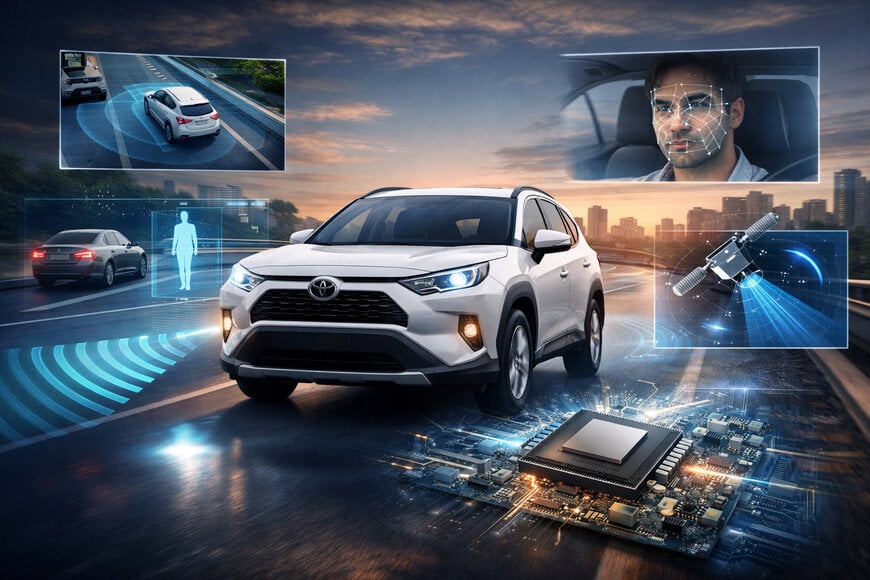
Renesas Electronics Corporation has announced that its R-Car V4H automotive system-on-chip (SoC) has been selected for the TSS (LSS) advanced driver assistance control unit in the new Toyota RAV4. The control unit is supplied by Denso Corporation. The integration positions the SoC at the center of camera, radar and in-cabin sensing tasks within the vehicle’s ADAS architecture.
Centralized ADAS Processing for Sensor Fusion
The R-Car V4H is designed for advanced driver assistance systems that require real-time processing of multiple sensor inputs. In the RAV4 implementation, the device performs front-camera image processing using on-chip image recognition capabilities, including AI-based neural network inference. The processed visual data are fused with radar inputs to support object detection functions such as identifying vehicles, pedestrians and other road obstacles.
This sensor fusion approach reduces latency between perception and actuation by consolidating workloads onto a single automotive-grade SoC. For OEMs and Tier 1 suppliers, such consolidation can simplify ECU design, reduce wiring complexity and support a more scalable automotive data ecosystem across vehicle platforms.
3D Surround View and Parking Assistance
For low-speed maneuvering and parking scenarios, the SoC’s integrated GPU renders real-time 3D panoramic images generated from four external cameras positioned at the front, rear and sides of the vehicle. The system combines camera feeds with ultrasonic sensor data to identify parking spaces and analyze surrounding obstacles.
By handling image stitching, spatial mapping and object recognition on a single chip, the architecture supports advanced park-assist functions without requiring separate graphics processors. This integration is particularly relevant in compact SUV platforms, where packaging constraints and cost optimization are critical.
In-Cabin Driver Monitoring
In addition to exterior sensing, the R-Car V4H processes in-cabin camera data to monitor driver condition. Driver monitoring functions typically analyze facial orientation, eye movement and attentiveness using neural-network-based image recognition. Integrating this workload into the same ADAS SoC enables coordinated safety strategies between external hazard detection and driver state awareness.
Role in Toyota Safety Sense Architecture
The SoC is deployed within Toyota’s TSS (LSS) control unit, forming part of the vehicle’s broader safety architecture. By combining front-camera processing, radar fusion, surround-view rendering and driver monitoring on a unified computing platform, the design supports higher levels of functional integration in modern ADAS systems.
Renesas stated that the R-Car V4H is engineered to run multiple ADAS workloads efficiently within a single device. In the RAV4, this approach enables coordinated perception across sensors while maintaining the performance required for real-time safety applications.
The adoption of the R-Car V4H in a high-volume SUV platform illustrates the ongoing shift toward centralized, high-performance automotive processors that underpin next-generation driver assistance and safety systems.
www.renesas.com
