
electronics-journal.com
23
'26
Written on Modified on
Toshiba Unveils New Stepper Motor Driver with Advanced Microstep Technology
Toshiba's new driver IC also features ADMD for higher speed, plus overcurrent, thermal, and stall detection to ensure motor safety and prevent system damage.
www.global.toshiba
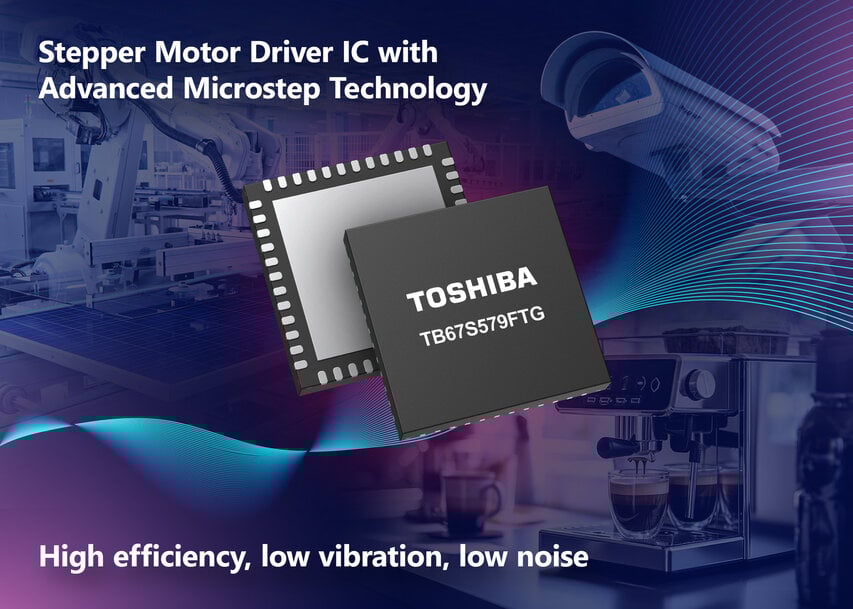
Toshiba Electronics has introduced the TB67S579FTG stepping motor driver IC, a next-generation semiconductor component designed to improve stepper motor performance in a range of consumer and industrial automation applications. The device’s combination of constant current control and Advanced Microstep Technology addresses vibration, noise, and integration challenges common in precision motor systems.
Enhanced Motor Control for Consumer and Industrial Equipment
The TB67S579FTG represents a technical advance in stepper motor driver ICs by employing multiple new control mechanisms—Continuous Microstepping, Automatic Wave Generation System (AWGS), and second-generation Active Gain Control (AGC2)—to increase operational efficiency and refine motion quality in two-phase bipolar motors. This integration offers high efficiency, lower vibration, and reduced acoustic noise, particularly at low rotational speeds, which are typical demand points in office and factory automation devices. The device targets office equipment such as printers and scanners, as well as industrial and commercial goods including surveillance systems, projectors, automated teller machines, 3D printers, and sewing machines.
Continuous Microstepping improves waveform smoothness by generating a near-sinusoidal drive current from a single clock input, reducing the need for high clock frequencies traditionally required for fine step resolution. AWGS enables seamless transitions between full-step and microstep modes without adjusting control signals, lowering the processing burden on host controllers. AGC2 dynamically adjusts drive current based on induced motor voltage to match load conditions, reducing power consumption under light loads and improving overall system efficiency.
Technical Characteristics and System Integration
The TB67S579FTG supports a single motor supply voltage range from 4.5 V to 34 V and features an integrated charge pump circuit and Advanced Current Detection System (ACDS), which eliminates the need for external current sense resistors. The integrated output stage has a typical on-resistance (RDS(ON)) of 0.6 Ω, supporting constant current operation up to 2.0 A. In sleep mode the device draws up to 1 mA, aiding power efficiency in intermittent-use systems. The inclusion of comprehensive protection functions—overcurrent, thermal shutdown, under-voltage lockout, and stall detection—enhances reliability in demanding applications. Housed in a compact 7.0 mm × 7.0 mm VQFN48 package, the driver facilitates board-area reduction and cost savings through a reduced bill of materials.
Relevance to Motor Control and Supply Chain Considerations
Stepper motors are widely used where precise position control is necessary without feedback encoders. By integrating advanced control features and reducing external component count, the TB67S579FTG enables designers to simplify system architecture and improve manufacturability. In the context of a broader digital supply chain for motor-driven products, components with higher integration and predictable performance reduce design variability and improve consistency across production batches, supporting quality and cost objectives in automated manufacturing environments.
Toshiba’s expansion of its motor driver IC lineup with this advanced stepper driver reflects ongoing industry demand for semiconductor solutions that balance performance, power efficiency, and integration, particularly as devices in consumer and industrial markets incorporate greater automation and motion control functionality.
www.global.toshiba
