
electronics-journal.com
10
'25
Written on Modified on
Toshiba introduces new 40V eFuse protection ICs
The expanded eFuse lineup supports wide-range power systems with integrated overcurrent, overvoltage, and thermal protection to simplify circuit design in industrial and consumer equipment.
www.global.toshiba
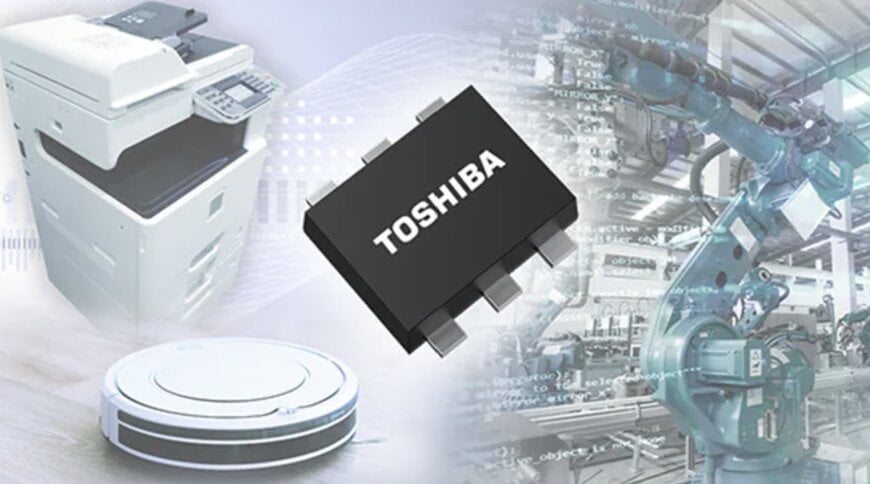
Electronic fuses (eFuses) are widely used in power management circuits for industrial equipment, consumer devices, and other systems operating at 5V, 9V, 12V, or 24V. They replace traditional physical fuses when designers require fast response to abnormal operating conditions, circuit-level intelligence, or the integration of multiple protection features within a compact footprint. Toshiba Electronic Devices & Storage Corporation has expanded its eFuse offering with the 40V TCKE6 series, which includes five new variants: TCKE601RA, TCKE601RL, TCKE602RM, TCKE603RA, and TCKE603RL.
Protection Functions Beyond Mechanical Fuses
While mechanical fuses provide a fixed-response short-circuit cutoff, eFuse ICs add functional layers that help protect downstream components from electrical stress. The TCKE6 series includes programmable current limiting and overvoltage protection, enabling the device to restrict current flow or disconnect the circuit when input conditions exceed preset limits. This prevents excessive current or voltage from reaching sensitive ICs during fault events.
Thermal protection is integrated as well. When abnormal heat generation or a sudden short-circuit is detected, the device shuts down before temperatures rise to levels that could damage the system. These capabilities exceed the behavior of physical fuses*, which cannot actively regulate current or respond to thermal events in real time.
Design Efficiency Through Integration
A key advantage of this eFuse technology is circuit simplification. Multiple protection functions are combined into a single component, reducing the number of discrete devices required on the board. For engineers working with limited space, the TSOP6F package—measuring 2.9 × 2.8 mm (typ.)—helps decrease overall board area and supports compact power distribution designs.
The devices operate across a wide 4.4V to 30V input range and carry a 40V rating, making them suitable for standard low- to mid-voltage supply rails. With a typical on-resistance of 52 mΩ, conduction losses remain low, which supports system-level efficiency in continuous operation.
Functional Variants for System-Level Flexibility
The TCKE6 series offers options tailored to different power management strategies. Some versions include a FLAG output that reports abnormal conditions, allowing microcontrollers or system monitors to detect faults. Others incorporate an EN (enable) pin for controlling device operation. Each function type is available in auto-retry versions, which restore operation automatically after a fault, and latched versions, which require an external reset signal. One variant includes no FLAG or EN pins but allows external mode switching between the two recovery types. These choices help engineers align protection behavior with equipment size and system architecture.
Expanding Protection in Power Electronics
With the addition of the TCKE6 series, Toshiba broadens its portfolio of eFuse ICs designed for equipment requiring compact layouts and robust circuit protection. The series supports designers building efficient and reliable power distribution networks in both industrial and consumer applications.
*Glass tube fuse, chip current fuse, etc.
www.toshiba.com
