
electronics-journal.com
19
'26
Written on Modified on
High-Temperature MEMS Accelerometer for Downhole Drilling Navigation
TDK's AXO315T accelerometers from Tronics Microsystems deliver closed-loop inclination measurement up to 175 °C for measurement while drilling and directional drilling tools.
www.tdk.com
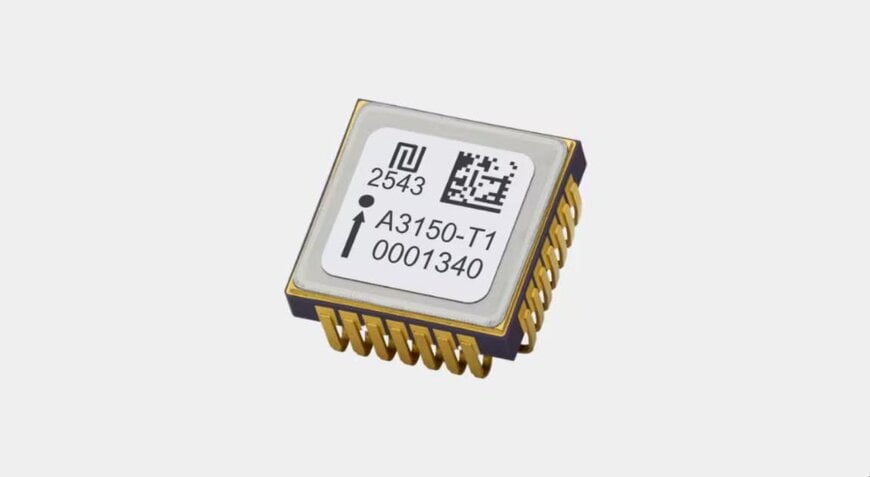
Directional drilling depends on knowing the exact position and orientation of the drilling assembly deep below ground, often in conditions where temperatures exceed 150 °C and drilling motors generate continuous vibration and mechanical shock. TDK has introduced the AXO315T series of high-temperature MEMS accelerometers for measurement while drilling (MWD), logging while drilling (LWD), directional drilling and wireline operations, with further use in energy, industrial and transportation markets.
The Navigation Challenge in Directional Drilling
Wells increasingly follow complex trajectories to reach precise targets or bypass formations that cannot be drilled vertically, and geothermal development is adding to this demand. MWD systems provide real-time inclination and orientation data, but accelerometer errors distort the calculated tool orientation and can require corrections or make targets harder to reach. Quartz accelerometers and fibre optic gyros offer high accuracy but are often expensive, bulky, largely analogue and more sensitive to shock and vibration. Because retrieving failed downhole components costs rig time, designers weigh size, weight, power, durability, integration effort and cost alongside accuracy.
Closed-Loop MEMS Architecture
MEMS sensors combine microscopic mechanical structures with semiconductor manufacturing to detect acceleration and motion, offering low size, weight and power (SWaP) and easy digital integration. The AXO315T series, marketed by Tronics Microsystems, TDK's group specialist for high-performance MEMS inertial sensors, uses a closed-loop force-feedback design. Instead of measuring the free deflection of a proof mass, the sensor applies a restoring force that keeps the mass near its rest position, which maintains stability under heavy vibration. TDK states that this reduces vibration rectification error (VRE) by a factor of 10 compared with conventional open-loop MEMS accelerometers.
"Our MEMS inertial sensors are known to provide extremely precise and stable acceleration measurement for dynamic systems operating under severe vibrations and shocks," said Pierre Gazull, Product Marketing Manager at Tronics Microsystems.
Technical Specifications
Two versions are available: the AXO315T0 for operation from –30 °C to +150 °C and the AXO315T1 with an upper limit of +175 °C. Both are single-axis accelerometers with a ±14 g range for precise inclination measurement. They are rated for more than 1,000 hours of powered operation at maximum rated temperature, measure approximately 12 × 12 × 5.5 mm and provide a 24-bit digital SPI interface.
Integration in MWD Directional Modules
Within an MWD directional module, accelerometers operate together with other sensors to determine the position and orientation of the drilling assembly. Lower VRE yields more reliable inclination data near motors and other vibration sources, while long operating life at temperature reduces the risk of interventions caused by component failure. The small footprint and digital output give tool designers more space and simplify electronics design.
Additional Context
This section details technical specifications and competitive benchmarking not included in the original product announcement.
Downhole directional sensor packages conventionally combine three orthogonal accelerometers with magnetometers or gyroscopes to calculate inclination, azimuth and toolface. Quartz-flexure servo accelerometers have long been the reference technology in MWD tools because of their bias stability, and they also use a closed-loop servo principle; MEMS devices compete on size, power consumption and digital integration. Vibration rectification error is a key parameter in drilling, because asymmetric responses to vibration produce a DC offset that the tool interprets as a change in inclination.
Edited by Evgeny Churilov, Induportals Media - Adapted by AI.
www.tdk.com
