
electronics-journal.com
18
'26
Written on Modified on
ams OSRAM Advances Digital Photonics to Enable Compact, Low-Power AI and AR Smart Glasses
The optical solutions provider integrates eye-safety protection directly into infrared LED drivers while combining color sensing and high-brightness MicroLED projection to accelerate next-generation wearable designs.
ams-osram.com
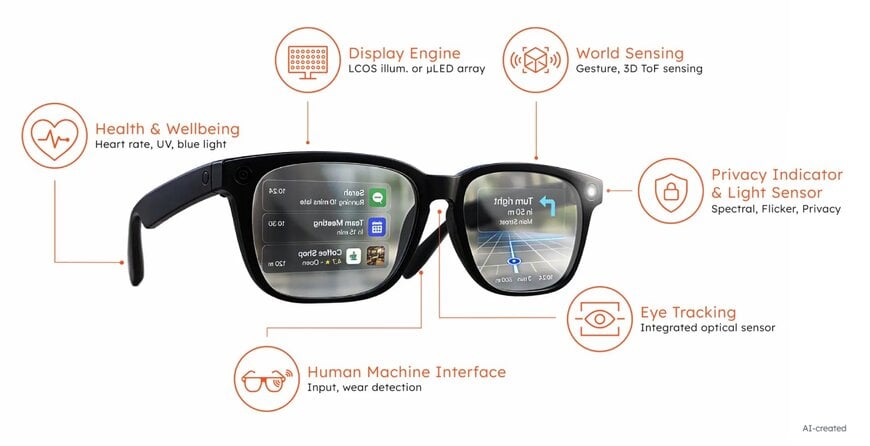
Wearable technology developers designing next-generation artificial intelligence (AI) and augmented reality (AR) smart glasses face severe power, thermal, and spatial constraints. Unlike early smart eyewear limited to simple voice interfaces, modern AI glasses maintain continuous links to agentic AI models, while AR glasses render world-locked, high-brightness visual overlays across near-to-eye displays. Fitting complex optical tracking, environmental sensors, and projection engines into lightweight, stylish consumer frames without sacrificing all-day battery life remains a primary engineering bottleneck. Traditionally, implementing eye-tracking illumination required discrete over-current protection (OCP) circuits and external processor monitoring to satisfy strict ocular safety limits, consuming valuable printed circuit board space and increasing component counts. Resolving these hardware constraints requires highly integrated digital photonics platforms that unite light emitters, optical sensors, power management, and safety logic onto compact, chip-scale packages.
Integrated Eye-Tracking Safety and Reference Architectures
To minimize component footprint and simplify compliance with international photobiological and laser eye-safety standards (such as IEC/EN 62471 and IEC 60825-1), ams OSRAM integrated fault-monitoring and automatic shutdown logic directly into its AS1181 infrared LED driver. Designed to pair with miniature infrared emitters such as the SFH4030B, the AS1181 provides eight 65 mA LED channels within a 2.85 mm by 1.7 mm wafer-level chip-scale package (WLCSP).
Whereas legacy eye-tracking circuits rely on an external discrete OCP switch that signals the main application processor to cut power during a fault, the AS1181 integrates internal fault detection for over-current, open-circuit, and short-circuit events, shutting off LED drive current autonomously. The driver executes a built-in self-test (BIST) at startup and continuously monitors temperature and per-channel forward voltage to compensate for thermal and aging drift, maintaining consistent infrared illumination for gaze detection. Beyond context-aware user interfaces—such as translating specific menu lines or displaying nutritional data for a viewed grocery item—gaze tracking enables foveated display rendering, dimming peripheral pixels and reducing graphics processor workloads to extend battery runtime.
To accelerate commercial adoption, ams OSRAM's AS1181 driver and SFH4030B emitters power Ganzin Technology's Aurora IIS eye-tracking reference design. Featuring synchronized binocular camera driving and daylight-capable tracking, the blueprint supports partner platforms from original design manufacturers including Jorjin and Quanta, alongside smart glasses eye-tracking platforms developed by SeeTrue Technologies.
Ambient Spectral Sensing and MicroLED Near-to-Eye Projection
Across the broader optical stack, ams OSRAM’s digital photonics portfolio supports environmental sensing, camera imaging, and near-to-eye displays:
- Ambient Light and Spectral Sensing: Multi-channel color sensors detect ambient lighting conditions to dynamically calibrate display color balance, brightness, and electrochromic or photochromic lens tinting, while performing tamper detection on camera privacy indicators. Dedicated flicker and spectral sensors optimize white balance and exposure for outward-facing cameras.
- Frame-Integrated Optical Controls: Embedded biosensors track vital signs such as heart rate, ultraviolet (UV) sensors monitor sun exposure, direct time-of-flight (dToF) sensors manage wear detection and hand gestures, and miniature optical force sensors replace mechanical buttons on eyewear temples.
- High-Efficiency Micro-Displays: For AR graphics, ams OSRAM develops MicroLED projection light engines alongside miniature integrated RGB LED and laser modules paired with custom driver ICs, delivering high luminance and precise angular resolution for outdoor legibility on compact batteries.
In near-to-eye optical systems and wearable photobiological safety governed by IEC 62471 (Photobiological Safety of Lamps and Lamp Systems) and IEC 60825-1 (Safety of Laser Products), continuous infrared illumination at 850 nm or 940 nm wavelengths falls within the retinal hazard region (400 nm to 1400 nm), where ocular tissues focus incident radiation onto the retina without triggering a natural human blink reflex. Meeting single-fault safety conditions—such as a shorted current-limiting resistor or driver output stage—requires redundant hardware current clamping or autonomous sub-millisecond hardware shutdowns independent of application processor software hangs. Integrating the OCP switch, forward-voltage telemetry, and BIST diagnostics inside a single WLCSP driver eliminates external MOSFETs and current-sense shunts, reducing total eye-tracking driver board area by over 50 percent compared to discrete protection topologies.
Within the smart eyewear optical component and micro-display ecosystem, ams OSRAM’s end-to-end photonics portfolio benchmarks against specialized component suppliers across distinct layers of the optical stack—including Sony Semiconductor Solutions and OmniVision in low-power global-shutter eye-tracking CMOS image sensors, STMicroelectronics in direct time-of-flight ranging and MEMS laser beam scanning, and Jade Bird Display (JBD) or Plessey Semiconductors in monolithic MicroLED micro-displays. While many suppliers focus exclusively on either silicon image sensors or standalone micro-display panels, ams OSRAM differentiates by supplying matched emitter-and-driver subsystems alongside multi-channel spectral sensors and MicroLED light engines, enabling tier-one consumer electronics brands and ODMs to source pre-validated optical sub-assemblies optimized for sub-50-gram eyewear form factors.
Edited by Romila DSilva, Induportals Editor, with AI assistance.
ams-osram.com
