
electronics-journal.com
13
'26
Written on Modified on
OSM Development Platform Speeds Carrier Board Prototyping
Tria Technologies' OSM-SB-EP5 gives engineers one platform to evaluate interfaces, validate architectures and start software development before custom carrier boards exist.
www.tria-technologies.com
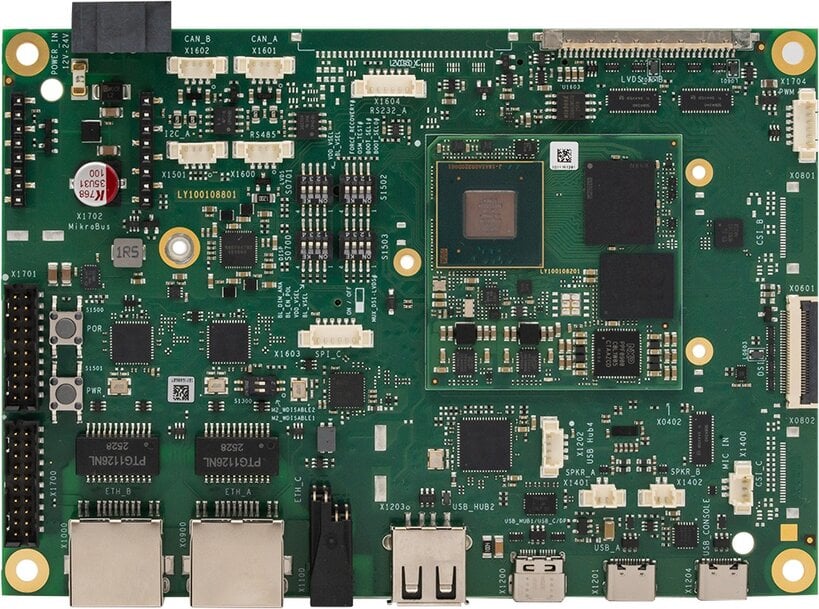
Tria Technologies, an Avnet company specialising in embedded compute modules, has released the OSM-SB-EP5, a development and evaluation platform for embedded systems based on the Open Standard Module (OSM) specification. The platform is being shown for the first time at electronica 2026, held 10–13 November in Munich (Hall B5, Stand 103), and targets engineering teams developing industrial IoT, edge AI, robotics and embedded vision products.
OSM Modules and the Carrier Board Challenge
OSM extends the standardisation of Computer-on-Module (COM) and System-on-Module (SOM) concepts to smaller, higher-volume embedded products in which traditional connector-based modules are too large or too expensive. Products built on OSM modules require an application-specific carrier board, and until that board exists, teams need a way to test interfaces, assess connectivity and begin software work. The OSM-SB-EP5 provides this as a common platform for hardware and software activities.
Interfaces and Expansion
The platform integrates Gigabit Ethernet, USB, CAN FD, RS-485, MIPI CSI-2 camera connectivity and display interfaces. An M.2 expansion slot allows developers to evaluate wireless technologies including Wi-Fi, Bluetooth and cellular solutions, so that different communication options can be compared and application-specific connectivity requirements validated within one development environment.
From Evaluation to Custom Carrier Board
Engineers can use the OSM-SB-EP5 to build working proof-of-concepts and start software development before a custom carrier board is available. The platform then serves as a hardware reference for application-specific carrier boards, allowing validated interface implementations and design concepts to be reused, which reduces development effort and shortens the cycle from prototype to deployable product.
"The OSM-SB-EP5 was designed to help engineering teams accelerate the journey from concept to product," said Harald Maier, Product Marketing Manager at Tria Technologies. "Supporting TRIA OSM modules across Size-S, Size-M and Size-L form factors, the platform enables rapid evaluation, application validation, proof-of-concept development and software bring-up on a single hardware platform. This allows customers to make design decisions earlier, reduce project risk and shorten time-to-market."
Combined with access to Tria's design and manufacturing capabilities, the platform supports customers from evaluation and validation through to scalable production.
Additional Context
This section details technical specifications and competitive benchmarking not included in the original news release.
The Open Standard Module specification is published by the standards body SGET and defines solderable BGA mini modules in four sizes, Size-0, Size-S, Size-M and Size-L, ranging from 30 x 15 mm to 45 x 45 mm. Other OSM suppliers also offer evaluation hardware. F&S Elektronik Systeme provides a starter kit for its FS 8MM OSM-SF module based on the NXP i.MX 8M Mini, consisting of a baseboard, OSM adapter, cable kit, MIPI-DSI to LVDS adapter and a 7-inch LVDS display. TechNexion offers an OSM starter kit for modules based on the Synaptics Astra SL2610 processor, aimed at edge AI prototyping. Both kits are built around a specific module, whereas the OSM-SB-EP5 is designed to support Tria OSM modules across the Size-S, Size-M and Size-L form factors on a single platform.
Edited by Aishwarya Mambet, Induportals Editor, with AI assistance.
www.tria-technologies.com
