
SECO launches Clea 2.0 for Edge AI orchestration
The hardware-agnostic platform enables one-click deployment of AI models across heterogeneous industrial edge devices.
www.secotools.com
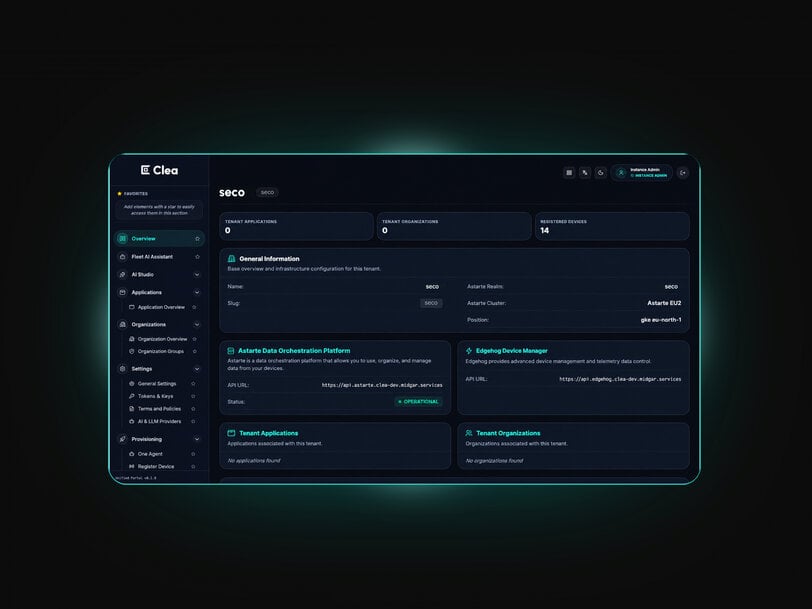
SECO has announced the release of the Clea 2.0 Agentic Framework, a proprietary software platform designed to simplify the deployment of artificial intelligence at the Edge. Aimed at developers, OEMs, and system integrators, the framework provides a unified workflow to deploy, manage, and orchestrate applications across both SECO and third-party devices. This approach streamlines the complex transition from initial AI development and pilot testing to full-scale industrial operations. Early access to the platform is available free of charge until April 30, 2027.
Overcoming deployment fragmentation
Moving Edge AI from proof-of-concept to industrial deployment traditionally involves navigating complex, device-specific configurations and fragmented management tools. Clea 2.0 eliminates this friction by offering one-click deployment of AI applications across heterogeneous hardware architectures. By decoupling the software workflow from the underlying hardware, the platform ensures that organizations can scale their Edge AI initiatives—such as visual quality inspection, operator assistance, or robotics—without needing to maintain separate, siloed deployment pipelines for every different device on the factory floor.
Agentic fleet orchestration and secure governance
A defining capability of Clea 2.0 is its natural-language interaction, powered by a native Model Context Protocol (MCP) server. This allows the system to translate complex, multi-step user requests into coordinated fleet-wide operations. The AI agents operate strictly within defined identity and permission parameters, ensuring complete operational traceability. To govern these deployments securely as fleets grow, the framework integrates advanced administrative controls, including sandbox testing campaigns, multi-tenant isolation, and granular role- and attribute-based access controls (RBAC/ABAC).
Additional Context: Agentic Frameworks and Model Context Protocol (MCP) in IoT
This section details software architectures and AI orchestration dynamics not included in the original press release.
Traditional IoT fleet management relies on rigid API calls, hardcoded scripts, and manual dashboard configurations (typically utilizing protocols like MQTT or REST) to push updates or configure devices. In contrast, an "agentic framework" utilizes AI agents capable of autonomous reasoning and tool use. The Model Context Protocol (MCP) is an emerging standardized architecture that allows Large Language Models (LLMs) to securely connect with external tools, local datasets, and control systems. In an industrial Edge environment, an MCP server acts as a semantic bridge. It can take a natural-language prompt from an engineer—such as, "Deploy the updated defect-detection vision model to all robotic arms in Zone B that have active idle time"—and autonomously translate it into the underlying Kubernetes, Docker, or OTA (Over-The-Air) orchestration commands. This abstraction layer shifts the paradigm from manual DevOps coding to intent-based fleet management, drastically reducing the time and specialized knowledge required to manage highly distributed computing nodes.
Edited by an industrial journalist, Lekshman Ramdas, with AI assistance.
www.seco.com
