
electronics-journal.com
13
'26
Written on Modified on
AI-Native Broadband Network Innovation Platform
Qualcomm Technologies introduces Dragonwing platforms to transform fiber, Wi-Fi 8, and fixed wireless access infrastructure into edge-computed intelligent service environments.
www.qualcomm.com
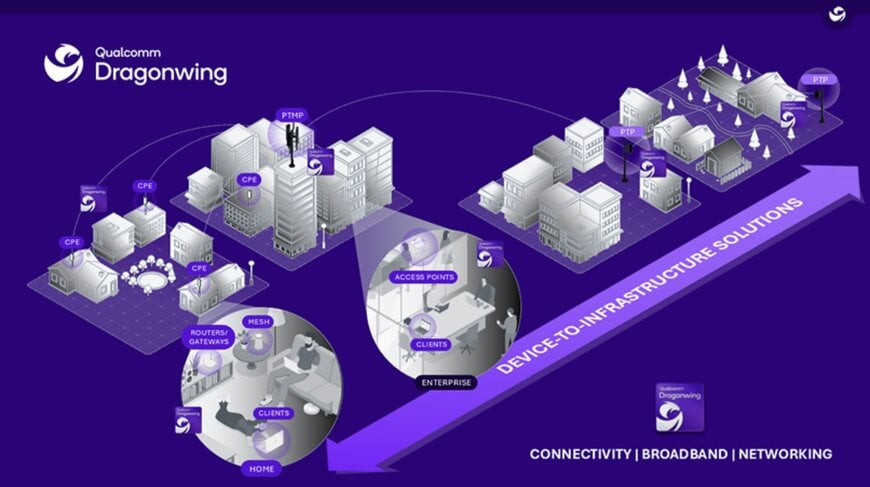
Broadband operators face growing challenges handling concurrent data traffic surges and stringent latency requirements that traditional pipe-expansion methods cannot resolve alone. Distributed smart-home management complexity, active endpoint cybersecurity demands, and heavy reliance on centralized cloud platforms create transmission latency and strain network resources. Addressing these operational challenges requires embedding edge AI inferencing and intelligence directly into broadband gateways and high-capacity wireless transport architectures.
Intelligent Processing Architecture for Gateways
Ahead of the Network X 2026 event, Qualcomm Technologies collaborated with gFiber to demonstrate the gFiber Wi-Fi 8 Premium Gateway powered by the Qualcomm Dragonwing NPro A8 Elite Platform. Engineered to support symmetrical 20 Gbps broadband deployments, the system redefines customer premises equipment by moving inferencing tasks closer to subscribers.
The gateway integrates concurrent quad-band Wi-Fi 8 connectivity, a dedicated Qualcomm Hexagon NPU, and a penta-core CPU. By executing neural processing tasks locally at the edge rather than routing telemetry to remote cloud servers, the platform reduces processing latency, enhances privacy, and provides sufficient compute headroom to run agentic AI models for automated quality-of-experience optimization.
Unified Network Security and Management Framework
To streamline operations across varied device fleets, Qualcomm Technologies developed the Qualcomm Dragonwing Security and Management (SAM) framework. The open software architecture integrates device-level analytics, on-premises security services, and cloud intelligence.
Dragonwing SAM provides deep visibility across subscriber environments to detect performance degradation, automate customer care workflows, and harden device security across the Dragonwing Wi-Fi 8 portfolio. Its open structure allows telecom providers to deploy third-party software and service upgrades without requiring hardware redesigns across deployed silicon.
Fixed Wireless Access and High-Capacity Transport Infrastructure
To extend fiber-class connectivity to areas constrained by cable deployment costs, Qualcomm Technologies showcased the Dragonwing Point-to-Multi-Point (PtMP) and Point-to-Point (PtP) platforms. Operating over licensed spectrum via custom mmWave transceivers, both platforms integrate a TDMA scheduler for deterministic low latency alongside multi-standard frame synchronization to mitigate inter-cell interference in dense topologies.
For subscriber endpoints beyond physical wirelines, the Qualcomm Dragonwing FWA Gen 6 Elite Platform incorporates the Qualcomm X105 5G Modem-RF system. The platform combines 5G Advanced specifications, non-terrestrial network (NTN) satellite connectivity, and tri-band Wi-Fi 8. Supported by the fifth-generation Qualcomm 5G AI Processor, the architecture dynamically adapts radio channel configurations to shifting propagation conditions and RF interference.
Additional Context
This section details technical specifications and competitive benchmarking not included in the original product announcement.
The transition from IEEE 802.11be (Wi-Fi 7) to IEEE 802.11bn (Wi-Fi 8, Ultra High Reliability) marks an architectural shift from maximizing theoretical peak throughput to guaranteeing deterministic latency under congested multi-user conditions. Core Wi-Fi 8 capabilities—such as Coordinated Spatial Reuse (Co-SR) and Coordinated Beamforming (Co-BF) between neighboring access points—focus on curtailing worst-case latency tail spikes below 5 milliseconds during heavy concurrent operation.
In conventional residential broadband architectures driven by GPON or XGS-PON systems, residential gateways typically rely on standardized networking System-on-Chips (SoCs) equipped with software-managed packet acceleration engines. These legacy gateways lack onboard tensor processing units. In contrast, incorporating dedicated neural processing hardware, such as the Hexagon NPU inside the Dragonwing NPro A8 Elite platform, bridges optical transport lines (including ITU-T G.9804-compliant 25G-PON and 50G-PON systems) with local autonomous intelligence capable of running local machine learning inferencing workloads directly on the premises.
Edited by Romila DSilva, Induportals Editor, with AI assistance.
www.qualcomm.com
