
electronics-journal.com
06
'26
Written on Modified on
Low-Power Dual-Channel Digital Isolators for Industrial Control Systems
Toshiba introduces the DCL32xx00 series to enable energy-efficient and secure signal transmission across electrical potential barriers in power conversion and automation architectures.
www.global.toshiba
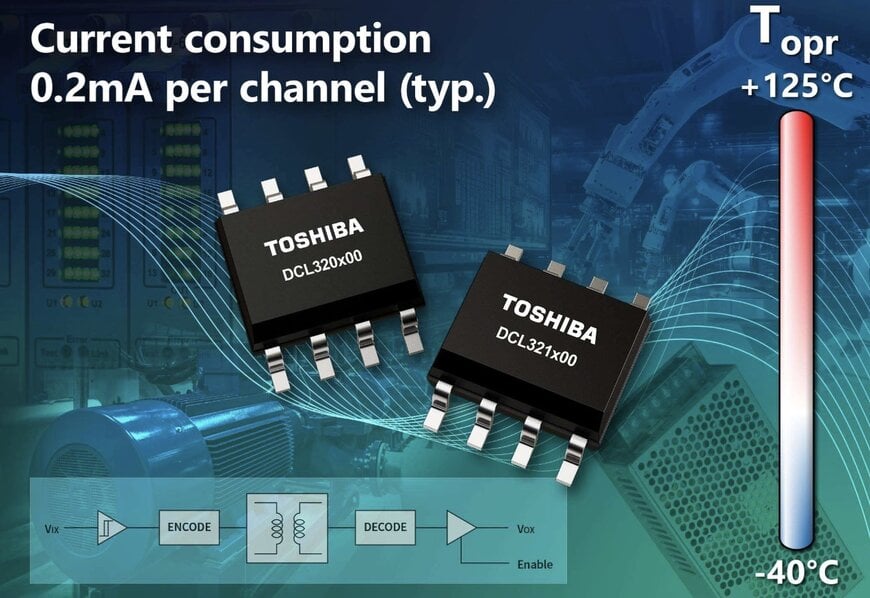
Toshiba Electronics Europe is releasing the DCL32xx00 series of dual-channel digital isolators, components designed to minimize power consumption in industrial control systems and power conversion equipment. The hardware facilitates secure digital signal transmission across circuits operating at differing electrical potentials, addressing spatial and energy constraints in programmable logic controllers (PLCs), inverters, sensors, actuators, and motor control systems.
Magnetic Coupling and Electrical Isolation
Industrial control networks require stable operation despite switching noise and ambient electrical disturbances. The isolators utilize magnetic coupling isolation technology combined with a specialized transmission circuit to maintain signal integrity across voltage barriers. Each device provides a minimum isolation voltage of 3,000 Vrms for 60 seconds and a minimum common-mode transient immunity (CMTI) of 30 kV/µs. This CMTI rating ensures continuous data transmission even during the rapid common-mode voltage fluctuations inherent to factory floors and switching power supplies. The hardware operates within an industrial temperature range of -40 °C to 125 °C and accepts supply voltages from 2.25 V to 5.5 V, allowing direct integration with standard 3.3 V and 5 V logic circuits.
Data Transmission and Configuration Options
To support varying system architectures, the isolators are housed in a standard SOIC8-N package and support maximum data transmission rates up to 25 Mbit/s. At a baseline rate of 1 Mbit/s, the components consume 0.2 mA per channel, reducing the overall thermal output and energy footprint of the host device.
The series offers multiple channel direction configurations to accommodate specific communication protocols. The DCL320C00 and DCL320D00 models provide two forward-direction channels suitable for unidirectional digital signals like I2C communications. Alternatively, the DCL321C00 and DCL321D00 models feature one forward and one return channel. This configuration supports interfaces that require bidirectional transmit and receive paths, such as UART (Universal Asynchronous Receiver/Transmitter) architectures. Furthermore, the C00 and D00 designations allow hardware engineers to select a default output state—either low or high—when the input signal is undefined or floating, such as during system power-up sequences.
Additional Context
This section details technical specifications and competitive benchmarking not included in the original news release.
Within the industrial digital isolator market, the Toshiba DCL32xx00 series competes directly with established dual-channel components such as the Texas Instruments ISO772x family and the Analog Devices ADuM120x series. While Analog Devices utilizes proprietary iCoupler transformer technology and Texas Instruments employs capacitive silicon dioxide (SiO2) isolation, Toshiba relies on its specific magnetic coupling architecture. A primary differentiator for the DCL32xx00 series is its baseline power consumption. Achieving 0.2 mA per channel at 1 Mbit/s positions the series as an ultra-low-power alternative to legacy optocouplers and standard digital isolators, which typically draw between 1.0 mA and 1.5 mA per channel at similar operating speeds.
The maximum data rate of 25 Mbit/s is optimized for standard industrial control applications rather than high-speed data acquisition, where competing devices from Silicon Labs or Texas Instruments can scale up to 100 Mbit/s or 150 Mbit/s. Similarly, the 30 kV/µs CMTI rating provides adequate transient immunity for standard PLCs and motor drives, though highly demanding wide-bandgap (SiC/GaN) inverter applications often utilize specialized isolators with CMTI thresholds exceeding 100 kV/µs.
Edited by Aishwarya Mambet, Induportals Editor, with AI assistance.
www.toshiba.com
