
electronics-journal.com
16
'26
Written on Modified on
Micron Demonstrates World’s First 512GB DDR5 RDIMM for Next-Generation Servers
Advanced vertical-interconnect packaging enables speeds up to 9,200 MT/s, 12TB server memory capacity and over 60% lower power consumption.
www.micron.com
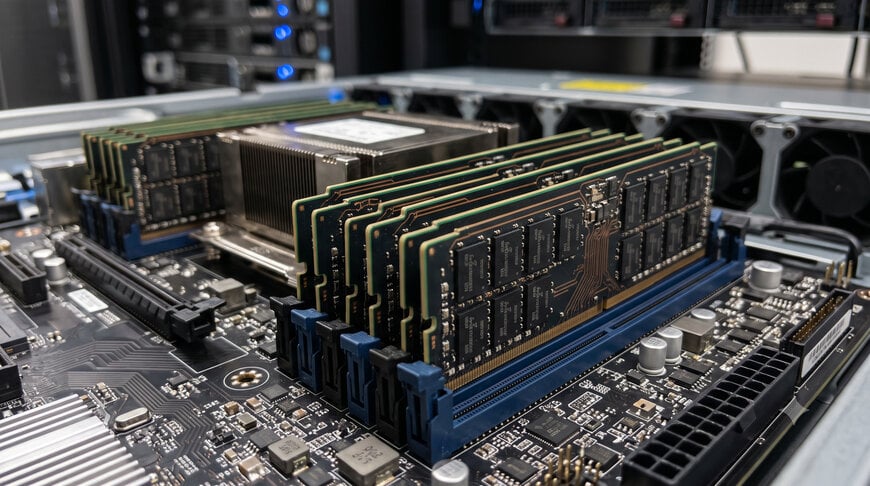
Micron Technology has demonstrated a 512-gigabyte DDR5 registered dual in-line memory module operating across multiple server platforms, targeting artificial intelligence processing, in-memory database engines, and high-performance enterprise compute environments.
Vertical Interconnect Packaging and Physical Density
The module leverages advanced through-silicon via (TSV) vertical interconnect packaging to stack dynamic random-access memory (DRAM) dies within standard package dimensions. This vertical integration allows enterprise architectures to reach unprecedented capacities within standard physical envelopes, achieving up to 12 terabytes of DDR5 system memory in a standard dual-socket server provisioned with 24 memory slots. Engineering validation conducted alongside AMD and Intel targets data transfer rates reaching up to 9,200 megatransfers per second (MT/s).
Power Reduction and In-Memory System Performance
Memory-intensive server tasks—including large language model inferencing, distributed vector analysis, and caching frameworks—face input/output latency bottlenecks when data must be swapped to peripheral non-volatile storage tiers. Keeping multi-terabyte datasets resident in primary memory mitigates bus serialization and interconnect overhead. In benchmark workloads such as Apache Spark Support Vector Machine algorithms, the 512-gigabyte configuration achieves up to 1.4 times higher throughput compared to 256-gigabyte DDR5 arrangements, alongside measurable latency gains in RocksDB and Redis deployments.
Consolidating memory capacity into monolithic 512-gigabyte registered DIMMs also alters power consumption curves. Operating a single 512-gigabyte module reduces active operating power by more than 60 percent relative to an equivalent 512-gigabyte capacity composed of four discrete 128-gigabyte modules, lowering thermal load within high-density chassis configurations.
Additional Context:
This section details technical specifications and competitive benchmarking not included in the original product announcement
High-capacity enterprise DDR5 registered modules operate in direct competition with monolithic and stacked die solutions from Samsung Electronics and SK Hynix. Standard server platforms running DDR5 have traditionally relied on monolithic 24-gigabit or 32-gigabit dies, limiting standard dual-rank registered modules to 64 gigabytes or 128 gigabytes without complex multi-die packaging.
Samsung demonstrated a 512-gigabyte DDR5 module using an 8-high TSV stack based on its 16-gigabit and 24-gigabit DRAM processes, rated for maximum transfer rates of 7,200 MT/s at 1.1 volts JEDEC standard operating voltage. Similarly, SK Hynix has produced 256-gigabyte and evaluated 512-gigabyte class modules via 1b-nanometer nodes targeting transfer speeds of 6,400 MT/s to 8,000 MT/s.
By demonstrating stability at transfer speeds reaching 9,200 MT/s, the Micron 512-gigabyte RDIMM exceeds the 6,400 to 8,000 MT/s ceiling typical of early-generation high-capacity modules. The resulting peak theoretical memory bandwidth approaches 73.6 gigabytes per second per channel, offering substantial bandwidth scaling for high-core-count processors such as AMD EPYC 9005 series and Intel Xeon 6 architectures supporting multi-ranked, high-speed memory channels.
Edited by Natania Lyngdoh, Induportals editor, assisted by AI.
www.micron.com
