
electronics-journal.com
21
'26
Written on Modified on
TE Connectivity Introduces SCHRACK RSY Relay for Automation
The new 10A PCB relay offers enhanced sustainability and high inrush performance in a compact footprint.
www.te.com
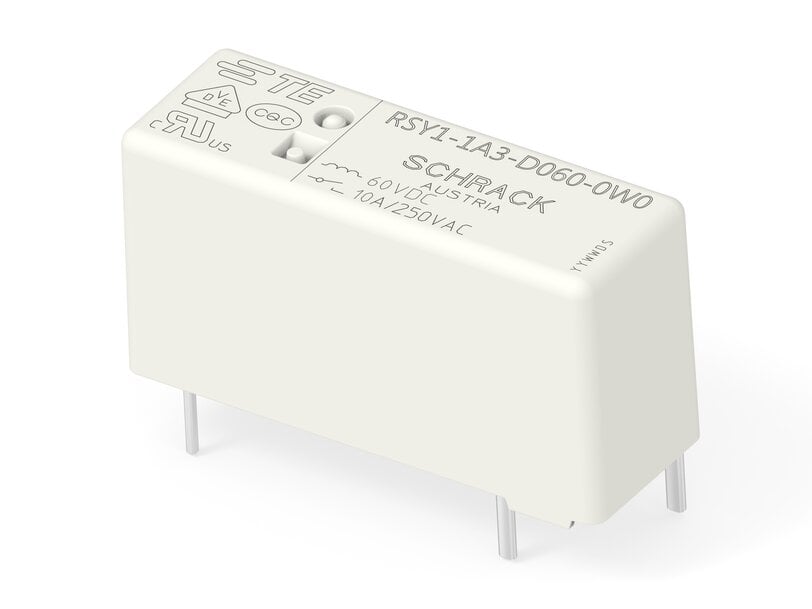
TE Connectivity has introduced the SCHRACK RSY relay, a reliable and high-performing PCB relay designed for factory and building automation, HVAC, and motion and drive markets. The new series supports high inrush loads and switching capacities up to 10 A at 277 VAC in a compact form factor. Serving as a compatible successor to TE's SCHRACK MSR relay—which has been on the market for over 35 years—the RSY relay allows for drop-in replacement without requiring PCB redesigns or assembly process changes. Manavika Goel, global product manager at TE Connectivity, noted that the series brings together performance, reliability, and sustainability to help customers meet both technical and environmental requirements.
Improved Reliability and Sustainable Design
Compared to its predecessor, the SCHRACK RSY series reduces CO2 emissions by over 15% through a combination of cutting-edge materials, improved components, and fully automated production. The relay is engineered to perform reliably in demanding environments, delivering higher vibration robustness and increased electrical load performance at elevated temperatures up to 105°C. With a minimum recommended contact load of 5V and 1mA over 1 million cycles, the improved contact system allows usage in low signal load applications under inrush cycles, while a more sensitive monostable magnetic coil system reduces heat generation.
Initially launching with a Normally Open (NO; Form A) contact type, the lineup will soon expand to include Change Over (CO; Form C) variants and through-hole-reflow soldering versions. The relay is also compliant for use in potentially hazardous environments, such as HVAC units utilizing eco-friendly A2L and A3 refrigerants.
Additional Context
This section provides technological and market background not explicitly detailed in the original release.
The transition toward low-global warming potential (GWP) refrigerants, such as A2L (mildly flammable) and A3 (highly flammable) gases, has been mandated by global environmental regulations aimed at phasing out hydrofluorocarbons (HFCs). This shift requires all electrical components within HVAC and refrigeration systems to meet strict hazardous location and safety standards, such as IEC 60079-1 and UL 60335-2-40. Electromechanical relays, which naturally generate electrical arcs during switching, must be carefully designed and sealed to prevent igniting these new refrigerants. Moreover, in modern industrial automation, the proliferation of DC loads and high-inrush components (such as LED drivers and automated motor drives) demands relays with highly robust contact materials and sensitive coil systems that minimize heat generation inside densely packed control cabinets.
Edited by Lekshman Ramdas, Induportals editor – adapted by AI.
www.te.com
