
electronics-journal.com
03
'26
Written on Modified on
Solid State Storage for High-Resolution Medical Equipment
Avalue introduces a hardware-encrypted, thermal-regulated memory architecture designed to maintain data integrity and regulatory compliance across mission-critical clinical environments.
www.avalue.com
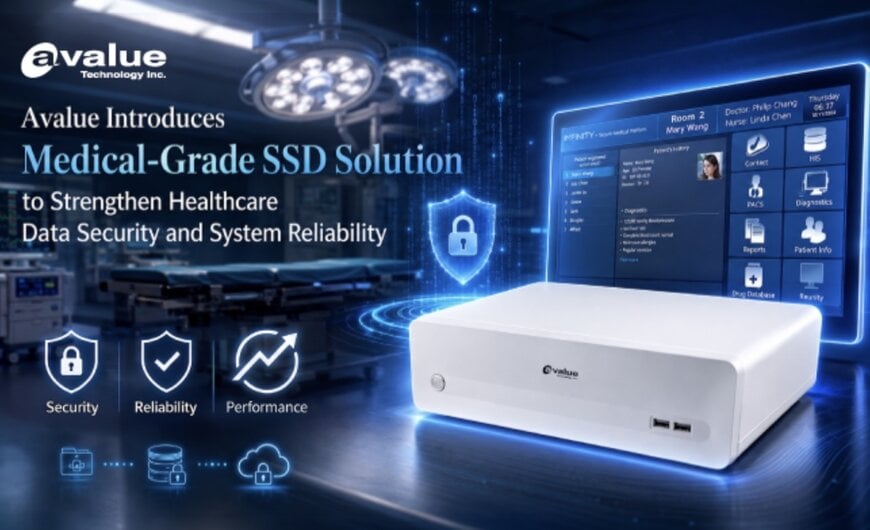
Avalue Technology Inc. has released a Medical-Grade SSD Solution designed to provide high-endurance, secure data retention for medical imaging systems, surgical platforms, and AI-powered healthcare devices. The release addresses the growing need for stable, compliant data processing in environments prone to electrostatic interference and intensive read-write workloads.
Operational Stability and Electrostatic Protection
Medical systems process massive volumes of patient data, making reliable storage fundamental to a secure medical data ecosystem. In clinical settings, continuous operation exposes sensitive electronic equipment to electrostatic discharge (ESD) generated by personnel, diagnostic carts, and surrounding devices. To mitigate data corruption and prevent sudden system interruptions, the storage drives comply with IEC 60601-1-2 electromagnetic compatibility (EMC) standards. The hardware integrates enhanced ESD protection capable of withstanding 15 kV air discharge and 8 kV contact discharge, maintaining stable operation for mission-critical medical hardware even in volatile electrical environments.
Thermal Management for Continuous Imaging Workloads
High-resolution medical imaging applications, such as ultrasound, endoscopy, and image-guided therapy, require sustained high-speed data recording. Standard storage components often experience thermal throttling under continuous workloads as heat builds up, which can lead to delayed image acquisition or dropped frames. To resolve this hardware bottleneck, the storage solution utilizes Adaptive Thermal Control (ATC) technology, a mechanism that dynamically scales operating performance based on internal thermal conditions. In deployed Image-Guided Therapy systems, this thermal regulation allowed the drives to maintain consistent data throughput with zero frame drops during prolonged, data-intensive imaging sessions.
Hardware-Based Encryption and Regulatory Compliance
Securing patient information against unauthorized access is a strict requirement for modern healthcare IT architectures. The drives employ TCG Opal 2.01 Self-Encrypting Drive (SED) technology to provide hardware-level encryption, securing stored data without consuming host CPU resources or degrading system performance. Additionally, the integration of a Crypto-Erase function allows administrators to securely delete cryptographic keys when decommissioning, servicing, or redeploying hardware. This mechanism renders stored data permanently inaccessible in seconds, assisting healthcare providers and device manufacturers in meeting strict data sanitization mandates under HIPAA, GDPR, and NIST SP 800-88 standards.
Hardware Specifications and Form Factors
To support diverse medical equipment architectures, the solid-state drives are manufactured in standard M.2 2280 PCIe NVMe and 2.5-inch SATA III form factors, facilitating integration into various embedded computing platforms and Edge AI systems. Available in capacities ranging from 256 GB to 2 TB, the hardware is rated for an enterprise-grade endurance of 1 Drive Write Per Day (DWPD) and is supported by a five-year lifecycle warranty to ensure long-term availability for clinical deployments.
Additional Context
This section details technical specifications and competitive benchmarking not included in the original news release.
In the specialized industrial computing sector, storage modules must meet stricter operational benchmarks than standard IT hardware. While standard commercial SSDs typically offer an endurance of 0.3 to 0.5 DWPD and baseline CE/FCC static protection, industrial-grade modules, such as those from Swissbit, Innodisk, and ATP Electronics, provide a sustained 1 DWPD endurance to handle continuous data logging from diagnostic equipment. Furthermore, standard commercial drives are rarely certified to IEC 60601-1-2 medical standards; surviving direct 8 kV contact discharges is a critical differentiator for hardware operating in close proximity to high-voltage surgical, radiological, or MRI equipment, where standard memory controllers would typically fail or reset.
Edited by Aishwarya Mambet, Induportals Editor, with AI assistance.
www.avalue.com
