
electronics-journal.com
02
'26
Written on Modified on
SiC-MOSFET Relays for High-Voltage Applications up to 3,300 V
Omron introduces the G3VH series to increase efficiency and compactness in high-voltage architectures.
industrial.omron.eu
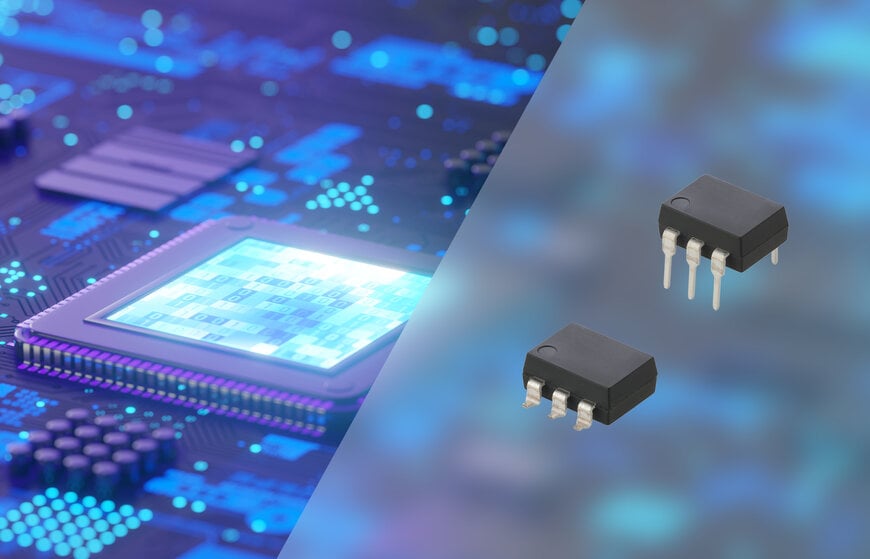
Omron Electronic Components Europe has unveiled the G3VH relay series, based on Silicon Carbide (SiC) technology. With rated voltages of 1,800 V and 3,300 V, these solid-state relays target systems utilizing bus or battery voltages exceeding 1,000 V. By utilizing SiC-MOSFETs, these components provide higher robustness and longevity with significantly smaller physical dimensions than conventional reed relays, enabling the development of smaller and more efficient system architectures.
Technical Specifications of the G3VH Series
The relays integrate back-to-back SiC-MOSFETs with an optically isolated gate driver in a compact 6-pin DIP package. They are characterized by fast switching times (turn-on time 1 ms to 2 ms, turn-off time 0.2 ms), which is particularly critical for safety commands and shortening test cycles in Automated Test Equipment (ATE).
- Model G3VH-331: Rated for 3,300 V, continuous load current 300 mA, inrush current 900 mA (Resistance: 3.5 Ohm).
- Model G3VH-181: Rated for 1,800 V, continuous load current 30 mA, pulse current 80 mA (Resistance: 120 Ohm).
Both models are configured as Normally Open (SPST-NO, Type 1a) and are available for both Surface Mount (SMD) and Through-Hole (THT) technology.
Advantages of SiC Technology
The high dV/dt tolerance of Silicon Carbide ensures stable switching even under challenging electrical conditions. Furthermore, the components offer excellent resistance to high operating temperatures and thermal stress. These properties make the G3VH series ideal for use in industrial drive systems, photovoltaic inverters, wind turbines, and Energy Storage Systems (ESS).
Additional Context: This section details technical specifications not included in the original announcement.
In high-voltage systems, mechanical contacts or simple reed relays often represent a weak point, as they are susceptible to arcing at high voltages and mechanical wear at high switching frequencies. SiC-MOSFETs utilize a wide bandgap, which not only increases thermal load capacity but also massively reduces switching losses compared to pure silicon.
A critical technical advantage of these relays is the "back-to-back" configuration. Because a single MOSFET has an internal body diode that becomes conductive in the reverse direction, a simple MOSFET would only be able to block current in one direction. The anti-parallel (back-to-back) connection of two MOSFETs ensures that the relay can effectively isolate current in both directions, which is mandatory for DC high-voltage circuits in battery systems. Optical isolation also prevents feedback between the high-voltage section and the control logic (PLC/BMS), enhancing the operational safety of the entire system under fault conditions.
Edited by Lekshman Ramdas, Induportals editor – adapted by AI.
www.omron.com
Advantages of SiC Technology
The high dV/dt tolerance of Silicon Carbide ensures stable switching even under challenging electrical conditions. Furthermore, the components offer excellent resistance to high operating temperatures and thermal stress. These properties make the G3VH series ideal for use in industrial drive systems, photovoltaic inverters, wind turbines, and Energy Storage Systems (ESS).
Additional Context: This section details technical specifications not included in the original announcement.
In high-voltage systems, mechanical contacts or simple reed relays often represent a weak point, as they are susceptible to arcing at high voltages and mechanical wear at high switching frequencies. SiC-MOSFETs utilize a wide bandgap, which not only increases thermal load capacity but also massively reduces switching losses compared to pure silicon.
A critical technical advantage of these relays is the "back-to-back" configuration. Because a single MOSFET has an internal body diode that becomes conductive in the reverse direction, a simple MOSFET would only be able to block current in one direction. The anti-parallel (back-to-back) connection of two MOSFETs ensures that the relay can effectively isolate current in both directions, which is mandatory for DC high-voltage circuits in battery systems. Optical isolation also prevents feedback between the high-voltage section and the control logic (PLC/BMS), enhancing the operational safety of the entire system under fault conditions.
Edited by Lekshman Ramdas, Induportals editor – adapted by AI.
www.omron.com
