
electronics-journal.com
26
'26
Written on Modified on
3D Hall-Effect Sensors for Automotive and Motion Control
Distributed by Rutronik, TDK's factory-programmable 3D sensing architecture resolves spatial constraints and alignment challenges within compact electric motor actuator designs.
www.rutronik.com
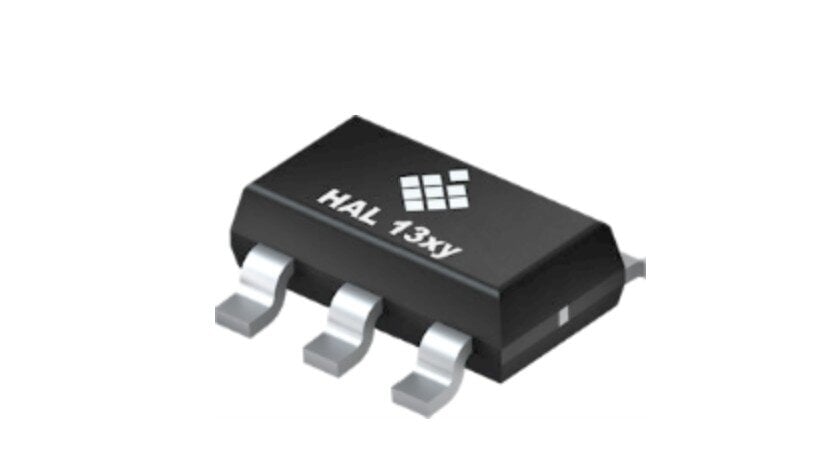
Electronic components distributor Rutronik is now supplying the TDK Micronas HAL 13xy family of factory-programmable dual-output 3D Hall-effect switch sensors, engineered to improve magnetic field measurement in physically constrained environments. This sensing technology provides accurate speed and position data for compact electric motors utilized across the automotive data ecosystem, industrial robotics, and smart-home equipment.
Resolving Spatial and Magnetic Alignment Constraints
Modern vehicles and industrial equipment increasingly rely on compact electric actuators for mechanisms such as window lifters, power seats, and tailgate drives. Engineers face mechanical tolerance variations, shifting air gaps, and inconsistent magnet distances that complicate the accurate capture of speed and position data. The HAL 13xy architecture addresses these mechanical limitations by utilizing 3D Hall technology to measure two orthogonal magnetic field components simultaneously. This capability allows for highly flexible placement of both the sensor and the magnet, differing from conventional one-dimensional Hall switches that require strict physical alignment to operate effectively.
Quadrature Signal Processing and Motion-Control Applications
The sensing components integrate dual outputs capable of delivering either quadrature signals for speed tracking or distinct speed and direction signals. The generated quadrature outputs maintain a stable 90-degree phase shift regardless of fluctuations in the magnetic air gap or the spacing of the magnetic poles. This phase stability directly reduces necessary calibration efforts and simplifies the overall design of encoders and motor controllers. Technical use cases include steering turn-count sensing, sunroof motor regulation, and window lifters equipped with anti-pinch functionality, as well as industrial motion-control applications demanding precise actuation within strict volumetric limits.
Functional Safety and Electrical Robustness
Ensuring continuous operation in harsh electromechanical environments requires stringent fault-tolerance mechanisms. Designed for automotive and industrial durability, the sensor family features a supply voltage range of 3 volts to 24 volts and operates securely in temperatures ranging from -40 degrees to +150 degrees Celsius. The units are packaged in a compact 5-pin SOT23 housing and incorporate continuous built-in self-test routines. Electrical safeguards include thermal and short-circuit protection, reverse-voltage defense down to -18 volts, and resistance to 40-volt load dumps. The devices hold AEC-Q100 qualification and are classified as Safety Element out of Context ASIL-B ready according to the ISO 26262 functional safety standard, ensuring compliance with automotive industry requirements for electromagnetic compatibility and operational reliability.
Additional Context
This section details technical specifications and competitive benchmarking not included in the original news release.
Within the automotive data ecosystem and motion control sector, dual-output 3D Hall-effect sensors are benchmarked against parameters such as phase accuracy, functional safety ratings, and package size. Comparable sensing technologies, such as the Allegro MicroSystems APS12626 and the Melexis MLX92256, also offer integrated quadrature outputs for motor speed and direction detection. The competitive differentiation often lies in the native functional safety integration. While standard dual-latch Hall sensors provide basic directional data, advanced 3D Hall architectures achieve ASIL-B readiness through continuous background diagnostics and orthogonal axis measurement, which compensate for mechanical misalignment more effectively than planar alternatives.
Edited by Aishwarya Mambet, Induportals Editor, with AI assistance.
www.rutronik.com
