
electronics-journal.com
19
'26
Written on Modified on
Compact MOSFETs for 24V and 48V Systems
Toshiba combines low conduction losses with package options tailored to industrial power designs.
www.global.toshiba
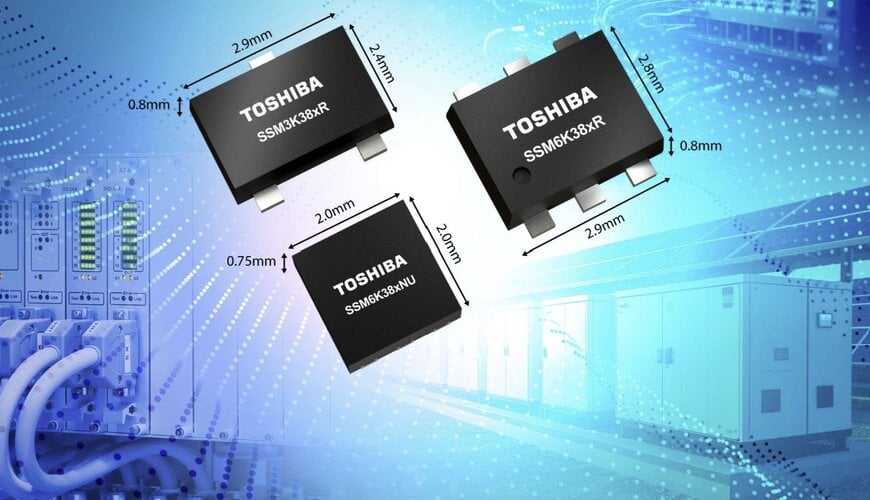
Toshiba Electronics Europe is releasing a new portfolio of 60V and 100V N-channel power MOSFETs designed to improve power conversion efficiency in industrial equipment. These discrete components target programmable logic controllers, variable frequency drives, server systems, and automated appliances operating within modern 24V and 48V power architectures.
Addressing the Transition to 48-Volt Systems
Industrial equipment manufacturers are increasingly migrating from conventional 12V and 24V power supplies to 48V systems to lower overall energy consumption and improve power distribution efficiency. Within these higher-voltage networks, inrush currents and transient surges can temporarily elevate line voltages beyond 50V, and occasionally up to 80V. To ensure reliable continuous operation under these electrical stress conditions, the new 100V MOSFETs provide the necessary voltage headroom for 48V circuits. Simultaneously, the 60V variants serve the established baseline of standard 24V applications.
Thermal Management and Package Miniaturization
Physical space constraints in industrial automation, variable frequency servomotors, and consumer appliances require power components that balance footprint reduction with necessary thermal dissipation. The released portfolio utilizes three distinct surface-mount package types to address varying spatial and thermal design requirements.
For general-purpose switching applications, the SOT-23F package measures 2.9 mm by 2.4 mm and provides 1.0 W of power dissipation. Designs requiring enhanced thermal performance utilize the TSOP6F package, which handles up to 1.5 W within a 2.9 mm by 2.8 mm footprint. Where strict board-space miniaturization is the primary constraint, the UDFN6B package delivers 1.25 W of thermal dissipation from a compact 2.0 mm by 2.0 mm area.
On-State Resistance and Component Designations
Minimizing conduction losses is critical for overall system efficiency in both heavy industrial equipment and consumer devices like water heaters and robotic vacuum cleaners. The components achieve low on-state resistance (RDS(ON)) despite their compact physical dimensions.
The 100V devices engineered for 48V power lines—comprising the SSM3K387R (SOT-23F), SSM6K387R (TSOP6F), and SSM6K387NU (UDFN6B)—operate with an RDS(ON) of 198 mΩ. For 24V systems, the 60V devices are available in two resistance tiers. The 99 mΩ tier includes the SSM3K388R, SSM6K388R, and SSM6K388NU, which are suitable for higher-current pathways. A 200 mΩ tier, comprising the SSM3K389R, SSM6K389R, and SSM6K389NU, is designed for lower-current auxiliary switching functions.
Additional Context
This section details technical specifications and competitive benchmarking not included in the original news release.
In the sub-100V discrete power MOSFET market, components are continuously benchmarked against specific on-resistance (RDS(ON)) per unit area (mm2) and thermal resistance from junction to ambient. Similar 100V N-channel devices in compact packages are manufactured by competitors such as Infineon Technologies and onsemi. For instance, Infineon’s 100V industrial MOSFETs housed in SuperSO8 or SOT-223 packages frequently target ultra-low RDS(ON) values below 10 mΩ for high-current server backplanes. However, those packages occupy significantly larger board area (e.g., 5.0 mm x 6.0 mm) compared to the 2.0 mm x 2.0 mm footprint of the UDFN6B. The 198 mΩ and 99 mΩ ratings of the newly introduced Toshiba devices position them specifically for low-to-medium power auxiliary switching, level shifting, and gate driving circuits where extreme board miniaturization and low gate charge are prioritized over maximum current-carrying capacity.
Edited by Aishwarya Mambet, Induportals Editor, with AI assistance.
www.toshiba.com
