
electronics-journal.com
10
'26
Written on Modified on
Hardware Acceleration Unit For Mission-Critical Data Workloads
Kontron introduces a compact computing solution designed to process artificial intelligence inference and parallel calculations within harsh aerospace defense environments.
www.kontron.com
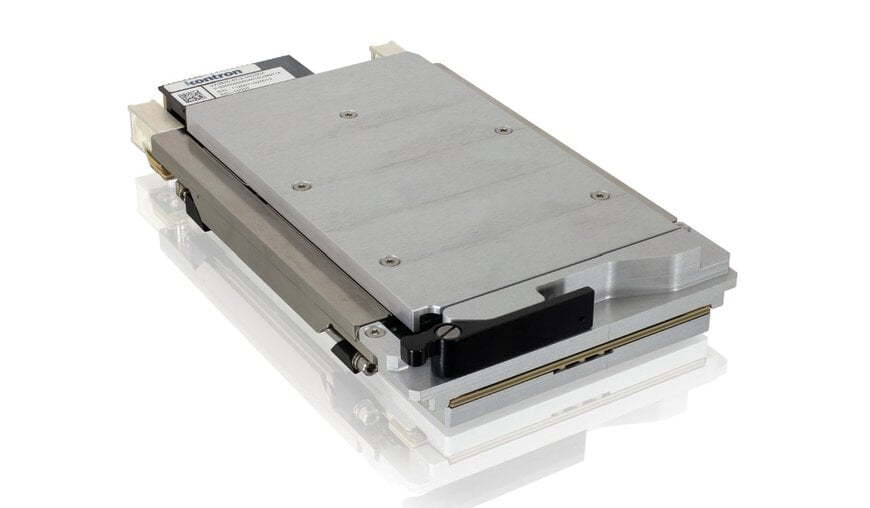
Kontron is releasing the VX33211, a 3U form factor component integrated with embedded graphics acceleration architecture. This hardware is explicitly engineered to manage high-throughput computing tasks within the defense and aerospace industries.
Processing Architecture and Computational Capabilities
The technology addresses the requirement for high-performance edge computing by moving compute-intensive operations directly to the point of data collection. Equipped with the NVIDIA RTX PRO 2000 Blackwell Embedded architecture, the unit supplies up to 13.78 TFLOPS of FP32 computational output. Its processing framework incorporates 3,328 CUDA cores for standard graphical and parallel operations, 104 Tensor Cores for deep learning mathematical functions, and 26 RT Cores to handle real-time ray tracing. Operating alongside these processing elements is 8 gigabytes of GDDR7 memory, enabling a maximum data bandwidth of 384 gigabytes per second to support continuous data streaming.
Interoperability and Environmental Compliance
For physical integration into existing tactical frameworks, the conduction-cooled variant adheres to the VITA 48 baseline and fulfills the environmental criteria specified by VITA 47. The hardware maintains operational stability at card-edge temperatures ranging from -40°C to +85°C. To ensure interoperability across various defense programs, the architecture aligns with Sensor Open Systems Architecture (SOSA) OpenVPX profiles. Network communication and system administration are facilitated through a PCIe Gen4 backplane connection and an Intelligent Platform Management Interface (IPMI) controller, providing VITA 46.11 Tier 3 out-of-band management. The hardware serves as a modular component in the HARAKAN-F system and interfaces with existing central processing boards, including the VX307C. An alternative air-cooled version provides a testing platform strictly for laboratory evaluation.
Application Areas and Operational Integration
Deploying this hardware facilitates several distinct technical use cases in rugged operational environments. Primary applications encompass electro-optical and infrared (EO/IR) sensor data parsing, radar and sonar signal filtering, and electronic warfare calculations. By processing these inputs locally, systems bypass the latency associated with transmitting raw data to centralized servers for intelligence, surveillance, and reconnaissance (ISR) tasks. Sébastien Vitre, Product Manager for Rugged Systems at Kontron, noted that utilizing open standard profiles combined with rugged physical constraints directly reduces integration complexity and shortens deployment timelines for artificial intelligence workloads at the edge.
Additional Context
This section details technical specifications and competitive benchmarking not included in the original news release.
The 3U VPX graphics sector features comparable hardware from manufacturers such as Mercury Systems, Abaco Systems, and EIZO Rugged Solutions. Benchmarking these components typically relies on thermal dissipation limits, total FP32 TFLOPS, and memory bandwidth capacities. Previous generations of SOSA-aligned graphics boards relied on Ampere or Ada Lovelace microarchitectures utilizing GDDR6 memory, which generally yielded between 250 and 300 gigabytes per second of bandwidth in identical form factors. The implementation of the Blackwell architecture alongside GDDR7 memory pushes bandwidth to 384 gigabytes per second, establishing a measurable increase in parallel data ingestion capabilities for high-frequency radar and visual sensor streams. Because conduction-cooled thermal design power (TDP) in this specific 3U class must typically operate within a strict 50-watt to 100-watt envelope, the resulting TFLOPS-per-watt efficiency serves as the primary objective differentiator among competing VITA 48 hardware profiles.
Edited by Aishwarya Mambet, Induportals Editor, with AI assistance.
www.kontron.com
