
electronics-journal.com
09
'26
Written on Modified on
MIPI Interface Cables for Embedded Vision Data Transmission
Vision Components develops an integrated hardware solution that streamlines the synchronization of external triggers and lighting within compact optical inspection networks.
www.vision-components.com
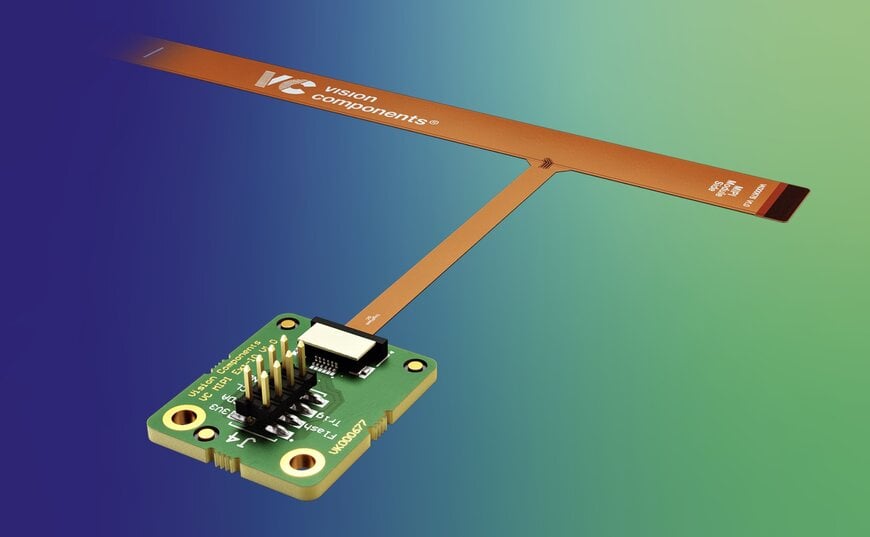
Vision Components is releasing a standard MIPI CSI-2 cable equipped with an integrated connector board designed for direct trigger input and flash output. This hardware simplifies the integration of synchronized lighting and capture mechanisms in embedded vision systems utilized across industrial automation and quality inspection environments.
Hardware Integration for Synchronized Image Capture
Standard imaging setups often require supplementary interface boards to connect external triggers and illumination sources to camera modules. By embedding the connector board directly into the flexible printed circuit (FPC) architecture, this new MIPI CSI-2 cable permits hardware-level synchronization without additional circuitry. This is a critical requirement in high-speed manufacturing applications, where precise microsecond timing between strobe lighting and sensor exposure is necessary to freeze motion and prevent image blur during automated visual sorting.
Configuration Options and Processor Compatibility
The integrated trigger cable is manufactured in a 200-millimeter length and interfaces directly with processor boards operating on the MIPI CSI-2 standard. It extends an existing portfolio of FPC transmission lines available in dimensions of 60, 100, 200, and 250 millimeters. For specialized physical constraints, custom wiring configurations accommodate 15-pin, 22-pin, or 24-pin layouts across either two or four data lanes. These structural variants allow system architects to route high-frequency signals through restricted mechanical spaces while maintaining data integrity between the sensor node and the main processing unit.
Extended Transmission via Serializer Architectures
The standard MIPI CSI-2 specification limits trace lengths due to signal degradation and electromagnetic interference at high data rates. To address applications requiring greater physical separation between the imaging sensor and the logic board, micro-coaxial wiring and Serializer/Deserializer (SerDes) protocols are implemented. These extended interfaces maintain uncompressed, high-bandwidth video transport over distances reaching up to 10 meters. The resulting cable infrastructure operates within a unified ecosystem, ensuring electrical and logical compatibility with more than 50 distinct camera modules from the manufacturer.
Additional Context
This section details technical specifications and competitive benchmarking not included in the original news release.
In the embedded vision sector, transmitting MIPI CSI-2 signals over flexible printed circuits is typically constrained to distances under 300 millimeters due to signal attenuation. Standard market solutions from manufacturers such as Basler or Allied Vision often require separate general-purpose input/output (GPIO) adapter boards or carrier boards to manage external lighting and hardware trigger signals. Integrating the I/O breakout directly into the FPC assembly reduces the overall physical footprint and minimizes connection points, lowering the risk of mechanical failure in vibrating industrial environments. For distances extending up to 10 meters, the deployment of SerDes architectures—commonly utilizing protocols like Texas Instruments' FPD-Link III or Analog Devices' GMSL2—translates parallel MIPI data into a single high-speed serial stream over coaxial infrastructure, establishing standard long-reach topologies for robotics and vehicular sensing systems.
Edited by Aishwarya Mambet, Induportals Editor, with AI assistance.
www.vision-components.com
