
electronics-journal.com
08
'26
Written on Modified on
Emerson Broadens Affordable Access to High-Performance RF Test Systems
New NI PXI Core VST instruments deliver synchronized calibrated RF measurements for wireless, medical, academic and production applications.
www.ni.com
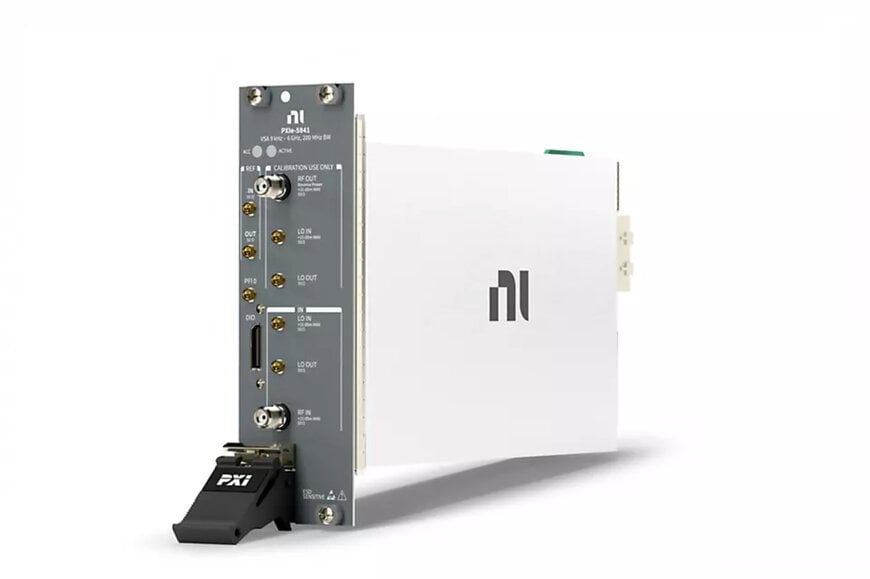
Emerson announced the expansion of its modular instrument portfolio to lower the cost barrier for calibrated, synchronized radio frequency test systems. The new core vector signal transceivers, designed for the peripheral component interconnect eXtensions for instrumentation express architecture, integrate vector signal generation and analysis into a compressed hardware footprint. By introducing the instruments at a lower price point, the company targets electronic validation, wireless production, and medical device manufacturing environments where instrumentation budget constraints previously restricted the adoption of high-performance automated testing. The hardware suite will be demonstrated at the International Microwave Symposium in Boston.
Scalable Architecture for Manufacturing and Laboratory Validation
In automated production and validation environments, testing costs scale with frequency coverage and instantaneous bandwidth demands. The PXIe-5841 and PXIe-5820 instruments address this economic pressure by offering hardware configurations tailored for repeatable execution. The PXIe-5841 features 200 megahertz of instantaneous bandwidth paired with a fixed field programmable gate array configuration, which eliminates the software complexity and cost associated with user-programmable field programmable gate arrays while maintaining rapid measurement cycles.
Operating within a digital supply chain requires consistent validation frameworks from initial research through final assembly. The core transceivers integrate with the specialized RFmx measurement software, creating a standardized environment that spans from interactive signal generation to automated data analysis. This consistency ensures that data collected during early-stage electronic prototyping aligns with high-volume production metrics, mitigating correlation errors across different stages of the product lifecycle.
Frequency Range and Hardware Versatility in the Automotive Data Ecosystem
Modern electronic validation demands broad spectrum coverage to accommodate various wireless standards, from legacy analog signals to modern radar systems. The new core transceivers expand their frequency baseline down to 9 kilohertz. This wide spectral range allows engineering teams to utilize a single instrumentation platform for testing industrial, scientific, and medical bands, amplitude modulation and frequency modulation broadcast signals, and low-frequency radar applications. This consolidation eliminates the necessity for separate, dedicated low-frequency signal generators and analyzers, reducing the overall footprint and capital expenditure of the test station.
The hardware architecture supports modular scaling, enabling individual channels to be configured as independent vector signal analyzers or vector signal generators, or combined into full transceiver workflows. Bandwidth options scale from 200 megahertz up to 1 gigahertz to meet changing validation protocols. This modular design aligns with the evolving automotive data ecosystem, where test benches must adapt to handle ultra-wideband vehicle-to-everything communication alongside narrow-band tire pressure monitoring systems without requiring complete system re-architecture.
Standardization on Software-Defined Automated Test Equipment
The test and measurement industry is transitioning away from high-cost, proprietary benchtop instruments toward open, software-defined modular platforms. Specialized setups often create operational silos, preventing testing organizations from standardizing their codebases and asset allocation across different geographic manufacturing sites.
The core transceivers mitigate these operational barriers by utilizing an architecture that allows testing organizations to scale into automated, data-driven workflows over time. The hardware integrates directly with multiple standard programming environments through unified software drivers, accelerating test bench setup and reducing the time required to deploy new test routines on the factory floor.
Additional Context:
This section details technical specifications and competitive benchmarking not included in the original product announcement.
The expansion of the vector signal transceiver market driven by modular architectures introduces clear performance and cost benchmarks against traditional automated test equipment vendors. A primary competitor in this segment is Keysight Technologies with its M9410A and M9411A vector transceiver series.
When evaluated on core hardware metrics, the competitive landscape demonstrates distinct trade-offs between performance ceiling and acquisition cost:
The Keysight M9410A series provides a base frequency range starting at 1 megahertz, expandable down to 1 megahertz via specific low-frequency extensions, with a maximum instantaneous bandwidth of 1.2 gigahertz across a multi-slot peripheral component interconnect eXtensions for instrumentation express module. In comparison, the core transceiver portfolio starts its frequency coverage lower at 9 kilohertz, allowing for direct baseband and low-frequency industrial, scientific, and medical band validation without external frequency conversion hardware.
While the competitor offers higher absolute bandwidth limits up to 1.2 gigahertz for complex modulation schemes like fifth-generation new radio and wireless local area network 7, the core transceivers optimize the cost-per-channel metric by fixing the field programmable gate array fabric and capping base instantaneous bandwidth at 200 megahertz. This architectural choice delivers calibrated, phase-synchronized multi-channel radio frequency measurements at a significantly lower capital cost, addressing applications that require high throughput and tight synchronization over absolute wideband performance.
Edited by Natania Lyngdoh, Induportals editor, assisted by AI.
www.ni.com
