
electronics-journal.com
29
'26
Written on Modified on
ROHM Launches Web-Based Power Electronics Simulation Tool
A browser-based platform for rapid loss and thermal analysis helps engineers evaluate power semiconductor choices before hardware prototyping.
www.rohm.com
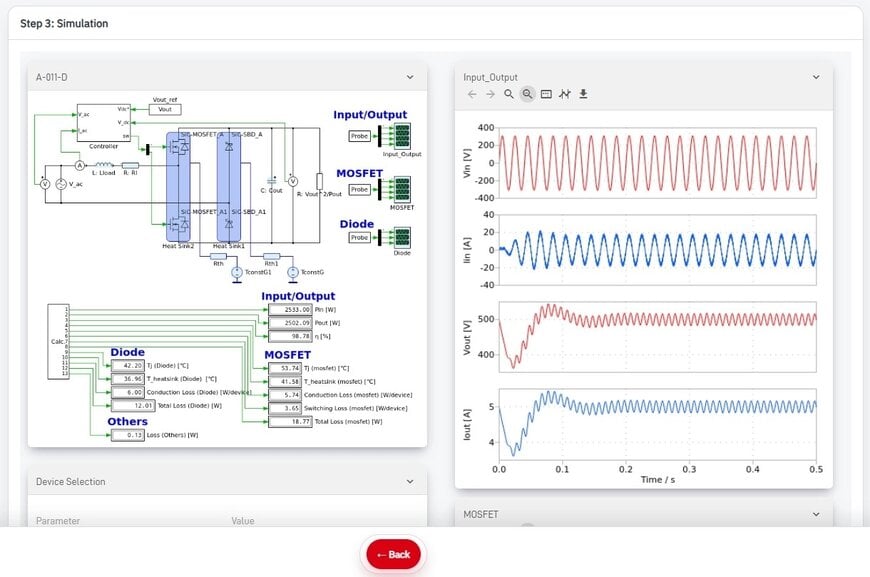
Power electronics designers increasingly rely on simulation to reduce development time and avoid the cost of multiple hardware iterations. ROHM has introduced the ROHM PLECS Simulator, a web-based simulation environment that enables rapid evaluation of power losses and thermal behavior in power electronic circuits using the company's semiconductor devices.
The tool is intended for engineers developing power conversion systems across industrial, automotive, energy, and motor-drive applications. By focusing on fast thermal and efficiency analysis during the early design phase, the simulator complements more detailed circuit-verification tools used later in development.
Fast Loss and Thermal Verification for Early Design Stages
Simulation has become a standard part of power electronics development, particularly when evaluating converter topologies, semiconductor devices, and thermal management strategies before building prototypes. While detailed circuit simulators can accurately reproduce switching waveforms and transient behavior, they often require longer simulation times and more complex model preparation.
ROHM developed the new simulator to address a different requirement: rapid assessment of power-device losses and temperature rise. Based on the PLECS simulation platform developed by Plexim, the tool enables users to select a predefined circuit topology and evaluate device performance through online simulations completed in seconds or minutes rather than hours.
The approach is particularly useful during component selection, where engineers need to compare multiple devices before committing to a detailed design.
Online Power Device Selection Using Predefined Topologies
The ROHM PLECS Simulator operates through a web interface hosted on the company's website. Users can select a power electronics topology and then evaluate various ROHM power semiconductors within that design.
At launch, the platform includes 20 circuit topologies covering common power-conversion applications. Available examples include power factor correction (PFC) circuits, single-phase and three-phase inverters, motor-drive architectures, and AC-DC conversion systems. ROHM plans to expand support for additional device models and circuit configurations, including silicon carbide (SiC) devices, IGBTs, and power modules.
This capability allows engineers to compare semiconductor options based on power dissipation and junction temperature performance before conducting detailed hardware validation.
Complementing Detailed Circuit Verification Workflows
The release extends ROHM's simulation ecosystem, which began with the introduction of the ROHM Solution Simulator in 2020. That platform focuses on high-accuracy circuit analysis using SPICE-based models capable of reproducing waveforms and device behavior close to measured hardware performance.
ROHM positions the new simulator as a tool for initial design exploration, while the Solution Simulator remains focused on detailed validation. Engineers can therefore use a two-stage workflow: first identifying suitable devices through rapid thermal and loss calculations, then performing detailed waveform verification and circuit optimization using high-precision simulation models.
This methodology supports a more efficient digital supply chain for electronic design by reducing the number of physical prototypes required during product development.
Thermal Modeling and Efficiency Analysis Mechanisms
PLECS technology is widely used in power electronics because it simplifies the simulation of switching systems while maintaining accurate loss and thermal calculations. Instead of relying on computationally intensive semiconductor switching models, PLECS uses ideal-switch representations combined with device-specific loss data to estimate switching losses, conduction losses, and junction temperatures.
This enables engineers to evaluate thermal performance early in development and determine whether a selected device can meet efficiency and cooling requirements. The simulator can also assist in estimating heat-sink requirements and identifying suitable device ratings before detailed circuit optimization begins.
Free Access and Supporting Design Resources
The simulator is available at no cost through the ROHM website following user registration. In addition to the simulation environment, ROHM provides supporting documentation including user manuals and application notes that explain circuit operation and simulation procedures.
The availability of both rapid-analysis and high-accuracy simulation platforms reflects the increasing role of virtual design workflows in power electronics development, where thermal management, efficiency optimization, and device selection are often evaluated before physical hardware becomes available.
Additional Context
This section details technical specifications and competitive benchmarking not included in the original news release.
The ROHM PLECS Simulator enters a market that already includes simulation environments from Plexim, Infineon Technologies, STMicroelectronics, Wolfspeed, and other power semiconductor suppliers that provide thermal and loss models for power-device evaluation. A common benchmark across these platforms is simulation speed versus waveform accuracy. High-fidelity SPICE-based tools typically provide detailed transient analysis but can require significantly longer simulation times, whereas PLECS-based environments prioritize rapid system-level thermal and efficiency calculations.
The ROHM PLECS Simulator performs loss and thermal analysis in tens of seconds to a few minutes, while the ROHM Solution Simulator focuses on detailed validation and may require substantially longer simulation times depending on circuit complexity. The new tool's competitive differentiation lies in its web-based implementation, support for approximately 20 predefined power-conversion topologies at launch, and integration with ROHM's growing portfolio of silicon, SiC, IGBT, and power-module models.
Edited by Aishwarya Mambet, Induportals Editor, with AI assistance.
www.rohm.com
