
electronics-journal.com
28
'26
Written on Modified on
Integrated 5G and Wi-Fi 8 FWA Platform for the FWA market
Broadcom and Samsung Electronics collaborate on a new broadband-optimized fixed wireless access reference platform integrating Broadcom’s BCM6776 Wi-Fi 8 SoC with Samsung’s B1320 5G Modem.
www.broadcom.com
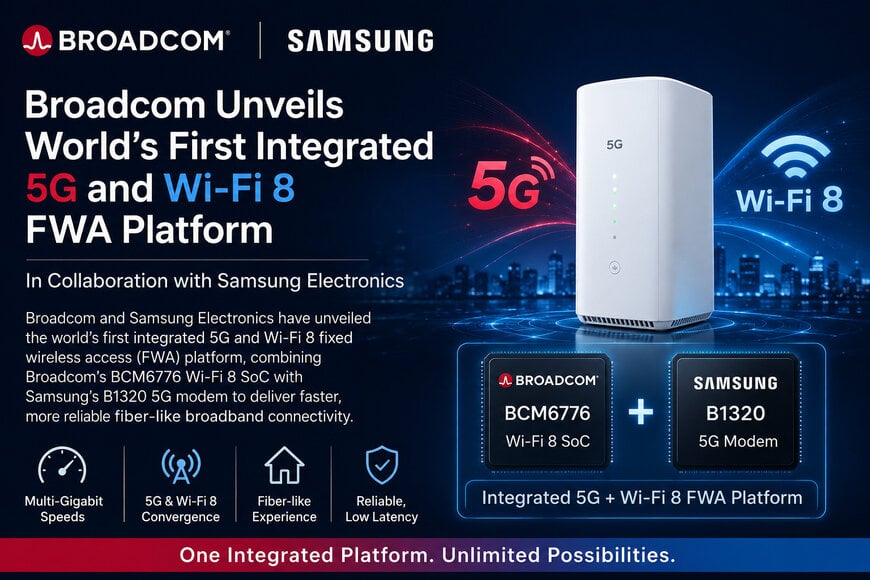
Broadcom announced its collaboration with Samsung Electronics on a new, broadband-optimized reference platform for the global fixed wireless access (FWA) market, integrating Broadcom's BCM6776 Wi-Fi 8 System-on-Chip (SoC) with Samsung's B1320 5G Modem.
This industry-first platform unifies 3GPP Release 17 connectivity with the emerging Wi-Fi 8 (IEEE 802.11bn) standard. As global broadband demand shifts toward higher performance standards, Broadcom’s latest SoC and Samsung's modem focus on delivering high reliability and consistent throughput. Designed for mass-market scalability, the platform provides a high-performance, cost-competitive blueprint that allows mobile operators to offer fiber-level broadband to accelerate service innovation and ecosystem growth.
Technical Leadership: 5G Meets Wi-Fi 8
The Broadcom BCM6776 is a highly-optimized tri-band Wi-Fi 8 SoC targeting high-volume retail and mass-market access points. It includes a quad-core Arm network processor and supports 2-stream 40 MHz channels in the 2.4 GHz band and 4-stream 160 MHz channels in the 5 and 6 GHz bands, delivering a complete Wi-Fi 8 platform in a single chip. By unifying the CPU and Wi-Fi 8 radio, Broadcom enables OEMs to significantly reduce bill of materials (BOM) costs, simplify board design, and achieve a 50% reduction in active power consumption compared to previous generations.
The Samsung B1320 is a highly-integrated and power-efficient 5nm chipset solution that supports 3GPP Release 17. It is capable of achieving 5G downlink speeds of 3.43 Gbps and uplink speeds of 1.17 Gbps. Combining Samsung’s 5G modem with a quad-core Arm CPU and the BCM6776’s network processor, the platform can support full Wi-Fi to 5G throughput. The platform also includes a Power Class 1.5 RF transceiver, power management, and a GNSS receiver. It also supports NR-NTN and NB-NTN for satellite communications.
A Global Ecosystem of Support
The launch is supported by the world’s leading original equipment manufacturers (OEMs), who are already integrating the B1320 / BCM6776 platform into their next-generation gateway portfolios. The combination of Wi-Fi 8 and 5G prioritizes coordinated reliability, giving operators a tool that delivers a consistent experience to every corner of the home.
Additional Context
This section details technical specifications and competitive benchmarking not included in the original news release.
Fixed wireless access customer premises equipment is technically audited using normalized metric criteria that evaluate peak wide-area-to-local-area pipeline translation efficiency, maximum radio frequency frontend output density, and interface bandwidth constraints under continuous thermal duress. Conventional mass-market customer premises designs from competing semiconductor providers frequently build reference layouts by connecting a standalone cellular modem to an external network application processor over a restricted peripheral component interconnect express lane, which introduces communication overhead and can elevate total active board power consumption beyond 15 Watts.
The combined B1320 and BCM6776 reference architecture modifies this performance baseline through cross-architecture optimization. The system establishes a 5 Gbps Ultra Serial Gigabit Media Independent Interface (USXGMII) pipe directly linking the 5nm cellular baseband to the 19x19 mm Wi-Fi 8 routing die. This native interface handles full Wi-Fi to 5G throughput without encountering internal bus saturation or packet dropping.
A comparative evaluation with alternative hardware platforms underscores the distinct structural differences present in this platform:
- MediaTek T830 Platform: While MediaTek’s FWA offering utilizes a built-in 5G modem with sub-6 GHz carrier aggregation, its local wireless distribution phase is structurally restricted to Wi-Fi 7 (802.11be) standards, leaving it without the coordinated reliability and deterministic low-latency multi-user scheduling enhancements native to the emerging IEEE 802.11bn (Wi-Fi 8) framework.
- Qualcomm FWA Gen 5 Elite Platform: Qualcomm's design deploys a highly capable Snapdragon X85 5G Modem-RF System that reaches theoretical peak downlinks up to 12.5 Gbps across paired millimeter-wave and sub-6 GHz spectrums. However, this configuration demands a premium-tier bill of materials including an array of external power management integrated circuits and separate high-power millimeter-wave antenna modules.
By restricting the wide-area transceiver to sub-6 GHz 4Rx/2Tx radio chains and implementing Power Class 1.5 transmission masks on a simplified, highly integrated single-chip wireless layout, the Broadcom and Samsung joint reference architecture delivers up to 3.43 Gbps downlink speeds while cutting active power consumption in half. This approach defines an energy-efficient, cost-competitive performance standard for high-volume, mass-market residential broadband gateways.
Edited by Romila DSilva, Induportals Editor, with AI assistance.
Edited by Romila DSilva, Induportals Editor, with AI assistance.
