
electronics-journal.com
27
'26
Written on Modified on
SK hynix Introduces iHBM Cooling for AI Memory
iHBM is a thermal management solution integrating cooling elements into HBM packages to improve AI chip stability.
www.skhynix.com

Reference Image
Rising AI workloads have increased demands on high-bandwidth memory (HBM), driving higher stack counts and faster interconnect speeds. As a result, thermal management in AI accelerators and high-performance computing (HPC) systems has become a limiting factor for memory performance, reliability, and scalability. SK hynix’s new iHBM solution addresses these constraints by embedding Integrated Cooling Elements (ICEs) directly within HBM packaging, targeting next-generation AI memory products including HBM5.
ICE Integration Targets Heat Concentration in HBM Interfaces
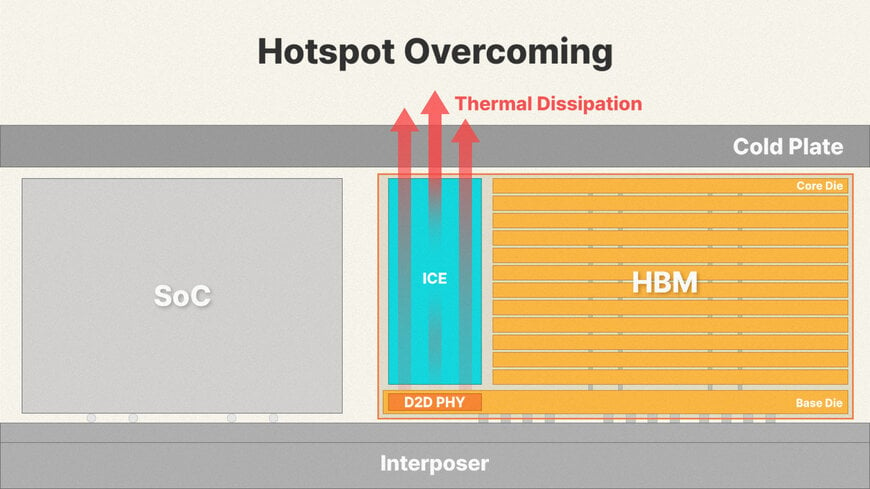
Conventional HBM architectures dissipate heat indirectly through the core die. The iHBM approach introduces a secondary heat dissipation path by placing electrically non-conductive, thermally conductive silicon-based ICEs within the Die-to-Die Physical Layer (D2D PHY), where thermal concentration is highest between HBM and AI accelerators.
The D2D PHY functions as the hardware interface enabling high-speed communication between HBM base dies and GPUs or AI accelerators. Increasing bandwidth and power density at this interface elevates heat generation, making localized thermal control increasingly important for future AI systems.
According to SK hynix, the structural redesign reduces thermal resistance by 30%, supporting stable operation in high-temperature and high-load environments. Lower thermal resistance can improve sustained throughput and reduce performance degradation caused by heat accumulation.
Packaging Compatibility Supports Existing AI System Designs
A major barrier in semiconductor thermal innovation is compatibility with established packaging ecosystems. The iHBM solution uses SK hynix’s existing Wafer Level Packaging (WLP) processes built on Mass Reflow Molded Underfill (MR-MUF) technology, allowing large-scale manufacturing without requiring entirely new production infrastructure.
MR-MUF is already deployed in HBM manufacturing, where liquid protective materials are inserted between stacked chips to improve structural integrity and packaging reliability. SK hynix has previously used MR-MUF to achieve higher-density HBM stacking while maintaining package height constraints.
The company states that iHBM maintains high compatibility with existing System-in-Package (SiP) architectures, enabling adoption with limited redesign requirements. This may reduce integration complexity for AI hardware developers and hyperscale data center operators.
AI Data Centers Drive Demand for Advanced Thermal Management
AI training and inference workloads continue increasing bandwidth requirements across GPUs and memory subsystems. Thermal limitations have emerged as a major challenge as HBM moves toward higher stacking densities and future generations such as HBM5.
SK hynix intends to deploy iHBM in next-generation HBM products to improve operational efficiency and stability in high-density AI computing environments, including HPC infrastructure and AI data centers.
Kangwook Lee, Senior Vice President and Head of PKG Development at SK hynix, said the technology combines memory design capabilities with advanced packaging techniques to improve thermal management for AI environments.
Additional Context
This section details technical specifications and competitive benchmarking not included in the original product announcement
Thermal management has become a key differentiator among HBM suppliers. SK hynix’s reported 30% reduction in thermal resistance represents a measurable packaging-level improvement aimed at sustaining performance under AI workloads.
Competing approaches differ structurally:
Rising AI workloads have increased demands on high-bandwidth memory (HBM), driving higher stack counts and faster interconnect speeds. As a result, thermal management in AI accelerators and high-performance computing (HPC) systems has become a limiting factor for memory performance, reliability, and scalability. SK hynix’s new iHBM solution addresses these constraints by embedding Integrated Cooling Elements (ICEs) directly within HBM packaging, targeting next-generation AI memory products including HBM5.
ICE Integration Targets Heat Concentration in HBM Interfaces
Conventional HBM architectures dissipate heat indirectly through the core die. The iHBM approach introduces a secondary heat dissipation path by placing electrically non-conductive, thermally conductive silicon-based ICEs within the Die-to-Die Physical Layer (D2D PHY), where thermal concentration is highest between HBM and AI accelerators.
The D2D PHY functions as the hardware interface enabling high-speed communication between HBM base dies and GPUs or AI accelerators. Increasing bandwidth and power density at this interface elevates heat generation, making localized thermal control increasingly important for future AI systems.
According to SK hynix, the structural redesign reduces thermal resistance by 30%, supporting stable operation in high-temperature and high-load environments. Lower thermal resistance can improve sustained throughput and reduce performance degradation caused by heat accumulation.
Packaging Compatibility Supports Existing AI System Designs
A major barrier in semiconductor thermal innovation is compatibility with established packaging ecosystems. The iHBM solution uses SK hynix’s existing Wafer Level Packaging (WLP) processes built on Mass Reflow Molded Underfill (MR-MUF) technology, allowing large-scale manufacturing without requiring entirely new production infrastructure.
MR-MUF is already deployed in HBM manufacturing, where liquid protective materials are inserted between stacked chips to improve structural integrity and packaging reliability. SK hynix has previously used MR-MUF to achieve higher-density HBM stacking while maintaining package height constraints.
The company states that iHBM maintains high compatibility with existing System-in-Package (SiP) architectures, enabling adoption with limited redesign requirements. This may reduce integration complexity for AI hardware developers and hyperscale data center operators.
AI Data Centers Drive Demand for Advanced Thermal Management
AI training and inference workloads continue increasing bandwidth requirements across GPUs and memory subsystems. Thermal limitations have emerged as a major challenge as HBM moves toward higher stacking densities and future generations such as HBM5.
SK hynix intends to deploy iHBM in next-generation HBM products to improve operational efficiency and stability in high-density AI computing environments, including HPC infrastructure and AI data centers.
Kangwook Lee, Senior Vice President and Head of PKG Development at SK hynix, said the technology combines memory design capabilities with advanced packaging techniques to improve thermal management for AI environments.
Additional Context
This section details technical specifications and competitive benchmarking not included in the original product announcement
Thermal management has become a key differentiator among HBM suppliers. SK hynix’s reported 30% reduction in thermal resistance represents a measurable packaging-level improvement aimed at sustaining performance under AI workloads.
Competing approaches differ structurally:
- SK hynix uses MR-MUF packaging and integrated cooling pathways within HBM packages. The company previously reported less than 2°C temperature variation across a 12-layer HBM3E stack using advanced thermal technologies.
- Samsung has pursued thermocompression bonding with non-conductive film (TC-NCF) in HBM manufacturing.
- Micron has explored through-silicon trench cooling concepts, though public evidence of commercial deployment remains limited.
Industry competition is increasingly centered on balancing bandwidth, stack height, thermal efficiency, and manufacturability for AI accelerators rather than memory capacity alone.
Edited by Natania Lyngdoh, Induportals editor, assisted by AI.
www.skhynix.com
Edited by Natania Lyngdoh, Induportals editor, assisted by AI.
www.skhynix.com
