
electronics-journal.com
15
'26
Written on Modified on
Low-Power Crystal Oscillator Targets Precision Timing Applications
Microchip introduces a miniature evacuated crystal oscillator designed for frequency stability in battery-powered and rugged environments.
www.microchip.com
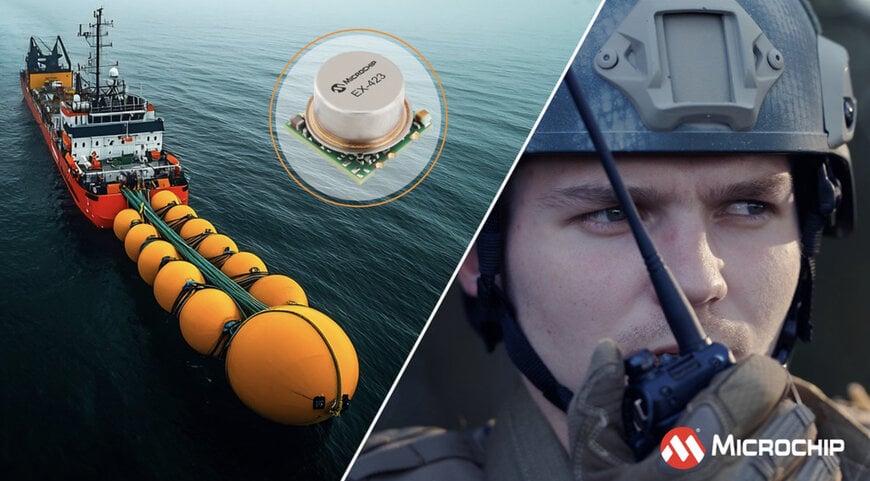
Microchip Technology has launched the EX-423 Evacuated Miniature Crystal Oscillator (EMXO), a timing device developed for applications requiring stable frequency reference signals under constrained power and space conditions. The oscillator targets sectors including satellite communications, military radios, GPS/GNSS tracking, medical devices, seismic monitoring systems and test equipment where long-term timing accuracy and low phase noise are critical.
Ultra-High Vacuum Packaging Improves Thermal Stability
The EX-423 is sealed in an ultra-high vacuum enclosure intended to improve thermal insulation and reduce frequency variation caused by temperature changes. The oscillator uses a four-point mounted quartz crystal architecture designed to increase shock resistance and reduce acceleration sensitivity, factors relevant in aerospace, defense and mobile systems exposed to vibration.
Published specifications indicate acceleration sensitivity below 1 ppb/g per axis and survivability under 1000 g shock conditions according to MIL-STD-202 testing methods. The device weighs less than 5 grams and operates across temperature ranges from −40°C to +85°C while maintaining specified performance.
Frequency Stability and Phase Noise Performance
The oscillator operates across a standard frequency range of 10–20 MHz and is specified for frequency stability of ±5 ppb over 0°C to +50°C, ±10 ppb over −20°C to +70°C and ±20 ppb over −40°C to +85°C. Aging performance is specified at ±0.05 ppm over one year and ±0.5 ppm over ten years.
Microchip reports an Allan deviation of 4 × 10⁻¹² at 1 second for a 10 MHz output, a statistical measure commonly used to evaluate short-term oscillator stability. Lower Allan deviation values indicate reduced frequency fluctuations over time.
The EX-423 also targets low phase noise performance, with published values of −105 dBc/Hz at 1 Hz offset, −130 dBc/Hz at 10 Hz, −145 dBc/Hz at 100 Hz and −160 dBc/Hz at 10 kHz offset for a 10 MHz signal. Phase noise affects signal purity and can influence communication, radar and navigation system accuracy.
Low Power Consumption Supports Battery-Driven Systems
The oscillator consumes approximately 1 W during warm-up and as little as 0.2 W during steady-state operation at +25°C. Warm-up time is specified at 120 seconds to reach frequency stability within ±10 ppb. Reduced steady-state power consumption can be relevant for battery-operated systems requiring extended operational periods.
The device is available with 3.3 V and 5 V supply options and supports both surface-mount and through-hole configurations.
Application Areas Requiring Stable Timing References
High-stability oscillators are used where timing errors can degrade synchronization, positioning accuracy or communication performance. Microchip identifies applications including ocean bottom node seismic systems, satellite communications, military portable radios and GPS/GNSS equipment, all of which rely on stable reference signals under varying environmental conditions.
Additional Context: This section details technical specifications and competitive benchmarking not included in the original product announcement
Comparable miniature high-stability oscillators exist from manufacturers including Wenzel Associates, Rakon and Q-Tech, where accepted benchmark criteria include phase noise, Allan deviation, acceleration sensitivity, power consumption, operating temperature range and aging performance. However, direct one-to-one comparison requires equivalent published specifications under matching test conditions.
The EX-423 specification of 4 × 10⁻¹² Allan deviation at 1 second, acceleration sensitivity below 1 ppb/g, and steady-state power consumption near 0.2 W positions it within the category of low-power, high-stability crystal oscillators intended for portable and ruggedized timing applications. Many ultra-low-noise oscillators achieve stronger phase-noise performance but typically operate with higher power consumption or larger package sizes, while miniature oscillators often trade stability for reduced footprint. The EX-423 combines a 13 mm × 13 mm package, low steady-state power and environmental ruggedization, metrics commonly used in evaluating oscillators for aerospace, seismic and GNSS systems.
Edited by Natania Lyngdoh, Induportals Editor, assisted by AI.
www.microchip.com
