
electronics-journal.com
30
'26
Written on Modified on
Embedded Software Integration for Scalable Vehicle Platforms
Vector contributes system integration and embedded software capabilities to NXP CoreRide, supporting faster deployment of software-defined vehicle architectures across automotive development programs.
www.vector.com

The transition toward software-defined vehicles is increasing demand for tightly integrated hardware and software platforms that reduce development complexity and enable predictable system performance. In this context, Vector has expanded its collaboration with NXP Semiconductors by contributing embedded software and system integration capabilities to the NXP CoreRide platform.
Pre-integrated platform reduces system bring-up effort
The collaboration targets automotive OEMs and Tier suppliers developing zonal architectures and centralized vehicle compute systems. The NXP CoreRide platform combines NXP hardware with Vector’s MICROSAR embedded software stack, forming a pre-integrated and pre-configured environment aligned at both hardware and software levels.
This approach reduces system bring-up complexity by minimizing low-level integration work typically required when combining ECUs, middleware, and application layers. Development teams can begin application-level development earlier in the vehicle program lifecycle, shortening evaluation phases and lowering engineering risk.
The latest implementation of this approach is the NXP CoreRide Z248 zonal reference system, designed as a real-time compute platform suitable for series production. The system integrates MICROSAR Classic as the embedded software stack, along with the DaVinci Configurator for configuration tasks and PREEvision for system design.
Software stack alignment in automotive data ecosystem
The integration model reflects a broader shift toward a software-centric automotive data ecosystem, where vehicle functionality is increasingly defined by software layers rather than discrete hardware components. By aligning embedded software closely with hardware architecture, the platform supports deterministic behavior across distributed vehicle functions.
Vector’s contribution includes software-centric system integration and performance tuning, ensuring that communication layers, middleware, and control logic operate within defined timing and resource constraints. This is particularly relevant in zonal architectures, where multiple vehicle domains share centralized compute resources.
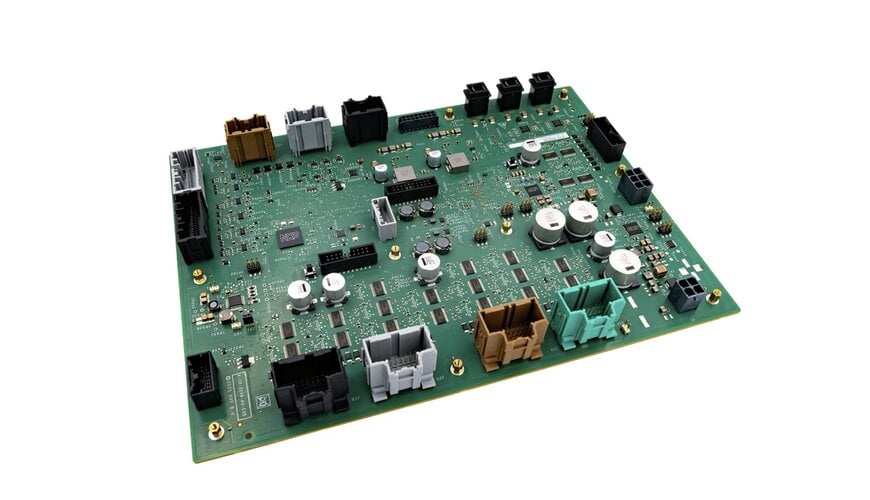
Vector contributes to the NXP CoreRide Z248 zonal reference system. This system provides OEMs with a ready-to-adopt, real-time compute platform ready for series production. Image rights: © NXP Semiconductors
Measurable impact on system performance indicators
The integrated software stack directly affects key system-level performance metrics. Boot and startup processes are optimized to ensure deterministic ECU availability, which is critical for safety-relevant functions. Update, wake-up, and sleep mechanisms are designed to balance responsiveness with energy efficiency.
Communication performance across CAN and Ethernet networks is also enhanced, supporting higher data throughput and reduced latency in vehicle networks. At the same time, memory usage is reduced through optimized software configurations, allowing more efficient utilization of available hardware resources.
These optimizations are implemented at the base software layer, enabling consistent performance improvements without requiring changes at the application level.
From evaluation platforms to series production readiness
The joint development approach focuses on enabling OEMs to transition from evaluation to series development with fewer integration challenges. By providing a pre-validated combination of hardware and software, the platform reduces uncertainties associated with system compatibility and performance validation.
The NXP CoreRide Z248 reference system serves as a baseline for scalable deployment across vehicle programs, supporting the industrialization of software-defined vehicle architectures. The collaboration emphasizes coordinated hardware-software engineering as a prerequisite for reducing development timelines and achieving predictable system behavior in production environments.
Edited by Aishwarya Mambet, Induportals Editor, with AI assistance.
www.vector.com
