
electronics-journal.com
29
'26
Written on Modified on
ROHM NFC Chipset Enables Wireless Charging in Wearables
Compact receiver and transmitter ICs support proximity-based power transfer for ultra-small devices, addressing design constraints in next-generation wearable electronics.
www.rohm.com
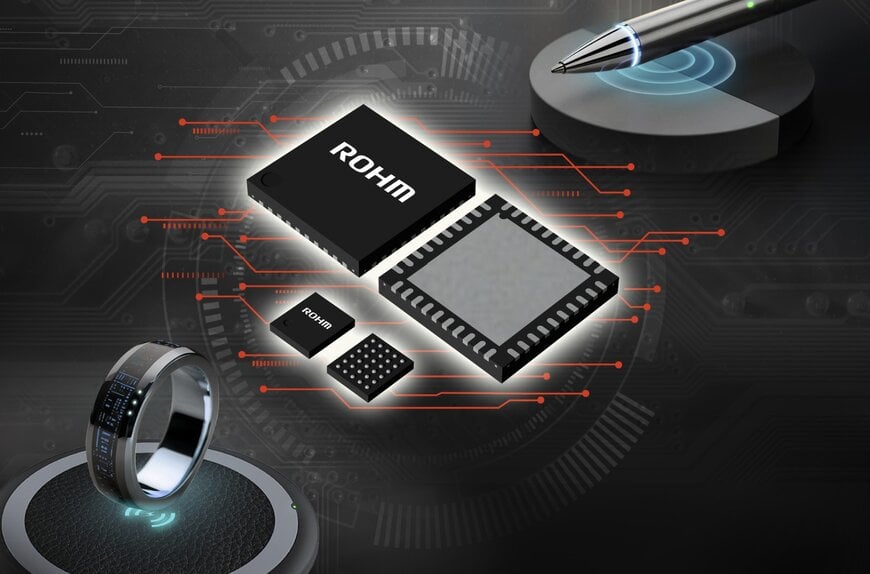
Wearable devices such as smart rings and fitness bands require compact, cable-free charging solutions that fit within strict size and power limits. In this context, ROHM introduced the ML7670 receiver and ML7671 transmitter chipset, designed for NFC-based wireless power transfer in ultra-compact wearable and peripheral devices.
NFC charging addresses size constraints in ultra-compact devices
Applications in healthcare, fitness tracking, and consumer electronics are driving demand for smaller wearable formats, particularly ring-shaped devices. These form factors limit the feasibility of wired charging interfaces and restrict the use of conventional Qi wireless charging, which typically requires larger coils.
NFC-based wireless power transfer operates at 13.56 MHz, enabling smaller antenna designs suited to compact geometries. This makes it suitable for proximity-based charging in devices such as smart rings, smart bands, and accessories including stylus-type input devices.
Power delivery architecture optimized for sub-watt operation
The ML7670/ML7671 chipset builds on the earlier ML7660/ML7661 platform, targeting lower power applications with a maximum transfer capacity of 250 mW. Integration of switching MOSFETs within the chipset reduces the need for external components required for power regulation, contributing to smaller board layouts.
The receiver IC, ML7670, achieves up to 45% power transfer efficiency in the 250 mW output range. Efficiency improvements are achieved through optimization of coil matching, rectification circuitry, and switching losses, enabling stable energy transfer within constrained power budgets typical of compact wearable systems.
Embedded control reduces system complexity
Firmware required for wireless power transmission and reception is embedded directly within the ICs, removing the need for an external microcontroller unit. This integration reduces system complexity, lowers component count, and simplifies development for device manufacturers.
The chipset complies with NFC Forum Wireless Charging Specification (WLC 2.0), ensuring interoperability with compatible NFC-enabled devices and supporting integration into the broader NFC wireless power ecosystem.
Integration into commercial wearable platforms
The ML7670/ML7671 chipset is in mass production and has been implemented in the SOXAI RING 2 wearable device developed by SOXAI, Inc.. The chipset is supported by evaluation boards and reference designs, enabling system-level testing and integration into new wearable platforms.
Enabling compact wireless power in wearable electronics
By combining NFC-based power transfer, embedded control, and component integration, the chipset addresses key design challenges in wearable electronics, including limited space, low power availability, and simplified system architecture. Its implementation supports continued miniaturization in wearable devices while maintaining functional charging capability within constrained environments.
Edited by Aishwarya Mambet, Induportals Editor, with AI assistance.
www.rohm.com
